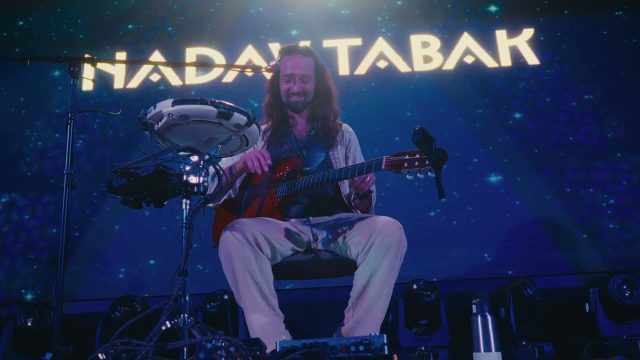
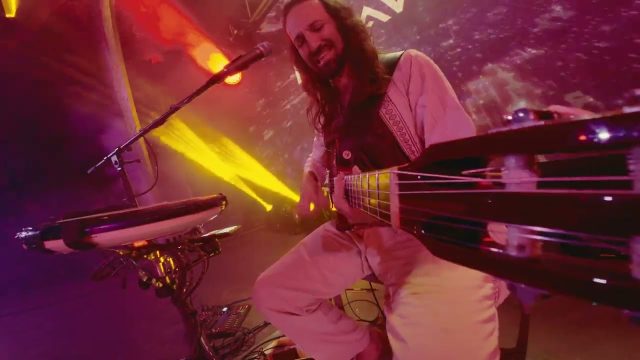
Deep in the Vosges Mountains of France, surrounded by dense forest, a musician sits with an instrument and a looper—and the boundary between performer and place dissolves. This is not a recording studio or concert hall. The only audience is the trees, the soil, and whatever sacred attention one can bring to a moment of pure creation. What unfolds is organic trance: music born not from a composition, but from listening—to the forest, to the instrument, to the felt sense of presence itself.
Organic trance is a category of improvised music that uses repetition, harmonic layering, and hypnotic rhythm to create altered states of consciousness—not through chemical means, but through sound itself. Unlike electronic trance, which often relies on synthesizers and rigid tempos, organic trance emerges from acoustic instruments, the human voice, and the spaces around them. It draws from kirtan traditions, minimalist composition, and world music practices where repetition is a tool for transcendence, not mere accompaniment.
The practice assumes something radical: that a musician can listen more deeply than they can plan, and that an instrument played in this state of receptivity becomes a voice for something larger than the individual ego. The looper—in this case a Boss RC 600—becomes not a trick, but a tool for building continuous sonic architecture, layer by layer, like a mandala made of sound.
The choice to film in the Vosges is not incidental. The forest is not backdrop; it is collaborator. Forest environments carry specific acoustic properties: the absorption of extreme frequencies by leaves and earth, the natural reverb of open space, the low-frequency hum of life itself. When a musician improvises in such a place, the forest becomes part of the instrument. Every sound is filtered, reflected, and transformed by the environment before it reaches a listener—or in this case, before it reaches a microphone that will later reach a viewer.
This approach reverses the usual logic of music production. Rather than isolating the musician in a controlled room and then adding reverb or ambience in post-production, the authentic acoustic space is captured from the beginning. The forest's dampening, its subtle echoes, its unpredictable environmental sounds (wind, birdsong, distant life) all remain. This is not sterile; it is alive.
The Boss RC 600 looper used here is not a simple tape echo. It is a phrase recorder and harmonizer that allows a single musician to layer multiple tracks of guitar in real time, creating the texture of an ensemble from one instrument. The technique demands a different kind of attention than traditional performance. The musician must simultaneously:
- Listen to what they just played
- Compose what comes next
- Manage the looper's footswitches without breaking presence
- Respond to the acoustic environment and mood emerging from the layers
This is not multi-tasking; it is a form of expanded awareness. Each loop becomes a living voice in a conversation. When the musician hears a sufficient density of harmonic and rhythmic information, they may step back and simply play within what they've created—a practice that echoes Indian classical music, where a single raga unfolds from a fixed drone, or minimalist composition, where variation emerges from rigorous limitation.
The choice of a Godin guitar matters. Godin instruments are known for warm, woody tones and excellent acoustic projection—qualities essential for capturing authentic sound in an open environment. A thinner-bodied electric guitar might require heavier amplification or might not carry well in the forest's absorbing acoustic. The Godin's voicing allows the natural harmonics of the instrument to be heard clearly, so each loop retains its character rather than becoming a compressed artifact of recording technology.
What makes this video compelling is its honesty about the nature of performance documentation. The original improvisation was filmed with equipment failure—two cameras did not record. Rather than abandoning the take or accepting the incomplete document, the musician performed a second version. The decision to release this second take—and to invite the audience to compare it with the preferred first version—acknowledges something crucial: that improvisation is not repeatable, and that each performance is a singular event. No two versions are identical. The second iteration may carry different energy, different choices, different accidents that become assets.
This transparency is itself a form of artistic integrity. It resists the polished, singular-take mythology of the studio. It says: this is how music is actually made. It is made again and again, with variations, with failures, with technical mishaps that sometimes become the most interesting part of the work.
To truly receive a six-minute forest improvisation requires a different quality of attention than passive background listening. The music does not announce itself with a verse-chorus structure or melodic hook. It builds gradually, adding harmonic layers, allowing repetition to create its own kind of forward motion. This is the temporal logic of meditation: not the excitement of novelty, but the deepening of presence within constraint. The listener is invited not to analyze, but to inhabit. To notice how the body responds to sustained harmonic tension. To observe how the mind settles or stirs as repetition continues.
This is why the forest setting is essential to the work's meaning. A forest improvisation asks: what does it mean to make music as an act of attention to place? Not music that describes or represents nature, but music that arises from listening to it, that uses the acoustic and psychological properties of that specific location as material. The result is an artifact of its context, impossible to fully separate from the Vosges, the season, the time of day, the particular quality of that light filtering through those trees.
If this work resonates, consider exploring the full catalog of organic trance practitioners and the traditions they draw from. Seek out ambient improvisation, the looping techniques developed by artists working at the intersection of folk and electronic music, and the deeper kirtan and raga traditions from which so much of this sensibility emerges. Listen to how different environments shape the same instrument. Play recordings from different times of day, different seasons, different geographies. Notice how your own body and mind respond to sustained, repetitive structures. And if you have access to forest or natural space, consider sitting with any instrument you have—even your own voice—and listening to what wants to emerge when you stop trying to control it and simply attend.