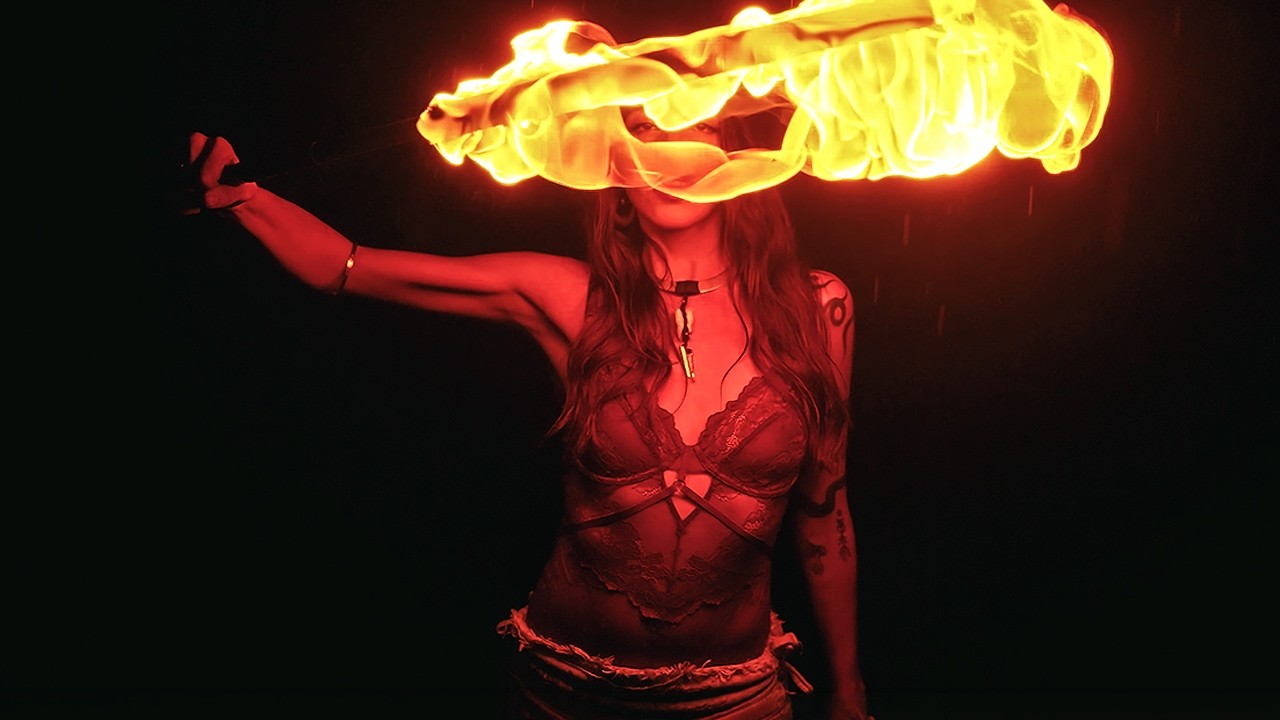
The clip opens on a sound, not a face. A low pulse of music hangs over the room for the first several seconds, and the crowd is already part of it before anyone speaks. This is the closing performance of Luminaries Summit 2026 in Croatia, and Nadav Tabak is playing "Between Worlds" under a Full Moon in Aries. Across roughly nine minutes, the set moves from a hovering, slow-building loop into a surge of percussion and voice, then into a moment where the artist asks the entire floor to drop to the ground and wait. It is a short document, and it does not explain itself. But it shows a particular craft clearly: the art of building a whole track live, in front of people, one layer at a time.
Live looping is the practice of recording a short phrase in performance, playing it back on repeat, and then playing over it with something new. A guitar figure becomes a bed. A vocal line becomes a chord. A hand-struck pattern on a percussion instrument becomes a pulse that runs underneath everything else. Each layer is captured by a pedal or software and held in time, so the musician is, in effect, conducting an ensemble made of their own earlier gestures.
The discipline is unforgiving. A loop has to be right before it can be left alone, because whatever goes into the memory repeats until someone changes it. Tempo drift, a missed downbeat, or a buzz in the signal does not fade out; it stays and gets louder with each pass. That is why live loopers tend to plan their layers the way a painter plans underpainting. In "Between Worlds," the structure is audible even in the fragments: a sustained texture arrives first, the rhythmic elements gather around it, and the voice enters as an additional voice in the room rather than a lead line laid on top.
For a listener, the effect is cumulative. You are not hearing a song that was rehearsed and then played. You are hearing a room fill up. The crowd becomes the last layer, and the reactions in the clip, the cheering and applause that rise and fall between sections, are themselves part of the arrangement.
Tabak's own description of the set lists its ingredients as "Live looping • Guitar • Voice • Percussion • Organic Trance." The phrase carries a lot of weight. Trance, in its electronic form, is built on repetition and gradual change: a motif returns, the filter opens, the energy climbs toward a release. Studio trance achieves that through sequencers that never tire. Organic trance keeps the same architecture but builds it from played instruments, so the repetition has human imperfections in it and the climb depends on a person reading the crowd.
That difference is audible in the clip. The percussion does not sound like a machine stamping the same sample; it breathes, speeds up and eases off, and the guitar and voice sit inside that breathing. When a sustained tone thickens and the pulse drops out for a beat, the silence is performed, not programmed. The effect is closer to a ritual drum circle than to a club DJ set, although the energy belongs to the dance floor.
About halfway through the clip, the sound thins and the artist speaks directly to the room. The exact words come from the clip, with the pauses preserved: "Can I have everyone on the ground? Down, down, down. Everyone get down. You guys will know what to do. It's very simple." Then, after a moment, the instruction continues: "When I'm ready, you will all jump." The moment is staged for surprise, and it works. A room of people sits or lies down together, and the music pulls the energy back up when the countdown begins.
Tabak then undercuts the tension himself. "Let's go!" he says, the crowd erupts, and he answers, "I'm just kidding. Let's go again." A hard count of "1 2 3" resets the set, and the loop returns with more force than before. The reset matters. It shows the performance as a shared event that the artist is steering in real time, with the room as a collaborator rather than an audience to be impressed.
Early in the clip, around the 1:26 mark, the artist speaks over the music. The words are: "Sometimes you feel the need to feel the urge within yourself push beyond the boundaries of what is impossible. And you have to step back, realize not everything is meant to be put together. But everything was always meant to be the way it was." The statement is not a summary of the track, and the clip does not connect it to the title. Read against the performance, though, it fits the method. A live looper keeps pushing against what seems impossible, layering until the structure threatens to collapse, and then has to step back and let the loop decide. The line reads less like a lyric than like a working note on the craft.
The description presents the performance as taking place "under the light of a beautiful Full Moon in Aries," and describes "something really special in the air that night" and a crowd "completely present." Astrologically, Aries is the sign associated with fire and initiative, and a Full Moon is traditionally read as a peak of energy. Those are framings the artist brings to the night. The clip itself is the evidence: a crowd that stays with a long build, drops to the floor on command, and comes back up on the count.
The clip is short and carries little spoken context, so it works best as an entry point rather than a full account of the artist's work. If the sound caught you, listen to the track "Between Worlds" on its own and notice where the loops enter and leave. Then try the same listening on any live looping set you can find: track the first layer, count how many times it returns, and listen for the moment the room becomes part of the music. That is the craft this closing set demonstrates, and it is the thing worth taking away from nine minutes under a Full Moon.