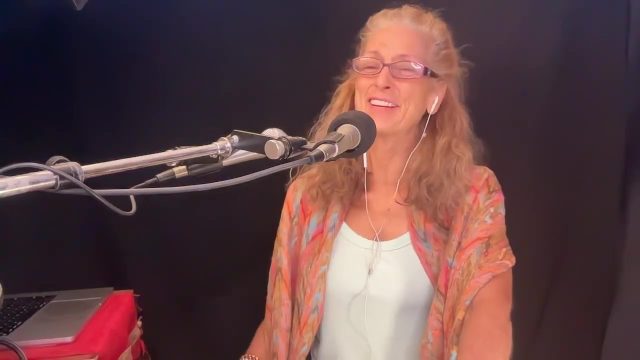
A woman sits with the sound of a song she has sung a hundred times, and she bends it toward the room in front of her. In a short clip from the Everything Wah! channel, the singer and composer known as Wah! explains the principle behind that habit: the same mantra, the same song, but never quite the same performance. Her account runs about three minutes, and it is a compact look at how a lifetime of improvisation becomes a practice of devotion, and how that practice produced a new set of songs for a community that gathers online every Friday night.
The clip opens with a family history that explains almost everything that follows. "I come from a family of musicians," Wah! says in the video (0:00). "I started violin when I was two years old." Her mother was a professional violinist and her father was a jazz lover, so music was not a special occasion in that house. It was the air.
The useful part of her story is the distinction she draws between herself and her mother. Her mother worked from classical repertoire: pieces that were "prepared and studied and memorized," and then performed. Wah! describes her own path differently. She moved toward the improvisational side of music and studied jazz, Indian music and African music, traditions that share a habit of building a performance in real time from a framework rather than from a fixed score.
"Music was always part of my life. But the difference, for example, between me and my mom is that my mom had classical music." (Wah!, in her Everything Wah! video, 0:20)
That contrast is worth dwelling on, because it is not a judgment of either approach. A classical violinist's memorized repertoire is an achievement of discipline and fidelity to a written or learned work. An improviser's achievement is different: the ability to make the work live again every time it is played. Wah! is describing herself as the second kind of musician, and the rest of the clip shows what that choice means for a devotional song-leader.
At 0:57 Wah! names the frameworks she works from: "theme oriented, raga oriented, mood oriented." For readers outside Indian classical music, a raga is not a melody in the Western sense. It is closer to a set of rules and moods: a selection of notes, characteristic phrases, and an emotional color that a skilled musician develops across a performance. Ragas are traditionally associated with particular moods and, in many classical systems, with times of day or seasons. Working inside a raga means the performer is not reciting a tune; they are choosing where to go within a known emotional territory.
That is the key to what she says next: "You create them in the moment." The mantra or song is the anchor, and the improvisation happens inside it. Jazz players will recognize the same logic from chord changes, where the harmonic map is fixed but each soloist finds new lines across it. Wah! is applying that way of thinking to devotional chant, where the words repeat and the feeling can still move.
There is a subtle point here about repetition. Mantra practice relies on repetition, and repetition is often assumed to mean sameness. Wah!'s account suggests the opposite can be true: the words stay constant while the performer's attention, emphasis and phrasing change. A chant repeated for an hour can feel different in its last minutes than in its first, and a leader who listens to the room can carry that difference into the sound.
The clearest evidence Wah! offers comes from her audience, not from her own theory. "My friend Sheridan says," she recounts at 1:14, "I've heard that song so many times and yet tonight you played it differently or I got something different out of it." The story is small, but it captures the central experience of a live chant practice: familiar material that still surprises the person singing it and the person hearing it.
At 1:25 she names the mechanism directly and calls it her gift: "I might be doing the same mantras. I might be doing the same songs and yet I'm applying it differently to the moment. I'm emphasizing something different that I feel is relevant for where we are in our lives and in our world." Here the improvisational habit stops being a question of musical technique and becomes a question of attention. The emphasis shifts because the person chanting is paying attention to what the moment asks for.
That is the connective tissue between her training and her spiritual practice. A jazz improviser responds to the band, the room and the tune. A Friday night chant leader responds to people who are scattered across time zones, tired from their weeks, looking for something to hold on to. The improvisation is a way of listening.
The emotional center of the clip is a single sentence at 1:49: "that's how all these new songs came forward was because we needed something just a little bit different." It explains why a practice that prizes familiar mantras would still add new material. Wah! does not frame the new songs as a marketing decision or a stylistic experiment. She frames them as a response to need, and the need is collective.
She then describes the purpose of the new collection in terms that are worth quoting in full at 2:19: "this is our new songs added to our collection of songs that we use for creating beautiful energy during this energetic shift on the earth." The phrase "energetic shift on the earth" is a spiritual framing rather than a technical one, and listeners should hear it as her own language for why the practice exists now. The video does not elaborate on the phrase, so it is best read as a statement of intention rather than a claim that can be tested.
The clip also includes the new chant itself. Wah! sings a sequence of Ram names, "Shri Ram," "Jai Ram," "Jai Jai Ram," with short musical interjections between phrases. In devotional Ram chanting, "Jai" is a word of praise or victory, and the repetition is meant to open the singer and the listener toward the name. The version here is patterned and call-like, and its phrasing shifts as it goes, which is the improvisational principle at work in the recording.
The video's description supplies the context the clip does not state on screen. It says Wah! has been running Friday night livestreams for six years, and that the new album IT'S FRIDAY NIGHT is meant to capture the energy of the global online community that has formed around them. The description also calls her "a founder of the yoga music niche" with a career spanning more than 25 years. The livestreams, according to the description, continue every Friday at 5:30 p.m. PT on Facebook and Instagram.
Those details change how the improvisation reads. A weekly livestream is a rare kind of musical room: the same time, the same people, and an audience that returns over years. A leader who needs to keep a six-year-old gathering alive has every reason to keep the songs moving, and the simplest way to do that is to find new material and new emphasis within the material already in use.
The album credits in the description add a practical note. The songs were composed and produced by Wah!, arranged in Ableton Live and recorded in Logic Pro, with mixing and mastering by Thomas Barquee. For a practice rooted in live breath and voice, the studio work is a way of carrying the livestream energy into recorded form without losing its improvised character, which is the same balance Wah! describes in her performance philosophy.
The clip is short, and it does not offer a full biography, a method, or a teaching sequence. What it does offer is a clear chain of ideas: a musical upbringing, a split between memorized and improvised music, a set of frameworks borrowed from several traditions, a principle that the same song can be played differently, and a motive for new songs that is rooted in listening to the moment. Each link is stated plainly by the speaker, and each is worth taking seriously on its own terms.
For musicians, the lesson is about the relationship between fixed material and live choice. For chant practitioners, the lesson is that repetition does not have to mean stagnation. For anyone who has ever found a familiar song suddenly open up in a room full of people, Wah!'s friend Sheridan has already described the experience, and Wah! has explained why it happens.
To hear the principle in action, watch the full Friday night livestreams on Facebook or Instagram, where the songs are sung live and the improvisation happens in real time. To hear the recorded version of the new material, look for IT'S FRIDAY NIGHT on the streaming platforms linked in the video description. If you are new to raga, start with a basic introduction to the form and its mood-based structure before listening, since that vocabulary will make Wah!'s "theme oriented, raga oriented, mood oriented" comment easier to hear. And if you chant at home, try one familiar mantra this week and change only one thing: the emphasis, the tempo or the phrase you hold longest. Notice what the same words do when you listen differently.