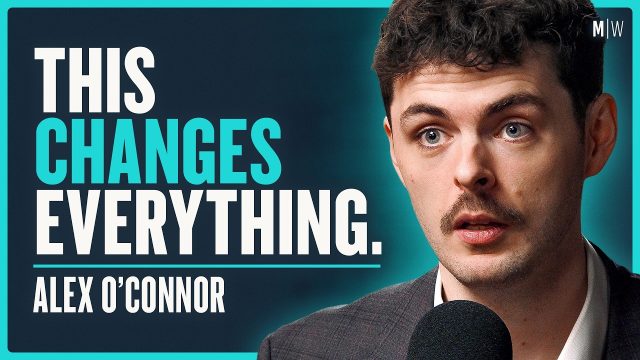
Somewhere in the middle of a long conversation on Chris Williamson's Modern Wisdom, Williamson leans in with a question that most atheism debates never get around to asking: has studying consciousness made atheism harder to defend? The answer Alex O'Connor gives is more precise than a yes or no, and it is the spine of this piece. Consciousness, O'Connor argues, is not just one more phenomenon sitting in the universe alongside tables, chairs and electrons. It is the instrument through which every phenomenon is observed, and that makes it poorly suited to being explained by the same method used to study everything else. The stronger claim he makes is not that atheism collapses but that materialism, the belief that the universe is nothing but matter, runs into a problem it cannot describe its way out of.
The question that opens the discussion is whether there are things science will never be able to explain, and whether consciousness belongs in a category of its own. O'Connor's answer is direct.
"I think consciousness is unlike anything else in the universe." — Alex O'Connor, Modern Wisdom, 0:26
He then explains why he means this in a literal sense rather than as a poetic flourish. Most of what we investigate, a table, a hand, a star, is something we perceive. Consciousness is the medium in which that perceiving happens. Everything else we study is seen through it.
To make the point land, O'Connor reaches for a tool analogy. Picture a wrench so versatile it fixes every problem you encounter. Then imagine the wrench itself breaks. The natural impulse is to repair the wrench with the wrench. But that cannot work, because the wrench is the only tool you have for doing the repairing.
"It is the tool with which you are empirically investigating the world around you." — Alex O'Connor, Modern Wisdom, 0:59
The analogy is worth slowing down on, because it explains why the problem is not merely that consciousness is hard. Science is a method: run experiments, write things down, turn results into mathematical descriptions. O'Connor's point is that every step of that method presupposes a conscious agent doing the observing. You cannot use the method to validate the faculty that makes the method possible. It is less like an unsolved puzzle and more like trying to lift yourself by your own bootstraps.
This is where the conversation makes its most useful move. Williamson asks whether studying consciousness has made atheism harder to defend, and O'Connor pulls the two ideas apart. Atheism is the absence of belief in God. Materialism is a claim about what the universe is made of. Those are not the same claim, and O'Connor is careful not to let one stand in for the other.
"I think it's made materialism harder to defend." — Alex O'Connor, Modern Wisdom, 1:59
He lays out the range of positions a thinker can hold about the mind without ever touching the question of God. You can believe consciousness is completely inexplicable. You can believe it is foundational to reality. You can believe it is somehow present in tiny atoms, or that it is a complete illusion. Each of these is compatible with belief or disbelief in God. As he puts it, you do not need to believe in God to believe that the mind is immaterial. The debate about the mind, in other words, cuts across the familiar lines of religious argument.
That distinction is the most useful thing a listener can take from the exchange. Many people assume that rejecting God requires accepting that minds are physical. O'Connor is suggesting that this assumption is itself the weak point, and that it can be examined on its own terms.
To show why materialism is difficult to defend, O'Connor walks through a chain of questions that anyone can follow. Start with the claim that the universe is made of matter. Then ask what matter is. Atoms, the answer comes. Then ask what an atom is. Protons and electrons. Then what an electron is.
The answer is usually a description of behavior. An electron is a fundamentally negatively charged particle, and if you bring it near another negative particle, they repel. O'Connor's challenge is simple: that tells you what it does, but not what it is.
"It tells you how things behave. It tells you what things do. It doesn't tell you what they are." — Alex O'Connor, Modern Wisdom, 2:21
He notes that the problem is old. Bertrand Russell wrestled with a version of it, and O'Connor frames the modern version as a question about substance. Physics gives an extraordinarily precise account of how particles interact, but when you ask what the stuff is that is doing the interacting, the vocabulary runs out. That is not a criticism of physics, he argues. It is a feature of what physics is for.
O'Connor's central illustration is the game of chess. The rules of chess tell you how the pieces move, what a bishop can do, how a knight jumps. They do not tell you what a chess piece is made of. A carpenter who wanted to carve a king by studying the rules of chess would learn a great deal about the game and nothing about wood.
"Anymore than the rules of chess can give you a substantial understanding of what a chess piece is made out of." — Alex O'Connor, Modern Wisdom, 3:21
Science, in this account, is a descriptive enterprise. It maps relationships and regularities with astonishing accuracy. It was never designed to answer the question of substance, and O'Connor is emphatic that most scientists would agree with him. "Objects don't move because of Newton's laws of motion," he says, in effect. Newton's laws describe how they move once they are in motion. The laws are not the cause of the motion.
He acknowledges that some people will find this unsatisfying, and he treats their discomfort with respect rather than dismissing it. If the only thing that exists is behavior, what is doing the behaving? That question has a long history in philosophy, and it is the question he presses hardest.
"So you're saying that the only thing that exists is behavior, but there's no thing doing the behaving." — Alex O'Connor, Modern Wisdom, 4:35
O'Connor points to the physicist Carlo Rovelli as having made the strongest case for this view in recent publications. He does not present Rovelli as a champion of religion. The point is that a serious thinker from within physics has himself acknowledged the limits of description.
Williamson raises the obvious counter: is the difference that science once hoped to describe everything, so that everything could be reduced to the kind of rules that govern chess? O'Connor says anyone who believes that is fooling themselves. Science can explain a great deal, but no method can fully explain its own presuppositions. The foundational laws of logic cannot be proven scientifically. Neither can the existence of other minds, or the existence of an external world.
"You can't scientifically prove that other minds exist." — Alex O'Connor, Modern Wisdom, 6:02
This is a point about the boundaries of any method, not a special pleading for God. O'Connor's claim is that the question of what reality is at bottom may simply lie outside what description can reach. He is not insisting that there must be a specific answer. He is saying that we may not have access to it at all.
The excerpt moves toward a more speculative terrain. O'Connor describes a view in which experience, rather than inert matter, is what is fundamentally being described, and in which reality has an element of unity. He connects this family of views to idealists and panpsychists, and notes that the image of a single ocean in which we are all particular waves has been used to describe what some traditions call God. He also places the idea in a lineage that runs through Spinoza, who he suggests tried to take a notion of God and bring it down into the structure of reality itself.
"Consciousness is unlike anything else in the universe." — Alex O'Connor, Modern Wisdom, 0:26 (the broader theme recurs throughout the conversation)
The excerpt cuts off before this line of thought is fully developed, so it would be unfair to present it as a finished argument. What is clear is the shape of the claim. If you take consciousness seriously as the foundation rather than a side effect, the old categories of materialist and theist no longer map neatly onto the debate.
Most people encounter the mind-body problem as something abstract. O'Connor's contribution is to show that it has concrete consequences for how we talk about atheism. If the debate has been framed as belief in God versus a purely physical universe, then the question of consciousness forces a third option into view: that the physical description of the world is incomplete in a way that has nothing to do with scripture.
He does not claim this settles anything. He claims that the materialist position, as usually stated, asserts more than it can deliver. When someone says "I am a materialist," it is reasonable to ask what they mean by matter. O'Connor's answer is that, pressed hard enough, the word turns out to be almost impossible to define without reaching for behavior, and behavior alone does not explain itself.
If this conversation interests you, the most useful next step is to separate the questions it bundles together. Ask whether a position is about God, about the mind, or about the substance of matter, because these can come apart. Read Bertrand Russell on the nature of matter, which O'Connor references as an early version of the problem. Then look at Carlo Rovelli's recent work, which O'Connor cites as a clear defense of the view that science describes behavior rather than substance. Finally, watch the full Modern Wisdom episode, since this excerpt captures only part of a longer and more open-ended argument that deserves to be heard in full.
The best reason to engage with this material is not to win a debate. It is to notice how much of what we take for granted about the world rests on the one thing we rarely examine: the awareness through which the examining happens.