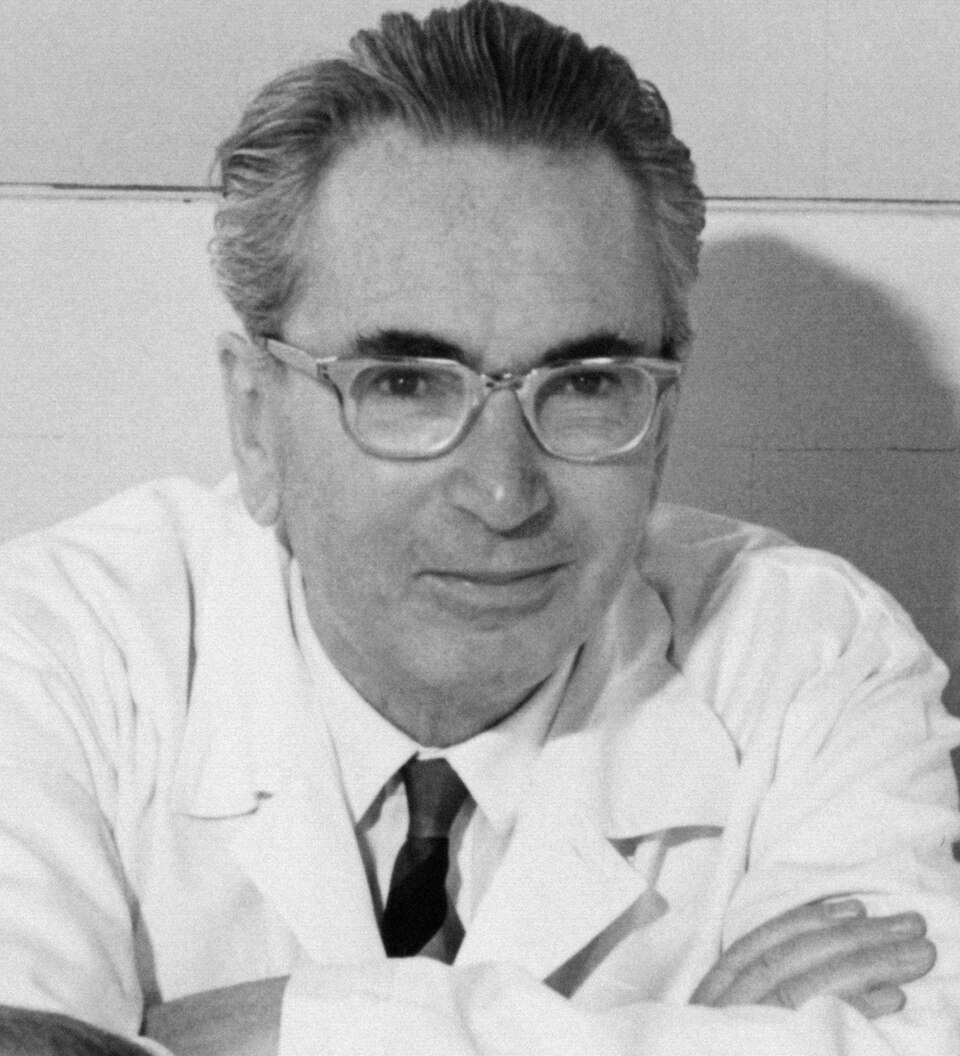
Viktor Frankl
Austrian neurologist, psychiatrist, Holocaust survivor, and founder of logotherapy — the 'third Viennese school' of psychotherapy after Freud and Adler — whose 1946 book Man's Search for Meaning, written in nine days after his liberation from Nazi concentration camps, has sold more than sixteen million copies and is regularly named among the most influential books of the twentieth century. Born in Vienna in 1905, Frankl survived Theresienstadt, Auschwitz, Kaufering, and Türkheim; his wife Tilly, mother, and brother were killed. From the camps he distilled a single conviction: that human beings can find meaning even in unavoidable suffering, and that the last of human freedoms is the freedom to choose one's attitude in any given set of circumstances. He went on to write more than thirty books, hold professorships at Harvard and Stanford, and lecture at over two hundred universities. Frankl died in Vienna in 1997.
quotes in library
Quotes by Viktor Frankl
110 quotes“We can discover this meaning in life in three different ways: (1) by creating a work or doing a deed; (2) by experiencing something or encountering someone; and (3) by the attitude we take toward unavoidable suffering.”
“The second and third need further elaboration.”
“The second way of finding a meaning in life is by experiencing something — such as goodness, truth, and beauty — by experiencing nature and culture or, last but not least, by experiencing another human being in his very uniqueness — by loving him.”
“For the first time in my life I saw the truth as it is set into song by so many poets.”
“The truth — that love is the ultimate and the highest goal to which man can aspire.”
“Then I grasped the meaning of the greatest secret that human poetry and human thought and belief have to impart: The salvation of man is through love and in love.”
“In times of crisis, in times when meaning seems further away than ever, we hold to a small thread of hope.”
“Saying yes to life in spite of everything presupposes that life is potentially meaningful under any conditions.”
“Even those that are most miserable.”
“And this in turn presupposes the human capacity to creatively turn life's negative aspects into something positive or constructive.”
“In other words, what matters is to make the best of any given situation.”
“'The best,' however, is that which in Latin is called optimum — hence the reason I speak of a tragic optimism.”
“That is, an optimism in the face of tragedy.”
“And in view of the human potential which at its best always allows for: (1) turning suffering into a human achievement and accomplishment; (2) deriving from guilt the opportunity to change oneself for the better; and (3) deriving from life's transitoriness an incentive to take responsible action.”
“Forces beyond your control can take away everything you possess except one thing, your freedom to choose how you will respond.”
“Self-actualization is possible only as a side-effect of self-transcendence.”
“Being human always points, and is directed, to something or someone, other than oneself — be it a meaning to fulfill or another human being to encounter.”
“The more one forgets himself — by giving himself to a cause to serve or another person to love — the more human he is and the more he actualizes himself.”
“In a way, suffering ceases to be suffering at the moment it finds a meaning, such as the meaning of a sacrifice.”
Explore More Teachers
Discover wisdom from 500+ spiritual teachers across all traditions.
Browse All Teachers