BrightStar

Browse All Events

Discover conscious gatherings

events

Yoga
Meditation
Breathwork
Qigong
Tai Chi
Sacred Music
World Music
Medicine Music
Sound Healing
Ecstatic Dance
Popular Destinations
BaliSedonaLos AngelesCosta RicaNew YorkSan FranciscoAustinMiamiJoshua TreeTulum
View All CategoriesView All Destinations

Explore All Features

Powerful tools to grow your events

Platform Features

Smart Dynamic Pricing
Ticket Categories
Assigned Seating
Abandoned Cart Recovery
Visitor Recovery
Donations & Sliding Scale
Affiliate Engine
Ticket Scanner
Coupon Codes
Custom Questions
Ticket Sharing
Upsells & Add-ons
Analytics & Reporting
Email Sequences
Waitlist / Notify / Remind
People & Places
Artists & TeachersEvent OrganizersVenues & StudiosKnowledge BaseGlossaryInspiration
View All FeaturesAbout Us
PricingBlog
Language
Saved events
Browse All Events

events

YogaMeditationBreathworkQigongTai ChiSacred MusicWorld MusicMedicine Music

Popular Destinations

BaliSedonaLos AngelesCosta RicaNew YorkSan Francisco

People & Places

Artists & TeachersEvent OrganizersVenues & StudiosKnowledge BaseGlossaryInspiration

Platform Features

Smart Dynamic PricingTicket CategoriesAssigned SeatingAbandoned Cart RecoveryVisitor RecoveryDonations & Sliding ScaleAffiliate EngineTicket ScannerCoupon CodesCustom QuestionsTicket SharingUpsells & Add-onsAnalytics & ReportingEmail SequencesWaitlist / Notify / Remind
View All FeaturesAbout Us
PricingBlog
Log inFind EventsHost Events
  • Browse All Events
  • For Seekers
  • Yoga
  • Meditation
  • Breathwork
  • Qigong
  • Tai Chi
  • Sacred Music
  • World Music
  • Medicine Music
  • Sound Healing
  • Ecstatic Dance
  • Retreats
  • Workshops
  • All Categories →
  • Bali
  • Sedona
  • Los Angeles
  • Costa Rica
  • Tulum
  • Byron Bay
  • San Francisco
  • Austin
  • New York
  • San Diego
  • Denver
  • Seattle
  • Portland
  • Miami
  • All Cities →
  • Join the Movement
  • Why we list
  • Sell Globally
  • For Creators
  • For Teams
  • For Writers
  • For Teachers
  • For Kirtan Artists
  • For Studios
  • For Festivals
  • For Retreat Centers
  • For Nonprofits
  • Brand Ambassador
  • Free Ticketing
  • Elevate
  • Amplify
  • 500K+ Buyer Network
  • Abandoned Cart Recovery
  • Smart Dynamic Pricing
  • Ticket Categories
  • Recurring Events
  • Assigned Seating
  • Affiliate Engine
  • Waitlist / Notify
  • Ticket Scanner
  • Embed Widget
  • Event Syndication
  • Message Center
  • Integrations
  • Reports
  • All Features →
  • About
  • The Ecosystem
  • Blog
  • Glossary
  • Inspiration
  • Help Center
  • Contact
  • API Docs
  • Brand Assets
  • Careers
  • Press
  • Terms of Service
  • Privacy Policy

Events

  • Browse All Events
  • For Seekers
  • Yoga
  • Meditation
  • Breathwork
  • Qigong
  • Tai Chi
  • Sacred Music
  • World Music
  • Medicine Music
  • Sound Healing
  • Ecstatic Dance
  • Retreats
  • Workshops
  • All Categories →

Destinations

  • Bali
  • Sedona
  • Los Angeles
  • Costa Rica
  • Tulum
  • Byron Bay
  • San Francisco
  • Austin
  • New York
  • San Diego
  • Denver
  • Seattle
  • Portland
  • Miami
  • All Cities →

For Creators

  • Join the Movement
  • Why we list
  • Sell Globally
  • For Creators
  • For Teams
  • For Writers
  • For Teachers
  • For Kirtan Artists
  • For Studios
  • For Festivals
  • For Retreat Centers
  • For Nonprofits
  • Brand Ambassador
  • Free Ticketing
  • Elevate
  • Amplify

Features

  • 500K+ Buyer Network
  • Abandoned Cart Recovery
  • Smart Dynamic Pricing
  • Ticket Categories
  • Recurring Events
  • Assigned Seating
  • Affiliate Engine
  • Waitlist / Notify
  • Ticket Scanner
  • Embed Widget
  • Event Syndication
  • Message Center
  • Integrations
  • Reports
  • All Features →

Company

  • About
  • The Ecosystem
  • Blog
  • Glossary
  • Inspiration
  • Help Center
  • Contact
  • API Docs
  • Brand Assets
  • Careers
  • Press
  • Terms of Service
  • Privacy Policy
BrightStar
Get the app
Download on theApp StoreGet it onGoogle Play
© 2026 BrightStar. All rights reserved.
Inspiration

Sikh Musicology: Understanding Ragas and Gurbani Sangeet

Professor Paramjeet Singh
May 11, 2012
9 min read
Watch · 7
Read · 7 sections

What is the purpose of ragas in Sikh devotional music?

Sikh musicology rests on a fundamental principle: ragas are not ends in themselves, but tools for spiritual elevation and connection to the divine. In Guru Granth Sahib, every raga carries a specific emotional and spiritual quality designed to assist practitioners in reaching a higher consciousness. Each raga possesses its own mood and character—some ragas are most effective during morning hours, others during afternoon or evening, reflecting the natural rhythms of human consciousness throughout the day. This deliberate pairing of raga to time and circumstance reflects what Professor Paramjeet Singh calls the systematic nature of Sikh musical tradition: unlike entertainment music, every choice in gurbani sangeet (Sikh sacred singing) serves a precise spiritual function.

The ragas found in Guru Granth Sahib derive from folk traditions rather than individual invention. According to Professor Singh, folklore ragas emerged from the collective experience of humanity—sounds created by natural phenomena such as rain, fire, and wind, which early peoples gradually shaped into structured musical forms. Because these ragas originated from the creative experience of all human beings, not from a single individual, they carry universal resonance. This is why ragas like Asa—one of the most popular ragas in Guru Granth Sahib—are recognized and appreciated across Afghanistan, Pakistan, India, and Sri Lanka. The raga's emotional and spiritual truth touches every human being because it was born from common human experience.

How do folk ragas work in the context of Guru Granth Sahib?

Folk ragas are distinguished from purely classical creations by their origin in systematic, communal expression. Folklore, as Professor Singh explains, represents systematic types of raga used by common people to signify important events and emotional states. Over time, these folk forms became defined and codified as complete ragas. Within Sikh scripture, these ragas were deliberately chosen and compiled by Guru Nanak and the successive Gurus to make spiritual connection more accessible to all people.

Consider the raga Asa, which remains the most important raga in the whole discipline of Sikh musicology. Its folklore origins make it deeply soothing and calming—qualities essential to the devotional practice. Similarly, ragas like Gujri, Sarang, and others used in Sikh devotional music carry folk qualities that produce a cooling, calming effect on the listener. This is not accidental. The Gurus selected ragas that would naturally predispose practitioners toward the mental and spiritual states necessary for genuine worship and meditation. As Professor Singh states, raagas are more effective for the human beings when they emerge from folklore, because they carry the imprint of collective human consciousness rather than the specialized technical inventions of trained musicians.

What is the fundamental difference between Gurbani Sangeet and classical Indian music?

This distinction represents perhaps the most critical misunderstanding in how Sikh sacred music is sometimes taught and performed. Classical Indian music prioritizes technical mastery of a specific raga. A student of classical music trains intensively to develop command over the notes, phrases, and emotional depth available within a single raga. Two students learning the same raga from the same teacher may practice very differently—one student may practice one hour weekly, another five hours daily. The depth they achieve, the phrases they create, and the technical sophistication they develop depend entirely on individual effort and skill. In classical music, the raga itself is the ultimate goal.

In Sikh gurbani sangeet, the relationship is inverted. The raga serves as a tool to express and embody gurbani—the sacred teachings and hymns of Guru Granth Sahib. Professor Singh uses a powerful metaphor: "In classical Indian music, the raag is a king, and music is a chair. In Gurbani sangeet, the Guru is the king, and music is a chair. The Guru has to sit on the chair, and that chair should be well properly decorated." The technical excellence of the musical performance matters only insofar as it honors and uplifts the spiritual content. The complete philosophy, the complete wisdom contained in each hymn, must remain central. One cannot perfect the gurbani by dominating the raga. Rather, one must serve the gurbani by using the raga to illuminate its meaning and facilitate the listener's access to it.

This represents a fundamentally different training methodology. In classical music, an individual's years of personal practice determine their mastery. In gurbani sangeet, respect for the complete Guru—both as spiritual authority and as the source of the hymns—must guide every musical choice. The shepherd (the singer) cannot impose personal virtuosity upon the Guru's words. The Guru remains sovereign; music is merely the decorated throne upon which the Guru's wisdom is presented.

How did ragas become separated from their spiritual function in Indian classical music?

Historically, ragas held deep spiritual significance across Indian musical tradition. In earlier periods—before the medieval era—ragas were understood as tools for salvation and spiritual transcendence. They were used exclusively in temples and sacred contexts, and only by musicians who had achieved genuine spiritual insight. Master singers like Tansen, the legendary classical musician of the Mughal court, initially received instruction from his guru Swami Haridasi, a saint who used music only when receiving divine intuition—not for entertainment or patronage.

During the medieval period, a critical shift occurred. As kingdoms developed courts and patronage systems, classical musicians began performing for kings and nobility as entertainment. The raga, originally a spiritual technology, gradually became divided into two functions: one for salvation, one for entertainment. The specialized technical tradition of classical music flourished, producing ever more refined and complex ragas. However, the original understanding—that ragas exist to facilitate communion with ultimate consciousness—became secondary to the demonstration of musical skill.

By the modern era, this separation had become nearly complete. Classical Indian musicians and scholars came to view ragas primarily as vehicles for individual artistry and technical demonstration. The Gurus, by contrast, compiled Guru Granth Sahib with explicit intention to preserve ragas' spiritual function. They selected folk ragas—forms that carried direct resonance with human consciousness—rather than purely classical innovations. This was a deliberate preservation of ragas' original purpose: to make us more easy to get in touch with the ultimate goal.

Why do modern practitioners sometimes misunderstand gurbani sangeet?

Professor Singh identifies a troubling trend in contemporary Sikh music practice: singers trained in classical Indian music traditions sometimes approach gurbani sangeet as if it were classical music. They focus on displaying technical mastery, on perfecting the raga, on achieving vocal virtuosity. Some perform gurbani with excessive ornamentation and showmanship, creating spectacle rather than facilitating spiritual connection. This represents a fundamental confusion about the art form's purpose.

The misunderstanding has deepened in recent decades, according to Professor Singh, as academic study of gurbani has become separated from its devotional and spiritual context. Scholars approach the music as folklore or musicological artifact, rather than as a living spiritual practice. Performers learn the technical aspects without receiving education in the philosophy and purpose that should guide their singing. The result is music that sounds like gurbani but lacks its essential spiritual direction—what is the correct word? It's gur-mukh, as Professor Singh emphasizes. Gur-mukh means oriented toward the Guru, centered in the Guru's consciousness and teachings, rather than centered in the individual performer's ego or skill.

The distinction matters profoundly. When gurbani is sung in proper ragas, with proper gur-mukh orientation, the listener can understand that philosophy from the body—not merely from intellectually grasping words, but from receiving the spiritual vibration directly. This requires that the singer subordinate technical display to spiritual transmission, that the raga serve the Guru's words rather than the performer's ambition.

What is the role of proper raga selection in achieving spiritual benefit?

The Gurus did not choose ragas arbitrarily. Each raga included in Guru Granth Sahib was selected because its emotional and spiritual character directly supports the meaning of the hymns set to it. A hymn about calm devotion appears in a raga known for its cooling, meditative qualities. A hymn expressing dynamic spiritual energy appears in a raga that supports that vibration. This integration of word and raga—of gurbani and sangeet—creates a unified vehicle for spiritual transformation.

Professor Singh emphasizes that when singers understand and honor this relationship, thousand times effective becomes the gurbani's power to transform consciousness. The folk origins of these ragas ensure that they work directly on human emotion and consciousness—they have been tested across centuries and cultures. They do not require years of specialized training to affect the listener. A person hearing Asa sung properly, for instance, experiences immediately the raga's cooling, devotional quality—the same quality that has moved human hearts from Afghanistan to Sri Lanka.

Conversely, when gurbani is sung without proper understanding of its ragas, or when technical display overshadows spiritual content, that thousand-fold effectiveness is diminished or lost entirely. The Guru's words are still present, but the musical vehicle no longer serves them. The listener may be entertained but not transformed, may hear beauty but not experience the direct transmission of spiritual truth that represents gurbani sangeet's true purpose.

Where to go from here

Understanding Sikh musicology requires stepping outside the framework of classical music analysis. The questions to ask are not "How well has the performer mastered this raga?" but "Does this singing serve the Guru's wisdom? Does it connect the listener to ultimate consciousness? Is the musical vehicle transparent to the spiritual message?" Serious students of gurbani sangeet must study the philosophy embedded in Guru Granth Sahib itself, not merely the technical aspects of raga. They must learn from gur-mukh teachers—those oriented toward the Guru's consciousness—rather than from classical music instructors who approach ragas as ends in themselves. Most importantly, practitioners must restore the understanding that in gurbani sangeet, the Guru is sovereign and music is subordinate. When that hierarchy is honored, the ancient power of folk ragas to elevate and transform human consciousness becomes fully available.

Comments

Loading the conversation…

Transcript

[0:00] y gu ji ka khalsa waheguruji ki Fateh

[0:03] welcome back to amritvani as you promise

[0:05] that was only a short short commercial

[0:08] segment so inner discussion which we had

[0:10] yesterday we will continue today

[0:12] speaking with Professor prime Jeet Singh

[0:14] on the importance of understanding sick

[0:16] musicology so we discussed thus far rogz

[0:20] and the basic rugs that are present

[0:22] within a shitty Guru Granth Sahib we

[0:24] talked about how the composition of rugs

[0:26] are made within the 22 microtones so

[0:29] professor G welcome back and get once

[0:31] again to the program khalsa ji ki Fateh

[0:35] so professor G speaking about rugs their

[0:39] presence within guru granth sahib ji so

[0:42] could you give us a bit more of an

[0:44] overview on the rugs that are present

[0:46] and why are they present the every rod

[0:49] has the different mood right game and

[0:52] especially morning the particular do

[0:54] those are very effective for doing for

[0:58] the religious things I say so some rugs

[1:01] have a different mood ok people are

[1:04] using for entertain but every dark like

[1:07] afternoon there is a siren morning is

[1:10] better in guru granth sahib 11oz a

[1:13] folklore because in sick goodbar eastern

[1:16] gate right we are singing us are every

[1:18] morning and evening also right because

[1:22] in fact our sizing morning god Martin

[1:25] sick music we are we can use this one 24

[1:27] hours anytime ok because it's a

[1:29] basically folklore ok and it's the

[1:32] region of us are from the fook load

[1:33] folklore raagas are more effective for

[1:36] the human beings ok so this way moves so

[1:39] much so many folk clothes we have used

[1:42] in Google's head that's aren t they also

[1:45] load ok outside a fuckload ya para

[1:48] pc folklore too ok also when we see

[1:51] folklore it is that folklore mean the

[1:53] rods the the origin of the rods not by

[1:57] any individual ok the fook voices you

[2:01] know there are so many folk songs are in

[2:03] when they are the armies are making some

[2:07] sounds due to the fire and rain on that

[2:10] time ok so much sounds creating created

[2:14] from those kind of message function ok

[2:18] and they later on they become the ragas

[2:22] I see like their be very is not in Guru

[2:25] Granth Sahib is there ok Mary is one of

[2:28] the middle folklore if you start singing

[2:30] from Afghanistan Pakistan India Sri

[2:33] Lanka everyone start enjoying those back

[2:35] flavor right because it's so touchy to

[2:37] every human being because that the

[2:39] creative who is the creator of those

[2:41] folklore all human beings all the masses

[2:43] right that's why so start to individual

[2:45] so folklore was generally a systematic

[2:48] type of Iraq that was used by the common

[2:50] people yes and it was usually used to

[2:53] signify something happening or something

[2:55] important and that is kind of what led

[2:58] to ya later on they got the definition

[3:00] as a pure rock complete rod-like casa as

[3:02] I still is very well popular in all the

[3:06] different states of India ok and even

[3:08] from in Rajasthan it's a scimitar

[3:10] folklore of rajasthan aza so but in sikh

[3:13] guru body sing it aza because assa devar

[3:17] is there right and it's a very very

[3:19] important most important drug in one of

[3:21] the whole discipline I see so all the

[3:24] ragas like gujri afternoon sahrin having

[3:28] a just flavor like giving you making

[3:31] calm down on cooling so it's a very

[3:32] calming you think yeah it's a also

[3:35] folklore and Lord of a lot of folk songs

[3:38] inside and out there but when you do

[3:40] Galvani sing it it's so soothing so now

[3:45] you say goodbye nice and Keith obviously

[3:47] it's a topic that we wanted to discuss

[3:49] what's good morning some Keith yes now

[3:50] you're studying classical Indian

[3:52] musicology and classical Indian music if

[3:55] we're to draw a parallel let's compare

[3:57] the two what is the difference between

[3:59] good Bonnie sangeet and classical Indian

[4:02] music so it's a lot of defending grove

[4:03] rd sing attention classical music first

[4:06] of classical music we don't need too

[4:09] much lyrics into that I say what we need

[4:12] a lot of that spin on your practice

[4:16] every individual every individual's

[4:18] practice ok

[4:19] if maybe parallel me and you we learned

[4:22] one rod right same from one teacher yeah

[4:25] there are many dogs out of cali Arnold

[4:27] prob okay you are practicing their child

[4:30] once a week okay I am practicing their

[4:33] drug five hours a day okay so only the

[4:37] notes and phrases every rug has a huge

[4:40] area okay you is depend how many phrase

[4:44] you can create how depth you can touch

[4:48] into that particular odds okay but in

[4:50] classical sand get it we need only that

[4:53] that specialty to create the phrase it

[4:57] and the depth and the high pitch

[4:59] everywhere you have has to be able to

[5:03] visit the whole area frequently so

[5:05] it'sit's mastering a certain drug now in

[5:09] classical and your voice quality your

[5:11] command on the nodes I say okay and the

[5:13] fast down medium plans sometimes

[5:17] speeding also okay so kind of the temple

[5:19] temple and in groove on easing it the

[5:24] Shepherd shepherd is a king his guru

[5:26] every hymns from guru granth sahib right

[5:29] it's complete ideas there so we we

[5:32] respect as a complete grew everyone

[5:34] shepherd also supporting guru says yes

[5:36] so good in goodbye raising it you can't

[5:40] do your I'm in musical skill and

[5:44] dominating the groupon in no way guru

[5:47] bonnie is a king and music is a chair in

[5:49] the groupon is indeed i said guru have

[5:53] have has to sit on the chair and that

[5:56] church it should be well properly

[5:59] decorated I like as a king you know that

[6:02] saying went King any King coming to the

[6:04] audience think about is a simple example

[6:07] what a chair of a king and the chair of

[6:10] all the simple people so here the chair

[6:12] art is a cheer in guru gobind singh ii

[6:14] for guru sab sonar which is good money

[6:18] good money so i guess looking at this

[6:21] comparison i think again shortage of

[6:24] time that we have that looking at the

[6:27] rug as just the throne upon which sits

[6:29] goodbye

[6:30] and rather than focusing just on the

[6:32] throne is where classical Indian music

[6:35] kind of lays but you know we will

[6:38] continue this discussion further

[6:39] professor g it's time for a short

[6:41] break so please join us again and I'm

[6:44] with Bonnie following these short

[6:45] messages that's excellent i think that

[6:53] y gu ji ka Khalsa Waheguru ji ki Fateh

[6:55] welcome back once again to Amrith Barney

[6:57] and today we will continue our

[6:59] discussion which is its in its third

[7:01] phase discussing sick musicology and

[7:04] professor gee professor Paramjeet Singh

[7:07] who's with us and kindly has joined us

[7:09] has a great you know acrid ations with

[7:13] him and he's got a lot of experience in

[7:15] sick musicology so thank you for joining

[7:17] me again q ji khalsa ji ki Fateh so

[7:21] professor Eon yesterday's program we

[7:23] were discussing sick musicology and

[7:25] comparing it to Indian classical music

[7:27] yes and a great analogy that you used

[7:29] was looking at the main goals of these

[7:33] different types of arts that in

[7:35] classical Indian classical music that

[7:37] the importance is given to the style of

[7:39] rock that's sung and making sure that

[7:40] the person has perfected that wrong yes

[7:42] but whereas in gurbani or good medicine

[7:45] eat that raag is actually just used as a

[7:48] tool to and the greater goal is using

[7:51] gurbani yes ultimate is good Bonnie that

[7:54] philosophy is there right because I even

[7:57] I told you before in this first segment

[7:59] that there are is the tool to get in

[8:02] touch with the ultimate goat right so

[8:05] when you're doing great buddy is

[8:06] thousand time effective because you have

[8:09] a pure tool right sometimes we respect

[8:13] in Indian classical music people expect

[8:15] rock as it as his spiritual as a worship

[8:19] okay they don't take long as

[8:20] entertainment right actually de razon

[8:22] the rug was only in full force super

[8:26] trilogy before okay in medieval time

[8:28] that become too kind of raagas okay one

[8:32] not right as the music one is for

[8:35] salvation and one is for entertain

[8:38] entertain in the medieval history people

[8:39] start entertaining their kings like a

[8:42] quark and but even that taunton who was

[8:47] a singer classical master of Indian

[8:51] classical music for at birth but his his

[8:53] guru his teacher his master Swami Harry

[8:56] dosti he was not used to sing for any

[8:58] individuals he was used to sing on any

[9:01] time when he get some intuition I said

[9:03] I'm good those were very few people

[9:06] so the used music so you know when they

[9:09] were enlightened really had you know a

[9:12] certain type transpiration music was the

[9:15] only tool on their time and it was only

[9:18] in the temples okay and there's the main

[9:21] Legion guru ji compile the Guru Granth

[9:23] seven holder agus to to make us more

[9:27] easy to get in touch with the ultimate

[9:29] achalpur right good yes so now the types

[9:32] of rocks that are used in group money

[9:35] and I know there's a general discussion

[9:37] and people there's arguments and I may

[9:40] want to use a Punjabi phrase here is

[9:42] that you know generally keep the rug and

[9:44] Ghana jada that's gettin that performed

[9:47] should be sung in drugs as opposed to

[9:49] whatever types of you know rhythms and

[9:53] musics and tones that are being sung

[9:55] together why is that so actually some of

[10:00] I can say unfortunately in the positive

[10:04] you can say three four decades okay this

[10:08] area of your body sing it you see

[10:10] classical first of all wish we should

[10:13] not make it something scary okay and it

[10:16] has been done already yes people are

[10:18] people are afraid yes so using be in

[10:21] because there was elect a lack of

[10:24] knowledge okay and sometime people start

[10:28] called himself classical singer but they

[10:32] are not they are so-called classical

[10:33] singers and why is that they yeah

[10:36] because in the sick ism we have a lot of

[10:40] respect for good body I say emotions are

[10:42] their horse everyone is coming with

[10:44] bringing the music we start appreciating

[10:46] it all right even with donations are

[10:50] there respect is there that is due to

[10:52] guru body then people start making a

[10:55] easy way of money sometime okay and they

[10:58] they didn't like to have some they don't

[11:01] think even to get some good education

[11:03] for that and there is a proper size and

[11:06] everyone thinks okay because I'm going

[11:08] nobody gonna ask me to that why I'm

[11:10] singing some people are making so much

[11:12] chiptune they are singing that songs in

[11:15] fact they are using the Sun students

[11:17] your song too

[11:19] everything in the girl body on that and

[11:21] it's a it's a surprise for me then and

[11:26] the other side that grew bodies

[11:27] classical people who are saying that

[11:29] they are singing goodbye in raga they

[11:31] are not and some of the academics came

[11:33] out recently from last two decades they

[11:36] are making more scared also both of the

[11:39] parts are not fear from the academic

[11:42] people and from the traditional people

[11:44] who are in the end up in the field of

[11:47] breaching so it's so do you think right

[11:49] now this huge miss education of the

[11:52] common people and people are using fear

[11:55] as you said you know telling people that

[11:57] oh you're not singing is properly

[11:58] perhaps or as you said the academics are

[12:02] being separate from the traditional

[12:04] people why is this actually good bodies

[12:09] and eat then they start from 91st first

[12:12] festival is held in ludhiana ok good one

[12:15] isn't it ok they said is good news

[12:18] indeed and when was this this was good

[12:20] monthly ok no it's 90 in 90s yeah so but

[12:24] we have to clear what your body's innate

[12:26] org or mesquite gujrat there's a way of

[12:28] life right we are not singing good mood

[12:30] right ok what's this a single Bonnie I

[12:34] can say gurbani guy or Gruber nice

[12:36] indeed right Kermit is a whole lifestyle

[12:40] in sick ism ok ok so it's education from

[12:45] guru right-ho we should live in this

[12:46] life as well for sure that called

[12:48] goalmouth we don't sing everything whole

[12:51] 24 hours of rain ok we were we have to

[12:54] work hard we have should take care of

[12:56] other liabilities and that's that's way

[12:58] of living your life the way of living

[13:00] yeah but when I limit but when it comes

[13:02] to good Barney singing which is

[13:05] different so what do you think is that

[13:06] what is the correct word is it's good

[13:07] worry sandy tour guide or government

[13:09] thing it s good Bernice organizing it

[13:11] right and they I don't know why they

[13:15] love group good must eat so much

[13:18] right because it looks English luffa

[13:20] English word I I couldn't find any logic

[13:26] behind that okay it's a good body sing

[13:28] it so the smellin the smelly mean

[13:30] festival I

[13:31] liana first to us and then they complete

[13:34] the research of all gragas of your body

[13:36] sing it okay and what would what he

[13:38] concluded from this festival they just

[13:40] want to they started that we should sing

[13:43] the whole group on in particular odds

[13:44] they mentioned because every him every

[13:47] share with all hymns in Google and said

[13:49] there is particular on that ok the idea

[13:52] is that to come that him should compose

[13:55] in that particular are which is

[13:56] mentioned on that top of that Shivan so

[13:59] now okay let's let's take away from this

[14:01] discussion because it looks like there's

[14:02] a lot of people with their different

[14:04] mindsets but the importance to the

[14:07] individual that we said singing good

[14:10] Bonnie in drugs is again an objective

[14:13] the final goal is is obtaining salvation

[14:16] yes so how is that helping us Anna

[14:20] because sometimes when we do when we are

[14:22] doing leading Google body we couldn't

[14:25] because of our mind is so this world we

[14:28] have so much restrictions are there

[14:30] right it's hard to concentrate and to

[14:32] understand that philosophy from the

[14:34] depth ok because music has its universal

[14:37] power to attacked you write everything

[14:39] existing on this earth music and affect

[14:42] everything so when we start doing good

[14:45] body singing in proper nagas right ok so

[14:48] it gives us a lot of energy and the

[14:50] power to concentrate and to touch that

[14:52] depth where we have to go excellent now

[14:55] this is again we've got that

[14:58] fragmentation of time which already

[14:59] always stops us against us but I think

[15:02] this is great because tomorrow we can

[15:04] discuss how people are using drugs or

[15:07] how goose Ives wanted us to use drugs in

[15:09] order to obtain salvation sure professor

[15:11] gee thank you once again for your time

[15:13] you're welcome and it's time for a short

[15:14] break viewers so please keep watching

[15:17] amarth Barney we'll see you right back

[15:19] following these short messages like

[15:21] gucci kaur khalsa ji ki Fateh

Professor Paramjeet Singh
ArtistProfessor Paramjeet Singh

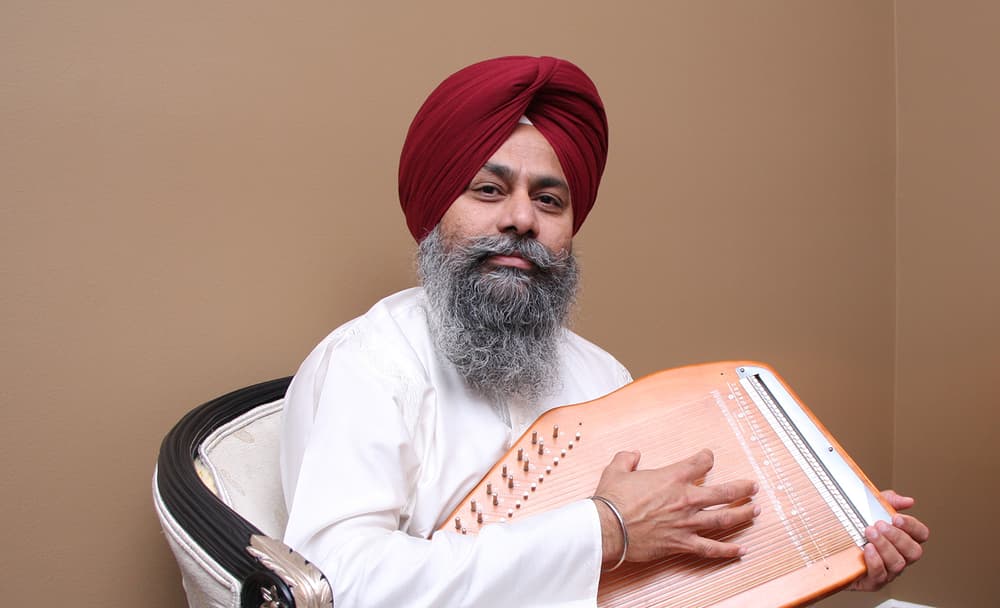
Professor Paramjeet Singh is an Indian classical vocalist and Sikh kirtan artist who has mastered over 125 ragas and devoted his career to preserving the devotional music of saints…

View profileWebsite
Explore Topics
Sikh-musicologyGurbani-sangeetRagasFolk-traditionsGuru-granth-sahib

Got Questions?

Frequently Asked Questions

In classical Indian music, the raga itself is the ultimate goal and musicians spend years perfecting technical mastery of a single raga. In gurbani sangeet, the raga serves as a tool to express and honor the spiritual teachings (gurbani) of Guru Granth Sahib. As Professor Singh explains, the Guru is the king and music is merely the chair—the musician must serve the Guru's wisdom, not display personal virtuosity.
Folk ragas originated from the collective human experience and natural phenomena rather than individual musical innovation. Because they emerged from all human beings, they carry universal resonance and work directly on human consciousness. The Gurus deliberately selected folk ragas for Guru Granth Sahib specifically to make spiritual connection more accessible and effective for all people.
Gur-mukh means oriented toward the Guru, centered in the Guru's consciousness and teachings rather than in the performer's ego or technical skill. A gur-mukh singer subordinates musical display to spiritual transmission, allowing the listener to understand the Guru's philosophy not just intellectually but through direct spiritual vibration.
During the medieval period, ragas transitioned from being exclusively spiritual tools used in temples to becoming entertainment music for courts and nobility. This divided ragas into two functions—one for salvation and one for entertainment—separating them from their original spiritual purpose and emphasizing technical mastery instead.
While gurbani can be sung, its full spiritual effectiveness is diminished without proper raga. Each raga in Guru Granth Sahib was deliberately selected to support the meaning and spiritual character of specific hymns. Singing gurbani in proper ragas with proper gur-mukh orientation makes it thousands of times more effective for spiritual transformation.
Rather than pursuing technical mastery of ragas, singers should study the philosophy embedded in Guru Granth Sahib, learn from gur-mukh teachers oriented toward the Guru's consciousness, and understand how each raga serves the spiritual content of the hymns. The goal is transparent service to the Guru's wisdom, not personal musical display.
The Gurus selected ragas deliberately to make spiritual connection more accessible and effective for all people. They chose folk ragas—whose origins lie in collective human experience—rather than purely classical innovations, preserving ragas' original function as tools for spiritual elevation and communion with ultimate consciousness.

Continue Reading

More from Professor

View All
Raag Rageshwari Practice: How Sargam Phrases Build a Raag
Inspire

Raag Rageshwari Practice: How Sargam Phrases Build a Raag

A classroom Raag Rageshwari drill built from sargam phrases shows how sur, voice control, taal and riyaz come together. Here is what the pra…

1 min read
Raag-Based Gurbani Kirtan: The Beauty of Mere Laalan Ki Sobha
Inspire

Raag-Based Gurbani Kirtan: The Beauty of Mere Laalan Ki Sobha

Learn how raag-based Gurbani kirtan preserves authentic Sikh devotional music through the shabad "Mere Laalan Ki Sobha," performed in classi…

1 min read
Minimal Vocalization as Spiritual Practice: Power in Simplicity
Inspire

Minimal Vocalization as Spiritual Practice: Power in Simplicity

A brief live vocal interlude demonstrates how devotional sound—stripped to its essence—can invoke presence and transformation through pure r…

1 min read
Har Har Har Har Gobinday: Sacred Mantra in Song
Inspire

Har Har Har Har Gobinday: Sacred Mantra in Song

Snatam Kaur's rendition of "Har Har Har Har Gobinday" brings one of Sikhism's most potent mantras into devotional music. A gateway to healin…

1 min read

Keep exploring

Continue your journey

More wisdom and gatherings from across the BrightStar directory.

More Articles

Browse the full library of teachings, interviews, and guides.

Back to all articles →

Teachers & Artists

Explore the lineages, musicians, and guides of the conscious world.

Explore artists →

Find an Event

Kirtan, retreats, sound baths, breathwork, festivals — happening soon.

Browse events →