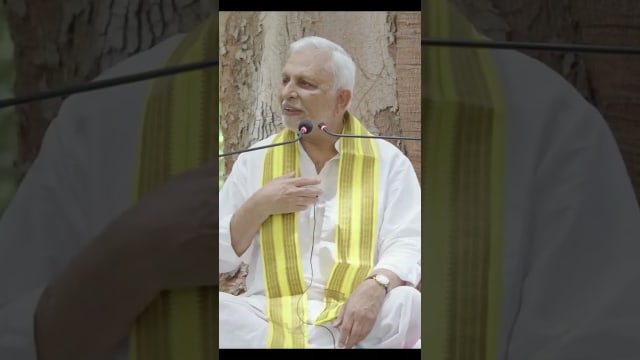
Most practitioners approach yoga asana as a discipline—something to be worked at, refined through repetition, mastered over months and years. But what if that grinding, muscular effort is only the opening act? Sri M offers a vision of asana practice that transcends the studio sweat, rooted not in modern fitness culture but in Patanjali's fifth-century aphorism, a single line that reframes what asana actually means.
When Sri M invokes Patanjali's teaching—"Sthirasukham asanam"—he's pointing to a definition so elegant, and so foreign to contemporary yoga, that it's worth sitting with. The Sanskrit breaks down into two elements: sthira (steadiness, firmness) and sukha (ease, comfort, happiness). Combined, it describes a posture that allows you to remain effortlessly for an extended time, without struggle, without pain. This is the ultimate asana, according to the Yoga Sutras.
The philosophical shift here is radical. In Patanjali's vision, asana is not a physical achievement. It's a state of being—one where body and breath have settled so completely that the pose itself becomes invisible to you. You're not holding a handstand; you're inhabiting stillness. You're not performing a backbend; you're resting in expansion.
This doesn't mean abandoning technique or skipping the years of disciplined practice. Sri M is clear: "You have to train yourself." The deliberate effort is real, necessary, and unavoidable for most practitioners. In the beginning, asana practice often brings soreness, restriction, even pain. If you emerge from your practice limping, with muscles aching the next day, you're still in the early stage—and that's expected.
But training is not the destination. It's the vehicle. The goal is to practice until the moment arrives when you're inhabiting the pose and everything relaxes. The effort vanishes. The struggle dissolves. What was once deliberate becomes spontaneous.
Sri M ventures into territory that conventional yoga pedagogy rarely touches: he observes that some people, though never formally trained in asanas, begin to express postures naturally once they reach a certain spiritual state. The forms arise unbidden, without instruction or imitation. This suggests something profound about asana itself—that the shapes are not merely human invention but may reflect something deeper, perhaps an intuitive knowing embedded in the body.
His conjecture is that many classical asanas were discovered, not invented—that great yogis in elevated states naturally moved into these postures, and later lineages codified and taught what had emerged spontaneously. In other words, the asanas we practice today may be echoes of enlightened bodies' own expression. We are practicing forms that originated not from biomechanical analysis but from the unfolding of spiritual states.
The practical implication is sobering for practitioners obsessed with achievement: the validity of your asana practice isn't measured by how deep you fold, how high you jump, or how long you hold an arm balance. It's measured by the presence of bliss—sukha. If your practice is leaving you depleted, injured, or chasing an aesthetic ideal, you've missed the point. If your practice is becoming increasingly relaxed, effortless, and suffused with ease, you're moving in the right direction.
This shift from practice toward what Sri M calls "that which is beyond practice" is the actual yoga. The postures are the grammar; the transcendence is the poetry.
If you're in the thick of asana training—feeling the burn, counting breaths, wrestling with your flexibility—remember that this phase is not failure; it's initiation. The goal is to practice deliberately until practice becomes unnecessary. Pay attention to moments when ease enters the posture, when your breath settles naturally, when there's no gap between you and the form. Those glimmers are signposts pointing toward the ultimate asana: the one that happens through you, not by you.