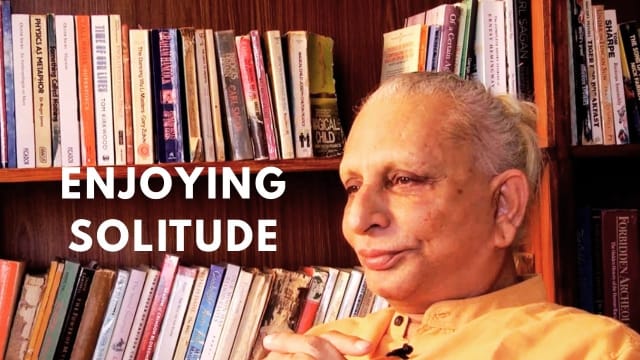
Near the end of a Guru Purnima 2025 talk, Sri M stopped to do what good teachers do before they sit down: he summed up. The summary came in three numbered points, delivered almost like a list on a whiteboard, and then he tied them to a single claim that gives the points their weight. Every person in the room, and every person listening from outside it, carries the supreme being in their own heart. The clip runs under three minutes, but it packs a complete ethic of devotion into that span: how to approach a festival dedicated to teachers, how to read a teacher who may not behave the way you expect, and why nobody should ever be considered beneath anyone else. This is a short, dense piece of teaching, and it rewards a slow reading.
The clip opens mid-thought: "So, understand that Guru Purnima's message. I'm going to now give you an outline." He explains the structure out loud, almost apologetically, with a line that reveals his teaching habit: "Like everything has to be summed up, right? Conclusion." That matters. Sri M is not improvising a sermon's ending. He is handing the audience a set of handles they can pick up later, after the room empties and the feeling of the gathering fades. For a listener who has not seen the full talk, this opening is the best map available: three instructions, each one a reminder of something larger.
The first instruction is brief: "Develop the three qualities mentioned by Krishna." The clip does not name those qualities. That is an honest gap, and a reader should not fill it with guesses. What the excerpt does establish is the framing. Sri M presents Krishna's teaching as something to be developed rather than admired, a practice of cultivation rather than a quotation to repeat. Anyone who wants the content of those three qualities will have to return to the complete talk, where the speaker presumably spells them out.
The second point is where the clip's tone turns practical. "When you come for Guru Purnima, think of the movement you have to make toward the spiritual. Enjoy yourself, of course, but spiritual is very important." The sentence holds two things at once. Sri M is not asking his listeners to stop enjoying the occasion, and he says so plainly. But he refuses to let the enjoyment crowd out the purpose. The festival, in his framing, is a point of movement: you arrive at one place and are expected to be heading somewhere else. The line "think of the movement you have to make" asks each person to notice direction, not just attendance.
This is a useful test for any devotional gathering. Ask whether the joy is pointing toward something or simply filling the evening. Sri M's answer is that it can do both, but only if the spiritual stays in view.
The third instruction is the most provocative, and Sri M spends the most time on it. "Do not form conclusions based on my behavior." His reasoning is candid about how spiritual teaching actually works. "In the course of spiritual evolution, sometimes I might be neglecting somebody totally because they will move forward. On the other hand, I might really show great affection to somebody who needs it. Who's in trouble."
Read closely, this is an argument about calibration. A teacher's attention is not distributed evenly. Someone who is ready to move on may receive less visible warmth, not because they have been dismissed but because the teacher's work with them has shifted. Someone in distress may receive a great deal of affection. From the outside, those two patterns can look like favoritism or neglect. Sri M is telling students that the outward picture is not the whole story, and that the inner logic of a teacher's relationship with each student is often invisible to everyone else.
He then pushes the point to its limit with a deliberately extreme example: "if you see me showing great affection to a murderer, don't misunderstand. You don't go and do that. You'll be murdered in your bed." The humor is blunt, but the principle is serious. A teacher's compassion is not a template for a student to copy. Affection that is right for one person in a particular state can be dangerous when a different person imitates it. Discernment is the student's responsibility, not an exemption from it.
"Do not form conclusions based on my behavior."
— Sri M, Guru Purnima 2025 talk, as published by The Satsang Foundation
The heart of the clip is its theology. Sri M moves from the instructions to a reminder of what he calls the treasure every listener already holds. "There is one treasure that you have in your heart. And that is the supreme being." He ties this to the Tripura Rahasya, a text the group was studying in London at the time, and to the image he repeats: "Tripura Sundari who sits in the lotus of your heart always. Or you can say that Brahman supreme who sits in your heart always."
He offers both names, Tripura Sundari and Brahman, as two ways of pointing at the same reality. The practical consequence follows immediately: "So, you're all divine. Not a single person here, sitting here or outside, who is not here, is not divine. Please keep this in mind."
The argument is that divinity is not a status some people earn and others lack. It is the common ground of every person. Sri M's phrase, "Different levels of manifestation, that's all," is the key distinction. People differ in how fully the divine shows through them, not in whether it is present at all. From that premise he draws his most direct conclusion: "There's nobody who is low down. How can anybody be low down when in the heart sits the supreme being? Tell me."
The question form matters. He is not asking for an answer so much as inviting the listener to notice the contradiction in looking down on anyone. If the supreme being is in each heart, contempt for another person is a kind of forgetting.
The clip ends with a request that is both humble and oddly warm. "Even if I do my thoughts or my deeds or my words, if they sound hurtful to you at some point, please don't curse me because I'll also get affected. You all have the supreme being in your hearts." He concedes that he is not beyond hurting people, and he admits that the reaction of his students reaches him. Then he adds, "Of course, I'll have my courage, that is different," and the room laughs.
That small exchange does a lot of work. It places the teacher inside the same relationship as everyone else: fallible, affected by others, dependent on a shared sense that each person is sacred. The laughter is part of the teaching. It lets the seriousness land without hardening into solemnity.
This clip is a compressed excerpt, and an honest reading has to say so. It gives the outline and the reasoning behind three instructions, but it leaves the three qualities attributed to Krishna unnamed, and it does not show the full context of the Tripura Rahasya study in London. Anyone wanting the complete picture should watch the full Guru Purnima 2025 talk on The Satsang Foundation's channel and look for Sri M's own explanation of Krishna's qualities.
Meanwhile, the clip offers a practice that fits in a sentence and is worth testing for a week: before deciding what a teacher, a friend, or a stranger is worth, remember the claim at the center of this talk, that the supreme being sits in the heart of each one. And before drawing a conclusion from someone's outward behavior, ask what their inner work might look like from where they stand.