P. D. Ouspensky
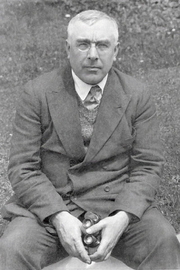
Russian esotericist, philosopher, and chief literary heir of G. I. Gurdjieff — the man whose 1949 In Search of the Miraculous became the canonical written record of Gurdjieff's oral teaching of the Fourth Way, and whose own books Tertium Organum (1912), A New Model of the Universe (1931), and The Psychology of Man's Possible Evolution (1950) developed an independent line of esoteric philosophy alongside the Work. Born 1878 in Moscow, Ouspensky encountered Gurdjieff in 1915, worked closely with him until their split in 1924, then taught his own groups in London for the rest of his life. He died in 1947, two years before In Search of the Miraculous was published. Through that book — and through his pupils, who include Maurice Nicoll, Rodney Collin, and Lord Pentland — Ouspensky became one of the principal channels through which Fourth Way teaching reached the English-speaking world.
Quotes by P. D. Ouspensky
115 quotes
To be identified with something is to be lost in it.
The Fourth Way · identificationYou cease to remember yourself.
The Fourth Way · identificationYou become a part of the thing you are identified with.
The Fourth Way · identificationIn ordinary life, man is identified with everything: thoughts, emotions, sensations, desires, antipathies.
The Fourth Way · identificationThere is nothing he is not identified with.
The Fourth Way · identificationTherefore he has no real self.
The Fourth Way · selfTo recover the self, identification must be observed and gradually weakened.
The Fourth Way · selfThis is one of the central practices of the Work.
The Fourth Way · practiceNegative emotions are the principal source of the loss of energy.
The Fourth Way · emotionsThey consume an enormous amount of force without giving anything in return.
The Fourth Way · emotionsTo free oneself from negative emotions is one of the great aims of the Work.
The Fourth Way · emotionsNot by suppression. By understanding.
The Fourth Way · suppressionBy seeing them clearly, their grip loosens.
The Fourth Way · seeingConscience is the higher feeling of moral truth.
Conscience: The Search for Truth · conscienceIt is buried beneath conventional morality and social training.
Conscience · conscienceTo uncover it is part of the Work.
Conscience · conscienceWhen conscience awakens, you cannot ignore it.
Conscience · conscienceIt points to a different way of being than ordinary morality.
Conscience · conscienceIt is the inner moral law of the awakened person.
Conscience · conscienceThere can be no real understanding without effort.
In Search of the Miraculous · understanding