P. D. Ouspensky
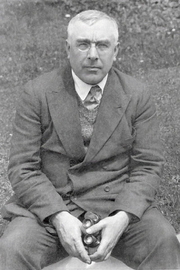
Russian esotericist, philosopher, and chief literary heir of G. I. Gurdjieff — the man whose 1949 In Search of the Miraculous became the canonical written record of Gurdjieff's oral teaching of the Fourth Way, and whose own books Tertium Organum (1912), A New Model of the Universe (1931), and The Psychology of Man's Possible Evolution (1950) developed an independent line of esoteric philosophy alongside the Work. Born 1878 in Moscow, Ouspensky encountered Gurdjieff in 1915, worked closely with him until their split in 1924, then taught his own groups in London for the rest of his life. He died in 1947, two years before In Search of the Miraculous was published. Through that book — and through his pupils, who include Maurice Nicoll, Rodney Collin, and Lord Pentland — Ouspensky became one of the principal channels through which Fourth Way teaching reached the English-speaking world.
Quotes by P. D. Ouspensky
115 quotes
In higher dimensions, time is a different thing entirely.
A New Model of the Universe · timeEternal recurrence is one possible understanding of higher time.
A New Model of the Universe · recurrenceThat this same life repeats again and again, with subtle variation.
A New Model of the Universe · repetitionAnd that conscious work is the only way to escape this circle.
A New Model of the Universe · consciousThis is the teaching of Pythagoras and the ancients.
A New Model of the Universe · pythagorasIt survives in the Fourth Way under a different language.
A New Model of the Universe · fourth-wayWhat we call 'I' is not one but many.
The Psychology of Man's Possible Evolution · IEvery thought, every mood, every desire, every sensation says 'I.'
The Psychology of Man's Possible Evolution · thoughtAnd in each case it seems to be taken for granted that this 'I' belongs to the whole.
The Psychology of Man's Possible Evolution · IThis is the chief feature of our being.
The Psychology of Man's Possible Evolution · featureIn place of one permanent and unchangeable I, there is a multitude of small, separate I's, very often quite unknown to one another.
The Psychology of Man's Possible Evolution · IOften hostile to one another. Often working against one another.
The Psychology of Man's Possible Evolution · IThis explains why a man so often promises something and so often fails to do it.
The Psychology of Man's Possible Evolution · promiseThe I that promised is not the I that has to deliver.
The Psychology of Man's Possible Evolution · promiseTo create a real I requires unifying the small I's around a center.
The Psychology of Man's Possible Evolution · IThat center is what the Work aims to develop.
The Psychology of Man's Possible Evolution · centerWithout this center, change is impossible.
The Psychology of Man's Possible Evolution · centerWith it, real change becomes possible.
The Psychology of Man's Possible Evolution · centerIdentification is the chief obstacle to consciousness.
The Fourth Way · identificationMan cannot be saved or changed by any external force.
In Search of the Miraculous · salvation