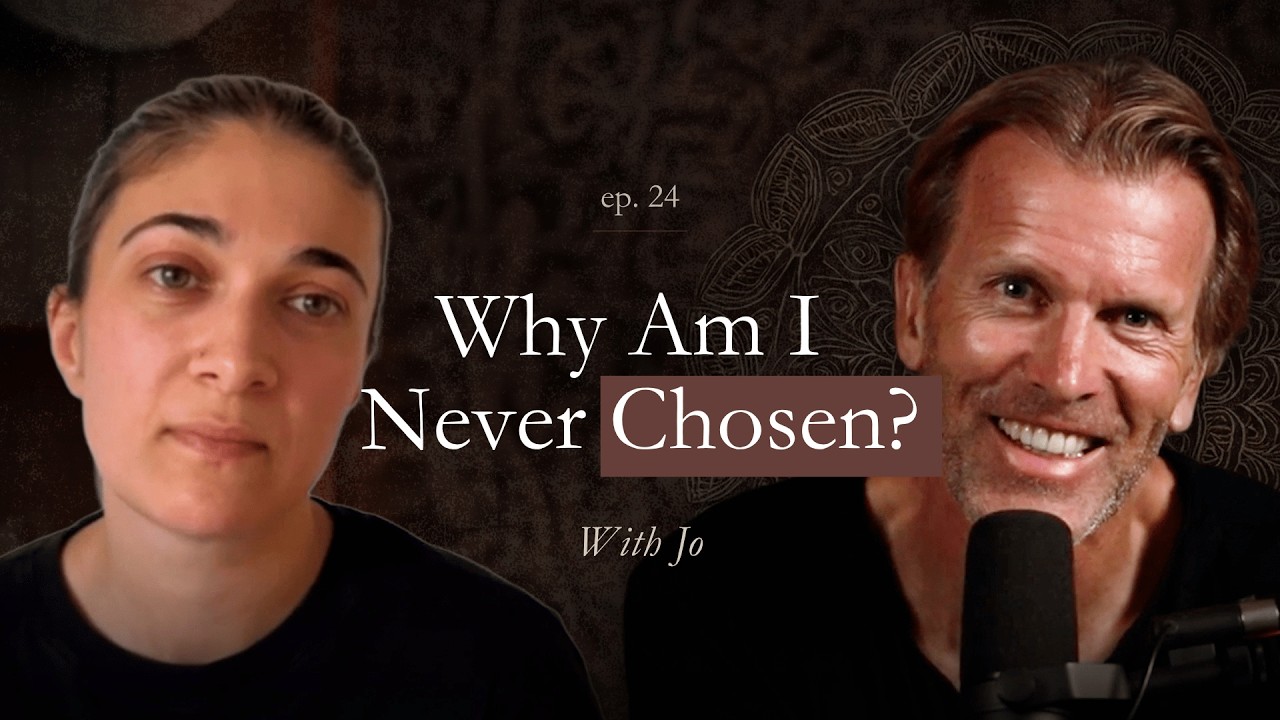
The persistent anxiety about making "the right choice" stems not from the complexity of the decision itself, but from an absence of trust in life. Crone argues that at a spiritual level, it doesn't fundamentally matter which path you take—you'll face the same inner work regardless. The real problem is the automated brain mechanism trying to predict and control outcomes from a place of fear. By recognizing this pattern, releasing the need to figure everything out, and cultivating trust and patience, you access genuine insight that arrives when you stop forcing it. The shift from fear-based problem-solving to inspiration-based action is what transforms both your decisions and your life.
The Paradox: Choice Doesn't Matter, Yet We Suffer Over It
One of the first things Crone establishes is a counterintuitive truth: "It doesn't matter what you do because we still have to face the things that we're here to face" (0:08s). This sounds disorienting until you understand his reasoning. Every human being arrives with what he calls karma—unresolved patterns, constraints, and lessons inherent to their journey. "You as a being on your journey here with whatever Karma you're here to resolve and transcend will still have to face whatever those constraints are" (0:15s).
What does this mean practically? If you're struggling with abandonment, that wound exists independent of whether you stay in or leave a relationship. If you're wrestling with self-doubt, that insecurity will surface regardless of whether you take the job or don't. The inner work remains. Crone offers this as "the first news to hopefully give you some reprieve and a bit of relief" (0:22s)—permission to stop believing that one particular choice will bypass your growth.
At the human, physical level, choices do create different consequences. The logistics differ. But at "the most profound and important level in terms of our own spiritual Evolution," the mechanism of growth and self-discovery activates either way (0:31s). This reframing is not nihilism; it's liberation from the illusion that perfection of choice matters more than presence to what arises.
What Is the Brain's Decision-Making Mechanism Really Doing?
Crone pivots to what he identifies as the core problem: the automated faculty of the brain that obsesses over working things out. "Should I take this job should I quit should I start my business should I try this supplement should I do this diet should I break up with this person should I stay with this person" (0:48s)—the litany is endless and familiar. Most people assume they're consciously deliberating. They're not.
"It's not even you it's automated," Crone says (0:105s). You don't wake up thinking, "I can't wait to exhaust myself today trying to figure out something I don't know." The compulsion to solve, predict, and secure outcomes is primal. "Your brain is designed to try and predict and protect" (0:95s). This is a survival mechanism born from our evolutionary history. In ancestral environments, prediction meant safety. The brain learned to obsessively scan for threats and map solutions.
The problem is that this mechanism activates even when there is no real danger—only uncertainty. And it activates from a fundamental position: we don't feel safe. We don't trust. "When we're trying to figure it out the underlying constraint that is normally at play is we don't feel safe we don't trust" (0:159s). So the brain keeps working, keeps churning, offers no rest. And it never arrives at certainty because certainty about the future is not available to human beings.
Crone asks you to shift your attention. Forget the outcomes for a moment. "Forget about what the potential outcome is and look at the means by which you're trying to assess what to do" (0:63s). Notice the *mechanism itself*—the anxious loop, the fatigue, the sense that you're missing something crucial. That's what to examine.
The Paradox of Stopping the Search
One of the most striking observations Crone offers is almost zen-like in its simplicity: the moment you stop trying to figure something out, new information arrives. "In the space that we give ourselves when we stop trying to figure it out new insights new information new out ofthe blue text emails show up that help us to navigate what we were trying to figure out by ourselves" (0:76s).
This is not about magical thinking. When your nervous system is not contracted in fear and problem-solving mode, your awareness expands. You notice opportunities, signals, and connections that were always there. You're more open to serendipity and receptive to intuition. But as long as you're in the grip of the brain's protective mechanism, you're essentially filtering reality through a lens of scarcity and threat. That lens narrows your actual options.
Crone is not suggesting passivity. Action matters. But the energy from which action flows matters more. "You're a co-creator in life yes you'll take action but when the inspiration is right and from an energy of inspiration excitement and possibility" (0:147s)—that's when choices and actions carry real power. When you act from fear, from the sense that you *must* figure it out or else, you're operating with incomplete information and compromised intuition.
How to Shift From Fear-Based Problem-Solving to Trust
Crone names two capacities as essential: trust and patience. These are not passive virtues but active practices. He acknowledges: "This is asking you to develop two of the words that I have struggled with with the most but try to embody as best as I can which is trust and patience" (0:120s).
The first move is radical honesty in the moment. "Take a few deep breaths and realize right now at this moment I don't know I don't know to be at peace with uncertainty" (0:129s). This is not resignation. It's clarity. You don't know. And that's okay. The relief comes when you stop pretending you have the information to solve something that can't yet be solved.
From that place of acknowledgment, Crone offers a reorientation: "Rest in the knowledge that life has got your needs met meaning you don't have to figure it out" (0:141s). This assumes a non-trivial worldview—that reality is not fundamentally hostile, that your survival is not contingent on your constant vigilance and correct calculation. For those whose nervous systems carry deep trauma or chronic unsafety, this trust cannot be forced. It must be built, often through slow rewiring and support. But the principle holds: trust is possible, and from trust, wise action emerges.
The patience piece is about timing. "Trust the information will be presented to me in a timely fashion that's the patience part" (0:192s). Not immediately, but in due time. This is not about waiting passively. It's about taking the next right action while not insisting on controlling the outcome or timeline of what unfolds.
Recognizing the Mechanism Without Judgment
Crone emphasizes a crucial distinction: seeing the mechanism is not the same as being caught in it. "When you can see the mechanism that's trying to figure it out not you your brain it's a survival mechanism it's Primal and don't get caught in that" (0:177s). The moment you can observe the brain doing its job—predicting, protecting, problem-solving—you've created space. You're no longer *identified* with the mechanism. You're the awareness noticing it.
This is a profound shift. Instead of believing the thought "I must figure this out or I'll fail," you can notice: "Ah, the brain is doing what brains do. It's trying to protect me from an imagined future risk. I see that." In that noticing, choice returns. You can thank the brain for its efforts and ask: What does inspiration suggest right now? What feels true beyond fear?
The Universal Question, The Same Answer
Crone concludes by naming the universality of this struggle. "Whoever's listening to this has their own version of this should I shouldn't I don't know what to do what's right what's wrong it's exhausting" (0:198s). Career pivots, relationship endings, health decisions, creative risks—the surface question changes, but the underlying existential question never varies. And neither does the answer.
"I promise all of you the answer is the same I don't know" (0:203s). Not because wisdom is unavailable. But because the *form* of the answer is always an invitation to enter the space of not-knowing and see what emerges when you stop forcing. "The question is to what degree can you Embrace being at peace with with uncertainty that will make you a very powerful human being" (0:205s).
This is the real teaching: power doesn't come from having figured it all out. It comes from the capacity to stay present, curious, and receptive in the face of the unknown. That capacity is what transforms not just your decisions but your entire relationship to life.
Where to Go From Here
If you resonate with this perspective, the next step is not to intellectualize it but to practice it. The next time you find yourself in the loop of trying to figure something out, pause. Take a breath. Notice the mechanism. Can you be at peace with not knowing, just for now? Can you sense into what feels true beyond the anxiety? What action, if any, wants to emerge from a place of inspiration rather than fear?
This is not a one-time practice but an ongoing recalibration. The brain will revert to its default. That's its nature. But each time you recognize it and choose differently—choosing trust, patience, and openness—you're rewiring your nervous system. You're teaching yourself that you're safe enough to not have all the answers. And in that safety, your actual wisdom becomes audible.