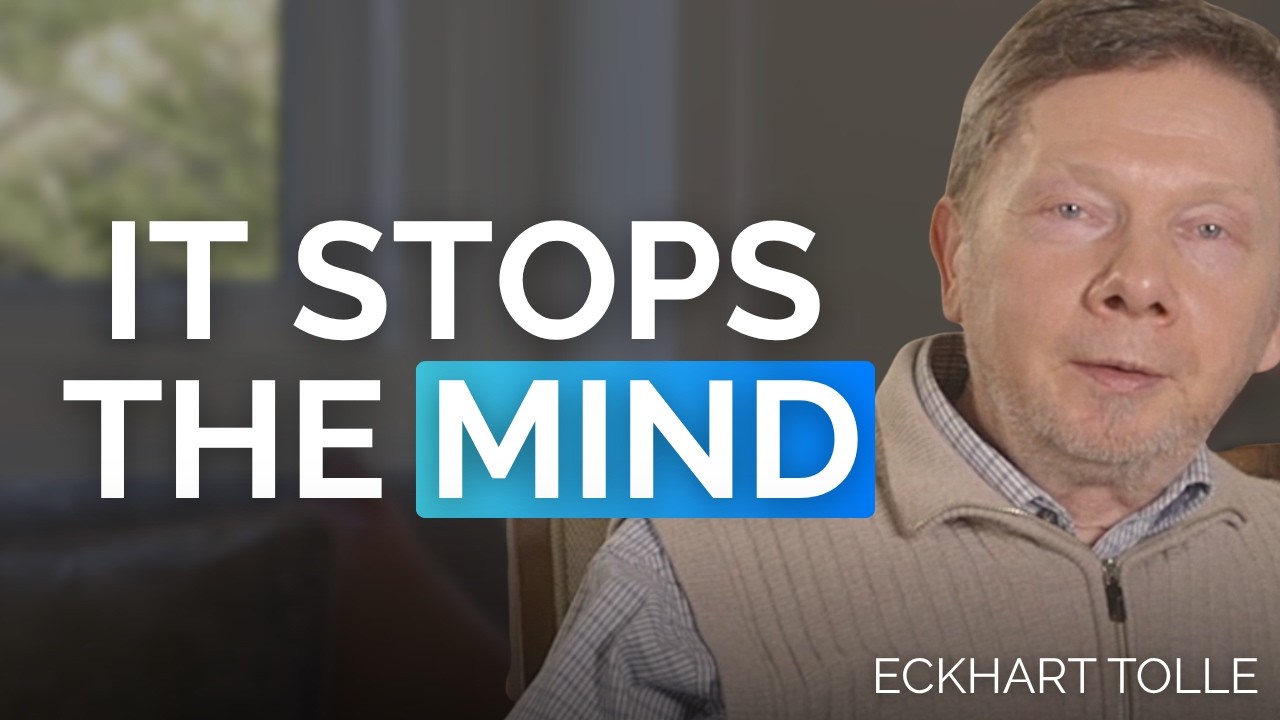
A therapist walks to the microphone carrying a question she has taken out of her sessions and into the room. She has spent close to a decade working with survivors of severe and complex sexual trauma, and lately the cases have felt heavier. Earlier in the week, the speaker she is addressing, Eckhart Tolle, had told a story about a man who finishes a meal and goes looking for the chef. She has questions for that chef. Why did you make this? Why does one person receive a gourmet plate while another gets something rotten? In this short talk, Tolle takes the therapist's anger seriously, then shows how the familiar argument against God, "if there were a God, he could not allow this," depends on one unexamined picture of what God is. He argues that the picture, a controlling power somewhere that makes events happen or permits them, is the real misconception.
The metaphor is the thread that ties the session together. The man at dinner has eaten well or badly, and his reaction is to search for whoever prepared the food. The therapist uses it to voice what she feels after work: "when I come out of these sessions and I think about... why did you allow this to happen in your kitchen?" She says plainly that this makes her "very upset sometimes," and she admits, "I have a little bit of resentment, if I'm honest, as a person" (about 3:03 in the video).
It is worth noticing how much she brings into that moment. She describes her work as healing and helping people, and says she is good at it. She also describes a growing sense of hopelessness on behalf of clients whose suffering seems to pile up. Tolle does not hurry past that. His first response, at about 3:25, is that the question itself is justified, and so is the resentment. Before reaching for a theological answer, he gives the feeling its legitimacy. That order matters. A reader who has sat with a grieving client or a survivor knows that an answer offered too quickly can feel like dismissal.
Tolle then lays out the logic that the therapist's anger echoes. The standard form runs like this: if there were a God, he could not allow this much suffering. People then add a second step: "If I were a god, I would not allow this to happen, obviously. And therefore, I'm morally superior to any god." From there the argument splits. Either there is no God, or there is one, and he is malevolent.
Tolle is careful to show that the argument has several exits, not just one. In his telling, there are at least three conclusions that people have drawn:
- The universe is random, and things simply happen to people without meaning.
- A malevolent God, or a lesser and flawed creator, is responsible for the world's suffering.
- A devil, the antagonist of God, is the one producing the pain.
He does not accept any of these. What he identifies is the single assumption they share. Each one begins by picturing God as "a controlling figure that controls events from somewhere," who "makes things happen or allows things to happen that he could prevent." If that figure is omnipotent, Tolle says, then there are only two options, and both are unappealing. Either God "uses his omnipotence to torture people," or he "doesn't use his omnipotence and just let things go." In neither case is he a God anyone would want to worship.
Tolle uses the Gnostics as a historical case study of this reasoning. He describes them, in the early Christian and pre-Christian period, as a sect "interested in two things": direct knowledge of the divine through real inner realization, and a strange belief that the world was created by a malevolent, inferior god, a demiurge, and not by the real God. In his account, the Gnostics pointed to the "dreadful things that were happening in the world," such as suffering children, and concluded that the world itself should be rejected (about 5:31 to 5:55 in the video).
"And that I believe was not a wise conclusion, although there's a lot to be said for the Gnostics otherwise."
That qualified verdict is typical of how Tolle handles traditions. He does not dismiss the Gnostics as simply wrong about everything. He credits their emphasis on inner knowing, and he rejects the conclusion that drove them away from the world. The point he is making is that the Gnostic answer, like the random-universe answer and the devil answer, still rests on the same inherited image of God as a power that could intervene and does not.
The turn in the talk comes near the end, when Tolle names the error directly. He calls the starting assumption "erroneous," and says the traditional case against God is in effect a case against a particular figure, a being who sits somewhere and steers events. He then says: "To see God as a power figure, that controlling entity that either makes bad things happen or does not prevent bad things from happen, I would suggest that is a wrong way of understanding what God actually means" (about 8:16 in the video).
This is a substantial move, and it is easy to flatten. Tolle is not offering a comforting answer that says suffering is secretly part of a plan. He is saying the question was framed on a misconception. The chef in the metaphor is being asked to answer for a kitchen that, in Tolle's view, was never run by a chef who could be summoned to account for each plate. The argument is aimed at a figure that does not match what the word "God" points to in the first place.
For a reader, the practical consequence is that the therapist's anger does not have to be resolved by first accepting or rejecting the chef's existence. Her resentment, and the grief of the client who gets the rotten plate, can be held as human responses. Tolle explicitly validates both. What he questions is the inherited story about who is in charge, and why that story keeps forcing a choice between a cruel God and no God at all.
The talk is short, roughly eight and a half minutes, and it does not attempt to resolve suffering in general. Tolle makes no claim to have ended the problem of evil. What he offers is a way to stop the argument from circling the same two bad options. For someone who works with trauma every day, or who lives inside it, that can be a meaningful shift: the question "why would God allow this?" is allowed to remain painful, without being forced into a verdict about God's character.
The video's own description is direct about the limits here. It says that if you work with suffering or are living with it, you should have somewhere to put it down, and that the talk is "a talk about a question, not a substitute for support." That is an accurate framing. Ideas like Tolle's can loosen a rigid belief, but they do not replace therapy, community, or medical care, and anyone carrying heavy trauma deserves real human support alongside any philosophical reflection.
If this talk has stirred the same question the therapist brought, the best next step is to watch the full clip with the original framing in mind. Listen for the moments where Tolle moves from validating the resentment to questioning the picture of God underneath it. The description notes that he "goes much further into this in the full session," which is available through the Eckhart Tolle Now membership.
Readers who want to examine the argument themselves can start with three questions the talk raises. First, when you ask why God allows suffering, what image of God are you picturing? Second, does that image describe a controlling power that could intervene, or something else? Third, what changes if the anger is allowed to stand as a true response, without first having to win an argument about the chef? Those questions are less tidy than a verdict, but Tolle's reframing is built to leave them open.