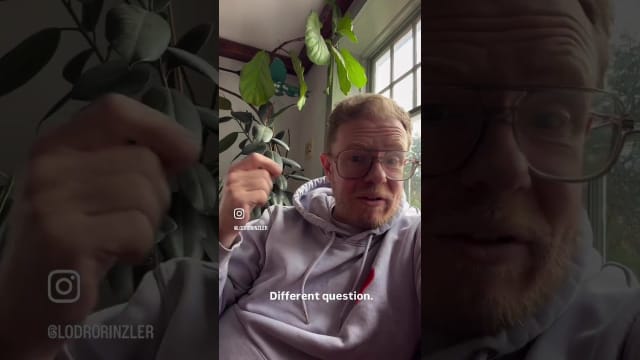
Lodro Rinzler offers a deceptively simple practice: when a big thought arises, stop and ask where it came from. Not philosophically. Not in your head. Just look. Does the thought have a shape? A color? A size? When it's gone, where does it live then?
This is the foundation of what Rinzler teaches as "investigating the very nature of thoughts themselves"—a core practice this week at the Basic Goodness Collective. The method sounds almost naive until you try it. Most of us treat thoughts as facts, as solid things that happen *to* us. This practice inverts that. It treats the thought itself as an object of inquiry, something you can examine the same way you'd examine an actual object in the room.
The payoff, Rinzler suggests, isn't intellectual understanding. It's something more direct: "through looking directly at these thoughts, we learn to rest the mind in its basic goodness, its Buddha nature. And there is true peace that can be found."
What Rinzler calls "basic goodness" is a core concept in the Shambhala Buddhist lineage he teaches within—the idea that beneath all confusion, the mind has an inherent wholeness, clarity, and sanity. It's not something you have to construct or earn. It's already there. But we spend most of our energy either chasing or fleeing from thoughts, rarely stopping to actually see them.
The investigation reverses this habit. By looking at the thought's apparent solidity—its shape, color, size, its birth and dissolution—the thought begins to lose its hypnotic power. It becomes transparent. And in that transparency, something shifts. The mind can relax. It can rest in what it already is.
This isn't meditation in the sense of trying to empty the mind or achieve a blank state. It's more like a scientist's investigation into the lab specimen that is your own experience. The object of study turns out to be radically empty of the substance you assumed it had. And in that emptiness, there's freedom—and the peace Rinzler points to.
To explore this practice more deeply and learn how investigation integrates into a fuller contemplative path, seek out Rinzler's teaching at the Basic Goodness Collective and his broader work in Buddhist meditation and dharma teaching. This short glimpse is an invitation; the real transformation lives in sustained practice.