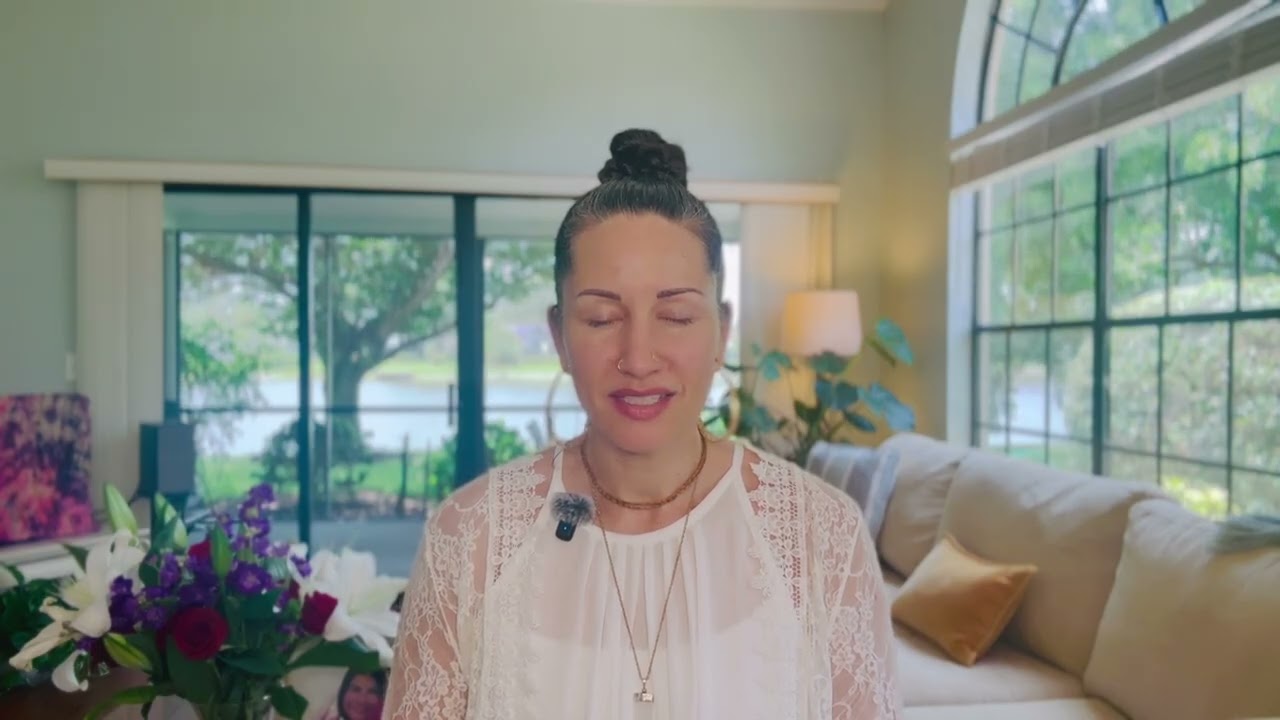
Close your eyes, let your breath slow down, and listen to a voice that begins with a simple reminder: thoughts create the world you live in. That is the premise of an eight-minute guided affirmation meditation posted by Julie Ela Grace in April 2020. Across roughly eight minutes and nineteen seconds, she leads the listener through a sequence of first-person statements that thank the body for its healing, its breath, its blood and its heartbeat, then move outward into confidence, creativity and a sense of worth that is not up for negotiation. The practice is short, plainly worded and built on a single working idea: that the mind becomes more fluent in whatever it rehearses, and that gratitude can be chosen deliberately rather than waited for. What follows explains how the meditation is structured, why its logic is worth taking seriously, and how to use it without forcing yourself to feel something you do not yet feel.
The practice has three movements. It opens with orientation: Grace introduces herself, sets the intention to "uplift and break negative patterns of thinking," and asks the listener to treat the words as their own "even if sometimes the words do not align with your current feelings." Then comes a short breathing stretch, deep breaths through the nose and a long exhale, repeated a few times so the listener can "drop into the moment, into your breath and into your body." The affirmations begin only after that settling. They are not meant to be spoken aloud. Grace is explicit on this point: "there's no need to repeat the affirmations aloud unless you wished."
The affirmations themselves run in a deliberate order. The first and longest stretch is pure gratitude for the body as an organism. "I am grateful for my body," the voice begins, and from there it names specific gifts: the times the body has healed after injury or illness, the fact that the body has been present "from the very beginning of this life," the systems that run "without even a conscious thought from me." The middle section shifts toward choice and self-acceptance. The final third widens into identity, worth and service, ending with thanks to the universe and a return to the body as the place where gratitude is lived.
The most important sentence in the recording arrives early, at around the 39-second mark. Grace says: "whatever you practice you get better at." She applies the principle directly to self-talk. If you repeatedly tell yourself negative things about your life and body, you become more skilled at believing them. If you repeatedly tell yourself positive things, you become more skilled at believing those too, and at "living from those positive spaces."
This is the logic underneath most affirmation work, and it is worth stating plainly because it explains why the practice does not require belief to begin. The meditation does not ask you to be convinced that "my body is perfect exactly as it is" before you hear it. It asks you to hear it again and again, in a calm state, until the sentence stops sounding foreign. Grace makes the same point about the wandering mind: at around 59 seconds she says that if attention drifts during the practice, "that's okay," and that you can "trust that your subconscious mind is taking onboard the messages." Distraction is not failure. The repetition still does its work.
Readers who have tried affirmations and dropped them after a week of feeling silly will recognize the trap this framing avoids. The practice treats the gap between words and feelings as expected, not as proof that the exercise is broken. Grace anticipates the skeptic directly, acknowledging that "the words do not align with your current feelings towards yourself and your life," and inviting you to listen anyway.
Most of the early affirmations are about function rather than appearance, and that choice shapes the whole meditation. "I am grateful for the blood pouring through my veins." "I am grateful for my heartbeat." "I am grateful for my breath for my lungs for oxygen." "I am grateful for nutrients and my body's ability to use them." Each line points at something the listener almost never notices, which is precisely the point. Gratitude that depends on noticing is easy to lose; gratitude anchored in the things the body does automatically gives the practice a stable object.
The sequence also reaches backward. Grace moves from the body in the present to "the millennia of ancestors" who came before, framing the listener's existence as the outcome of a long and improbable chain, "by some accident of fate I am here now." Whether or not you hold a specific view of fate, the move is useful: it turns the body from a problem to be fixed into a continuity to be received.
The nourishment lines, which begin around the three-minute mark, make a subtler argument. "I choose to nourish my body" is repeated and then specified: with "healthy clean foods," with "deep breaths," by "enjoying my life," and by "moving in any way that I am capable." The language of choice carries much of the weight here. The affirmation does not simply observe that the body needs care; it places the decision to provide that care in the speaker's hands.
One of the most quietly radical lines in the recording comes at about 3 minutes and 33 seconds. "I appreciate whatever movements my body allows even if I am sick and all I can do is blink." It is worth sitting with that sentence. Much popular positivity material assumes a healthy body and a cheerful mood. This affirmation does not. It holds that appreciation can be sized to what is actually possible, and that a body that can only blink is still a body worth thanking.
The same generosity runs through the lines about the past. The meditation thanks the body "every time my body has healed when I have injured myself or become unwell." That reframes illness not as betrayal but as evidence of repair. Read this way, the practice is not asking anyone to pretend pain is pleasant. It asks for a more accurate ledger, one that includes the recoveries along with the injuries.
The final third of the meditation turns from the body to identity. At around 4 minutes and 53 seconds, Grace says: "I release fear and old stories and patterns about my worth that aren't even mine." The phrase is worth lingering on. Many of the beliefs people carry about their bodies and worth were absorbed rather than chosen, from family, culture or earlier experiences. Naming them as borrowed gives the listener permission to set them down without first having to prove they were false.
From there the affirmations widen into creativity, confidence and service. "I am worthy of living a creative life." "I am confident in my skin." "I help heal this world by being a light and by being in love with myself and my life." Grace is consistent on one idea across these lines: self-acceptance is not a private endpoint but a starting point for how you move through the world. The closing statements, including "I am so blessed and I am so grateful," return the listener to thanks.
There is a line that cuts against the grain of self-improvement culture, and it is easy to miss. "I am the only me that will ever be and I choose to embrace that." The meditation does not frame the body as something to be corrected into a more acceptable version. It frames the body and the personality as irreplaceable, and asks the listener to stop auditioning for a template.
The recording is short enough to fit into a morning or an evening, and it asks very little. A few practical approaches follow directly from how Grace structures it:
- Begin with the breathing stretch even if you skip the rest. The instruction to breathe through the nose and exhale slowly is the part most likely to change your state before any words arrive.
- Listen first without repeating aloud, as the recording suggests. Let the sentences do their work at the level of attention rather than performance.
- Notice which lines snag. The ones that feel untrue are often the most useful to return to, because they show where the old patterns are strongest.
- Do not measure success by how you feel in the moment. Grace's own framing points to repetition over time, the slow accumulation of a practice you "get better at."
- Adapt the body lines to your actual condition. The meditation itself models this in its "even if I am sick" line, which makes room for limited movement and limited capacity.
The practice is not a substitute for medical care or for therapy when it is needed. It does not promise a specific outcome, and the recording does not claim one. What it offers is narrower and, for many people, enough: a structured, repeatable way to rehearse gratitude for a body that has been doing its work all along.
If the meditation resonates, the most useful next step is to return to it on several different days rather than treating it as a single event. Keep a notebook of the lines you found hardest to accept and revisit them after a few weeks. Pay attention to whether the practice changes how you speak to yourself during an ordinary, unremarkable moment, such as getting dressed or stopping on the stairs, because that is where Grace's central claim, that practice builds skill, would show up first. And if you want to extend the thread, write your own gratitude lines for the parts of the body you rarely think about, in the same first-person, present-tense form. The recording gives you a template; the rest is the slow, unglamorous work of practicing it.