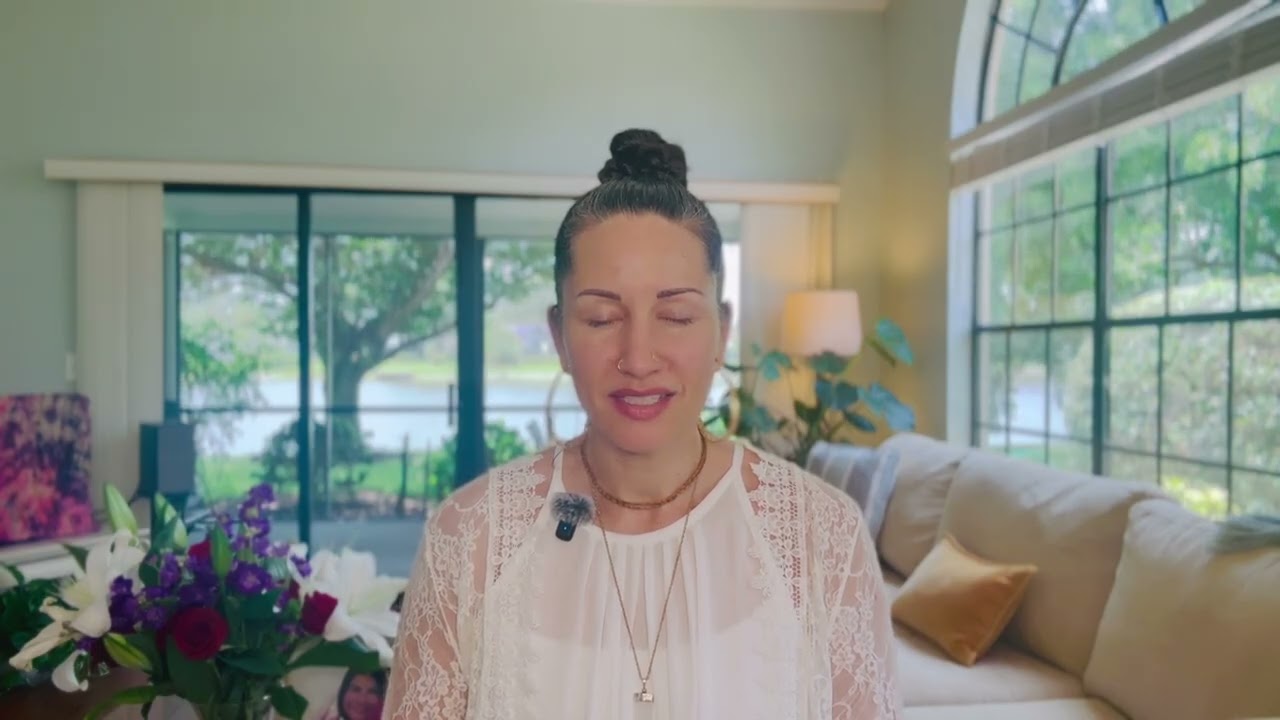
Three minutes and forty seconds into the official visualizer for "Grandmothersphere," a short spoken meditation runs underneath slow, shifting imagery and a bed of soft music. There is no chorus to hook onto and no verse structure to count. What you get is a series of sentences that circle one idea: enlightenment is not a summit you reach but a practice you keep returning to, and what you most need to release is not the world but your own rigid verdicts about it and yourself. The piece is built on that spine, and it is worth slowing down for, because the words are doing more work than the sparse production suggests.
This article draws only on the video itself: its spoken lines, its title, and the description that accompanies it. The visualizer was published on YouTube in November 2012 under the channel eastforestmusic, and its description ties it to the release "Love Bomb." Beyond that, there is no interview, biography, or production history here. What follows is a reading of what the words say and how they fit together.
The video opens with a question rather than a statement: do you want to know what enlightenment is? The answer, when it comes, is deliberately deflating in the best way. Enlightenment, as the spoken line frames it, is "with you every moment," and it moves in a "back and forth." That phrasing matters. It rejects the picture of enlightenment as a permanent state you finally arrive at and never leave. Instead it describes an oscillation, a repeated movement of gripping and releasing.
Contemplative teachers across many traditions have made a similar point, often with the image of waves or breath. The practitioner is not asked to stop the movement but to notice it, and to return. The line at roughly the 33-second mark makes the practical instruction plain: the work is "letting go of your attachment to yourself to outcomes, letting go to the way things are." Three objects of attachment are named there, and they escalate in subtlety. First the self, then outcomes, then the basic fact of how things are. Letting go of the way things are is the hardest of the three, because it means releasing the hope that reality would be different.
Around the 87-second mark the visualizer makes its most radical move. The speaker says that "if I could let go of everything or I could let go of right or wrong it would get deeper and deeper." Right and wrong are the most automatic filters most people carry. They sort every experience before we have consciously chosen to evaluate it. To let go of that sorting is not to stop caring about what is good or harmful; it is to stop treating each moment as a verdict.
The sentence is compact, but the logic is clear. Every act of letting go removes a layer of friction, and the layers beneath the surface are the deepest ones: the moral reflex, the instinct to classify. The spoken line says the process "would get deeper and deeper," and then adds, "it was amazing." That word is not hedged. The visualizer treats the release as a pleasure, not a penance.
The emotional center of the piece arrives around 136 seconds: "I could sense the lifetime of judgment against myself and letting it go." This is the most personal line in the visualizer, and it is also the most instructive. The judgment is not described as a fresh event. It is a lifetime of accumulated self-criticism, layered over years, that has become so familiar it reads as neutral.
Notice the grammar. The speaker does not say "I fixed my judgment" or "I overcame it." They say they could sense it, and then they let it go. Sensing comes first. That is the difference between suppressing a self-critical thought and seeing it clearly enough that it loosens. Sensing a pattern in the body and in the mind is the precondition for releasing it, and the visualizer compresses that whole process into a single gentle exhale of an "oh."
At about 186 seconds the spoken line offers its most concrete instruction: "with thoughtless breath instant bliss returns instant." The phrasing is spare and almost liturgical. Thoughtless breath is breath that is not being narrated, managed, or evaluated. It is simply happening. The line suggests that when the commentary stops, something returns quickly, and the word "instant" is repeated for emphasis.
There is a practical teaching embedded here. Many people assume bliss or peace must be pursued through effort, through the right technique or the right mental state. The visualizer points the other way. Bliss is described as something that returns when the mental noise pauses. The breath is the doorway because it is always available, always in the present, and cannot be argued with.
The final section of the spoken track, from about 198 seconds, carries the most distinctive idea of the piece: "Infinity. I didn't transcend my ego. We became partners. We became teammates."
This is a notable reversal. A large part of the spiritual vocabulary is built on transcending the ego, dissolving it, or defeating it. The visualizer declines that framing. The speaker says they did not transcend the ego at all. Instead the relationship changed from opposition to collaboration. The ego becomes a teammate rather than an enemy to be eliminated.
For a listener who has struggled with self-criticism, this is a useful correction. A war against the ego tends to reproduce the very judgment the visualizer describes: one part of the self condemning another. A partnership is different. It assumes the ego has a job, perhaps protection, perhaps planning, and asks that it do that job without running the whole show. The word "teammates" implies shared goals rather than a truce.
"Grandmothersphere" is short, and its strength is its restraint. Its lines are best approached as practices rather than conclusions. A useful way to sit with them is to take one at a time: notice where you attach to outcomes this week, notice where you sort experience into right and wrong, and notice when your breath is narrated by your thinking and when it is simply breathing. Then notice what changes when you let it be simply breath.
If the idea of the ego as a teammate resonates, the video is worth watching more than once, since the spoken phrases return to the same themes from different angles. The official visualizer and its description are the primary sources here, and they are enough to build a practice on without needing to know anything more about the speaker. The lines themselves are the teaching.