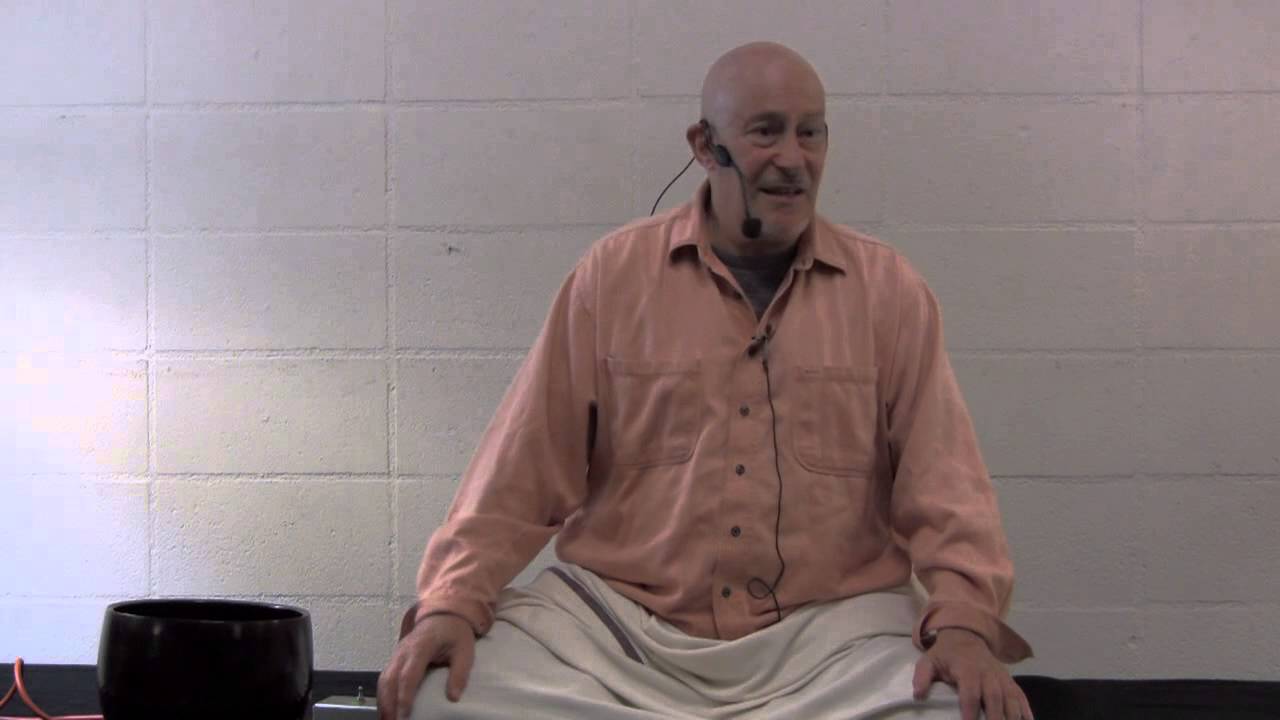
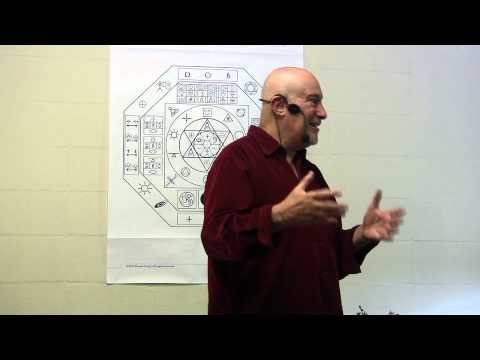
Filmed in November 2009 at Mt. Carmel Spiritual Centre in Niagara Falls, a short teaching by Shinzen Young takes up one of the least comfortable subjects in contemplative practice: what happens when meditation goes somewhere nobody intended. He opens with an abbreviation, DP/DR, and a provocation. Depersonalization/derealization disorder, he says, is "enlightenment's evil twin." The two experiences can share the same raw material, a sense that the self is empty and the world is paper-thin, yet they land in opposite places. For one person, that emptiness is the most fulfilling event of their life. For another, it becomes a pit. Young's answer is practical rather than theoretical: a skilled guide can recognize the drift, use the same tools of mindfulness and concentration to loosen the fear, and then help rebuild a positive sense of self from what remains.
Young starts with the good news, because the comparison only makes sense if you see what the "good twin" looks like. As the result of successful practice with classic mindfulness, he explains, a person comes to an experience of "the no-thing-ness of themselves and the no-thing-ness of their world." For that person, this is "the most fulfilling and empowering event of their life." He says it allows them to live "ten times the size that they would have lived otherwise," and frees them from fears and concerns.
"It's a kind of rich and wonderful and empowering nothingness." (Shinzen Young, 2009 teaching, 2:00)
Then he turns to the other side. DP/DR is also an experience of the nothingness of self and the insubstantiality of what you formerly thought was the world. Young is careful to note that it is not a folk notion. It is, in his words, "a recognized psychopathology," a diagnosis that appears in the Diagnostic and Statistical Manual. And the effect of that same kind of emptiness on a person with DP/DR, he says, is "the exact opposite" of what enlightenment produces.
That is what makes the phrase work. The vocabulary overlaps almost completely. Both states describe a self that is not a solid thing and a world that is not as solid as it seemed. The difference lies entirely in how the experience is held and what it does to the person living inside it.
This is the question that Young keeps circling back to. He puts it plainly: "And it is possible that the nothingness is the same nothingness. What's the difference?" (3:04) He calls it "a huge, huge question," both theoretical and practical, and he is honest that the theoretical side has no settled answer. "No one knows the answer to that," he says.
He does suggest why the question matters. The theoretical side, he argues, asks listeners to look "in a new way, and in a deeper way, at what enlightenment is." If the same nothingness can be a liberation for one person and an injury for another, then the simple picture of enlightenment as "emptiness is good" is incomplete. Something about the person's relationship to the emptiness, not only the emptiness itself, appears to decide the outcome. Young does not claim to have mapped that something. He leaves it open, and that openness is itself part of the lesson: practitioners should not assume that every encounter with emptiness is the same encounter.
Here Young is deliberate about his wording, and it is worth following him closely. He says that "very, very occasionally," people doing a meditative practice find their experience moving in the direction of DP/DR. (4:06) He knows the statement can frighten people. Meditation is not something most people know well, and a listener might reasonably imagine ending up "in the pit of the void" in "this horrible nihilistic dysfunctional state." So he asks his audience to listen carefully.
"In my entire career of teaching, which is long, into my fourth decade now, I have encountered this in students only a few times. In the few times I've encountered it, with maybe one or two exceptions, I've been able to cure it." (Shinzen Young, 2009 teaching, 4:42)
His account is measured. In the few cases he has seen, he says, "through giving the right direction, it ended up eventually becoming the empowering and fulfilling experience." He puts the odds for a student working under a competent guide as "very remote." He is careful not to claim zero. There is "a nonzero probability," he says, and he compares it to other remote risks in life, adding that it is "really not highly probable." The condition for that reassurance is the guide. Young's advice for anyone considering the meditative path is conditional: the risk is manageable when the teacher is "a senior, competent guide that has dealt with this problem successfully and has some idea of how to work with it."
The most striking section of the talk concerns the cases Young has not handled. He says the great majority of people who develop DP/DR "do not develop it as the result of having done a meditative practice." It simply arrives. "One day, suddenly, the somethingness of the self is gone, and the world is paper thin, and everything that ever gave them meaning has now vanished." (6:20) He describes such people as flailing "for the rest of their lives trying to get back to normalcy."
Young is clear about the limits of his experience. He has never tried to cure someone who developed the condition spontaneously using mindfulness methods, and he does not know whether that is possible. He also says he has "the impression" that there is no drug-based or therapy-based cure, and then adds that he could be wrong and hopes he is.
From that gap comes his most unusual idea. He wonders whether the strategies he uses with meditators could be tried on the general population. He uses the word "homeopathic" for the experiment, and the context makes his meaning clear: he means applying the meditator's methods to non-meditators, not a remedy in the pharmacological sense. (7:25) He says he has no idea whether it would work, and he admits that if he had another lifetime he would like to find out. It is a rare moment in the talk where a teacher openly describes an experiment he has not run.
Young places the phenomenon inside an older vocabulary. In Buddhism, he notes, this drift is traditionally called "falling into the pit of the void," and descriptions of it can be found in the classical literature, including the Pali Canon. (7:59) The name is old. What he adds is a practical response that treats the pit as something a student can work through rather than simply endure.
He describes two moves he usually makes.
- Negate the negative. If the person is freaking out because of the emptiness, Young reasons, then something is not empty: the freak-out itself. He has the student see that the freak-out reaction is also empty. "So that's sort of negating the negative." (8:19)
- Systematically develop the positive. Using concentration skills, the student creates positive feel, image, and talk, deliberately and repeatedly. Young presents this as a reframing: "good, now you have nothing, and from that nothing, that's the ideal place to reconstruct a completely new self."
The second move is where his imagery becomes most vivid. He compares himself to a physical therapist.
"You can still, at will, create positive feel, image, and talk, and now, like a physical therapist would exercise atrophied muscles, and in a systematic way rebuild that person's ability to move. So, I sort of push them, very much like a PT." (Shinzen Young, 2009 teaching, 8:39)
The analogy repays attention. A physical therapist does not argue an atrophied limb back to health. The therapist sets repetitions, measures progress, and pushes slightly past comfort. Young describes doing the same with attention and language: pushing the student to build positive feel, image, and talk "over and over and over again, until they literally build a new, and indeed better, self." The emphasis falls on repetition and training, not insight alone. The student is treated as someone whose capacities have weakened and who can rebuild them.
There is also a quiet logic in the first move. The fear feels total, but it is an object of awareness, and objects of awareness can be seen as empty. Seeing the fear that way does not deny that it hurts. It removes the sense that the fear is a solid fact that cannot be examined or moved.
Young's talk is short, under ten minutes, and it leaves much unresolved. That is an honest feature of the material rather than a flaw. For readers who want to go further, a few steps follow directly from what he says.
- Read the difference between a "rich and wonderful" nothingness and the same nothingness experienced as a pit. Young asks the question without answering it, so writing down your own sense of what separates the two is a useful exercise.
- If you practice meditation and notice fear arising alongside emptiness, treat the two as separate objects. Young's first move suggests that the fear itself can be observed.
- If you are considering intensive practice, look for a teacher who can speak directly about this risk. Young's reassurance depends on the guide being experienced and having some idea of how to work with it.
- Explore the classical sources he names, including the Pali Canon, where descriptions of falling into the pit of the void are said to appear.
- If you are supporting someone with DP/DR who has never meditated, consult a qualified clinician first. Young himself says he has never tried to cure such a case with mindfulness and is unsure whether it is possible.