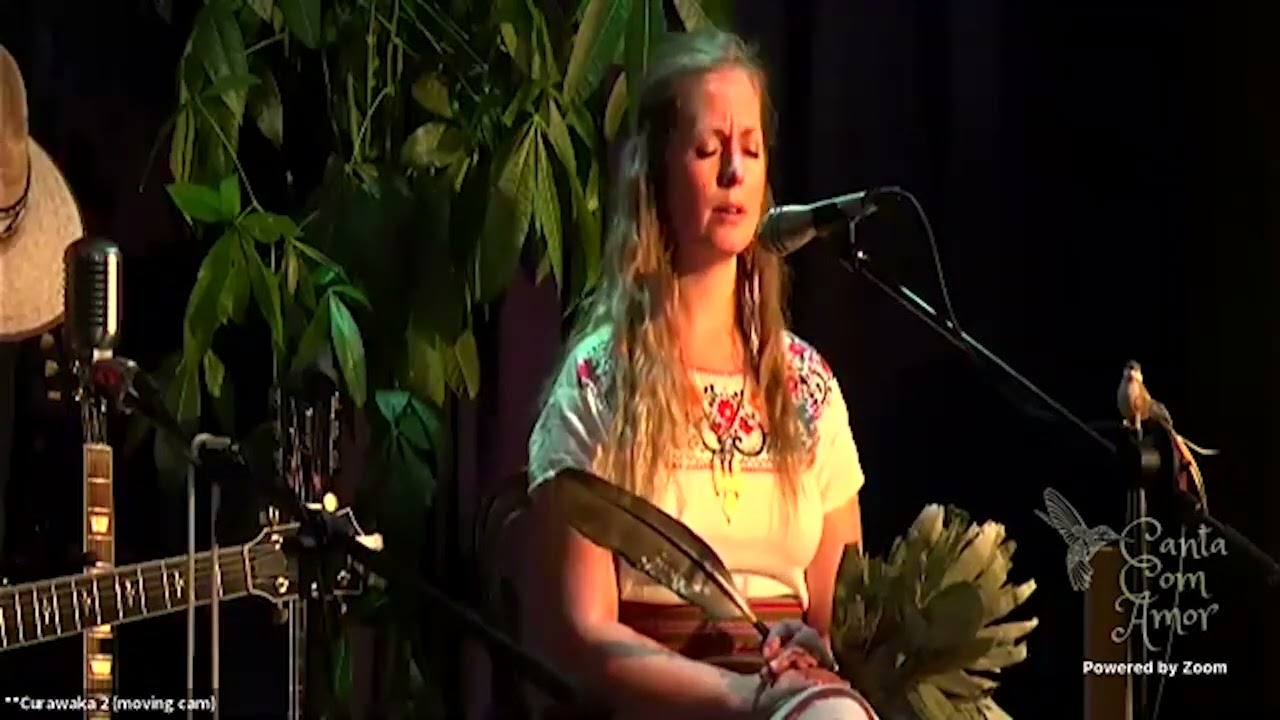
On the second day of January 2014, on Praia Almada in Ubatuba, a stretch of Brazil's southeastern coast known for its green hills running down to the water, a group of musicians stood in the open air and sang a piece called Cunaq. The Curawaka Official channel posted the recording that month, and the video runs about four and a half minutes. It is a plain, unhurried document of a song in performance: no stage dressing, no cut-away montage, just the sound of a chant carried by the place it was sung in. For anyone arriving at it now, the video works as a small window into how sacred and devotional music travels from one setting to another, and into how a single piece can carry more than one name and more than one lineage at once.
The description is brief, and it is worth reading closely because it does most of the work of framing the clip. It states that Curawaka is performing "Cunaq" "as known by Shimshai," and it gives the date and place: 2 January 2014, Praia Almada, Ubatuba, Brazil. It also notes that a new album was out at the time, with a pointer to the artist's own website. That is the full extent of the written context. There are no liner notes, no credits list, and no lyric sheet in the description, so anything beyond those facts would be guesswork, and this article will not guess.
What the video offers instead is the performance itself. Recorded outdoors, the chant has to contend with wind, surf, and open air, which changes how a voice sits in the mix. A chant recorded in a room decays back toward the walls; a chant recorded on a beach dissolves into distance. Listen for that. The edges of each phrase soften, and the drone or pulse underneath seems to belong to the landscape as much as to the singers.
This is the detail that rewards attention. Attributing a song "as known by" a particular person is a way of saying that the version you are hearing comes from a specific source rather than from a single, fixed original. In devotional and oral traditions, a melody or chant is rarely owned in the way a studio recording is owned. It is passed from teacher to student, from one community to another, and it bends a little with each carrier. Naming the person who knows it is a form of honesty about that chain. It tells the listener that the performance is one link in a transmission, not the final word on what the song is.
That framing changes how to listen. Rather than asking whether this is the "correct" Cunaq, a more useful question is what this version keeps and what it lets go of: the contour of the melody, the rhythm of the breath, the places where the voices come together and where they open apart. Variation in a living chant is not a flaw to correct. It is the mechanism by which the song stays alive.
Start with the breath. In many chant traditions the phrase length is governed by how long a singer can comfortably sustain a note, which means the pauses between phrases are part of the music and not dead air. On a beach, with waves in the background, those pauses fill with the sea, and the rhythm of the water can seem to answer the rhythm of the voices.
Next, listen for the foundation. Whatever sits underneath the melody, whether a steady pulse, a sustained tone, or a simple repeating figure, gives the chant its sense of ground. Stay with it for a full minute before following the melody. You will hear how the upper voices move freely against a fixed reference, and how that tension produces the feeling of settling and lifting that such chants are known for.
Finally, listen to the room that the recording creates. An open beach has no walls to return sound, so any reverberation is coming from the air and the shoreline. Notice how little artificial echo there is, and how the voices sound closer and more exposed than in a studio. That closeness is part of what makes field recordings of devotional music feel intimate even when the sound is distant and rough.
A four-minute clip cannot tell the full history of any chant, and it would be a disservice to pretend it could. What it can do is demonstrate a principle: that devotional music is most fully itself when it is sung in a real place, by people who know it, for a reason beyond the recording. The beach, the date, and the attribution in the description are not decoration. They are the facts that locate the song in time and in relationship.
The fact that a video of this kind drew a very large audience over the years also suggests how many listeners are drawn to music that does not arrive pre-packaged. Viewers who came for a chant on a beach were, in effect, looking for a sound that sounds like it was made in the moment and for a purpose. The minimal production of the clip is the point.
If this recording has pulled you in, the most useful next step is to listen to it several times with a single focus each time: first the breath and the pauses, then the sustained foundation, then the room. Pay attention to the attribution as well. Whenever you encounter a chant credited "as known by" someone, treat that credit as a doorway into the question of lineage rather than a label to be checked off. For the album that was promoted alongside the video, the artist's own website is listed in the description at www.music.curawaka.com, which is the most direct place to hear more of the work and to read whatever the artist chooses to say about it. Listen slowly, listen outdoors if you can, and let the sea stand in for the reverb.