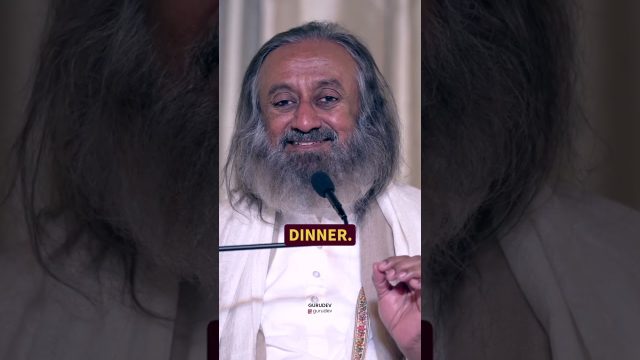
Eyes closed, body settling, a soft tone hanging in the room before any words arrive. In "It's Time to Slow Down," a guided meditation posted to the Meditations By Gurudev channel, Gurudev Sri Sri Ravi Shankar opens with a simple invitation: sit comfortably, easily, and take contentment as the theme of the sitting. Over roughly twenty-three minutes, the practice moves from breath to memory to sound to silence, asking the listener to stop chasing the next thing and simply notice what already has been good. It is a short, spare meditation, and its power lies in how little it asks of you and how precisely it sequences that request.
Most meditation instructions ask you to do something with attention: follow the breath, count, watch a sensation, repeat a phrase. This one is different. The opening instruction is to set the theme, and then to breathe and release. "Another deep breath in and let go," the voice says, twice, with the release built into the exhale rather than tacked on afterward. The repetition is deliberate. A breath that ends in letting go is a small rehearsal of the larger theme: you are not holding on to the day, the to-do list, or the sense that something is missing.
Then comes the central instruction, delivered at about the 31-second mark: "We can take today theme as contentment." Notice the word choice. Contentment is not framed as a goal to achieve, a state to earn, or a problem to fix. It is a theme to recollect. That distinction shapes everything that follows, because recollection looks backward into experience you have already had, while striving looks forward into experience you do not yet have.
The practice's most distinctive move arrives around the 79-second mark. The voice asks the listener to "just recollect those moments of contentment that you have had in your life." It then narrows the search: moments "when you have experienced pleasure and you're content." Gurudev's examples are concrete and sensory: "Good food you have eaten, you went around through all the five senses, whatever the moment of contentment, just recollect that."
This is worth slowing down on, because it is easy to skim past. Rather than asking you to imagine a peaceful state or to conjure a feeling from nothing, the meditation directs you toward the ordinary record of your own life. A meal that tasted right. A sound that settled you. A texture, a scent, a view. By moving through the five senses, the recollection stays physical and specific, which tends to make it more believable than an abstract affirmation. You are not telling yourself you are content. You are noticing evidence that you have been.
There is a practical logic here too. A mind that is agitated rarely responds well to being told to be calm. It responds better to being given a concrete thing to do. Recollection gives the restless mind a task that is pleasant rather than punishing, and it quietly reframes the sitting: the question is no longer "why can't I settle?" but "what in my life has already felt enough?"
At about the 154-second mark the voice shifts from memory to sound: "Let us resolve the con moment of contentment with the sound Om." The transcript shows the chant returning several times, at roughly 160, 172, 186, and 204 seconds, each Om following the previous one with a little room between. The word "resolve" is doing quiet work here. The recollected moment is not simply thought about; it is brought down into the body and gathered into a single syllable.
Om is one of the most widely recognized sounds in Indian contemplative traditions, and in guided sittings it typically serves as a bridge. The mind has been working with images, memories, and sensations. The chant gives it a single, repeatable point, and the length of each exhale does the rest. Notice how the practice is built so that the chant is not a performance. It is a way of letting the recollected feeling settle into one sound and then letting that sound go.
Later, the closing chant of "Om Shanti Shanti Shanti," heard around the 1268-second mark, works the same way at the end of the sitting. Shanti means peace, and the threefold repetition closes the practice with a single word for the state the whole session has been pointing toward.
The most instructive line in the transcript may be the shortest. Around the 335-second mark, the voice says: "Let go of all your effort. Let the mind expand." It is easy to hear this as a throwaway cue, but it is actually the hinge of the meditation. Up to this point, there has been a lot of gentle doing: breathing, remembering, chanting. Here the instruction changes direction. You are asked to stop managing the sitting and let the attention widen.
For many people this is the hardest part of any meditation, because effort feels like diligence. We are trained to work at things, and sitting still can produce a quiet anxiety that says you should be doing more. The meditation addresses that directly. It does not ask you to become a better meditator. It asks you to stop pushing and see what the mind does when it is no longer being driven. The phrase "let the mind expand" describes a shift from focus, which narrows, to openness, which spreads out.
The transcript's spoken cues become sparse after this point. Between the cues at 526 seconds (a simple "Okay") and 770 seconds (a counted "4"), and again through the long stretch before the closing chant, the video appears to carry little or no narration. That is itself a design feature. A meditation that keeps talking would keep giving the mind something to do. Silence gives the expansion room to happen.
The ending is as deliberate as the beginning. Around the 1376-second mark, the voice says: "And slowly and gradually become aware of body and surrounding." Then, at about 1397 seconds: "Slowly you may open your eyes." The instruction to return gradually matters. Eyes that open too quickly can undo the settling a sitting has produced, and the meditation builds in a transition from interior attention back to the room.
If you try this practice at home, you can follow the same arc. Sit comfortably. Take a few breaths and let each one end in release. Choose the theme of contentment and recollect two or three moments from your own life, using the senses to make them specific. Chant Om slowly, letting each exhale complete the sound. Then stop directing the mind and let it widen. When you are ready, become aware of your body and the space around you before you open your eyes. The practice takes only as long as you give it, but the sequence is the point: breath, memory, sound, release, return.
One honest caveat: the transcript provided is a subsampled record, and the video's full runtime is nearly twenty-three and a half minutes. The spoken guidance here is concentrated in the opening and closing, with the middle largely silent. That matches how many guided sittings are structured, but readers should not expect a lecture. The teaching is in the instructions themselves.
Start with the practice rather than with more reading about it. Set aside the full length if you can, and if you cannot, the opening recollection alone, followed by a few Oms and a gradual return, still carries the core of the meditation. Notice which sensory memory comes most easily and which one resists. That friction is often where the practice does its work.
If you want to go further, the video's description points to Gurudev's broader teachings, including a free download of The Art of Living app and a page for learning Sudarshan Kriya, a breathing technique the Art of Living describes as one of its core practices. Those resources extend the same underlying question this meditation begins with: what does it look like to slow down enough to notice that you already have something to be content about?