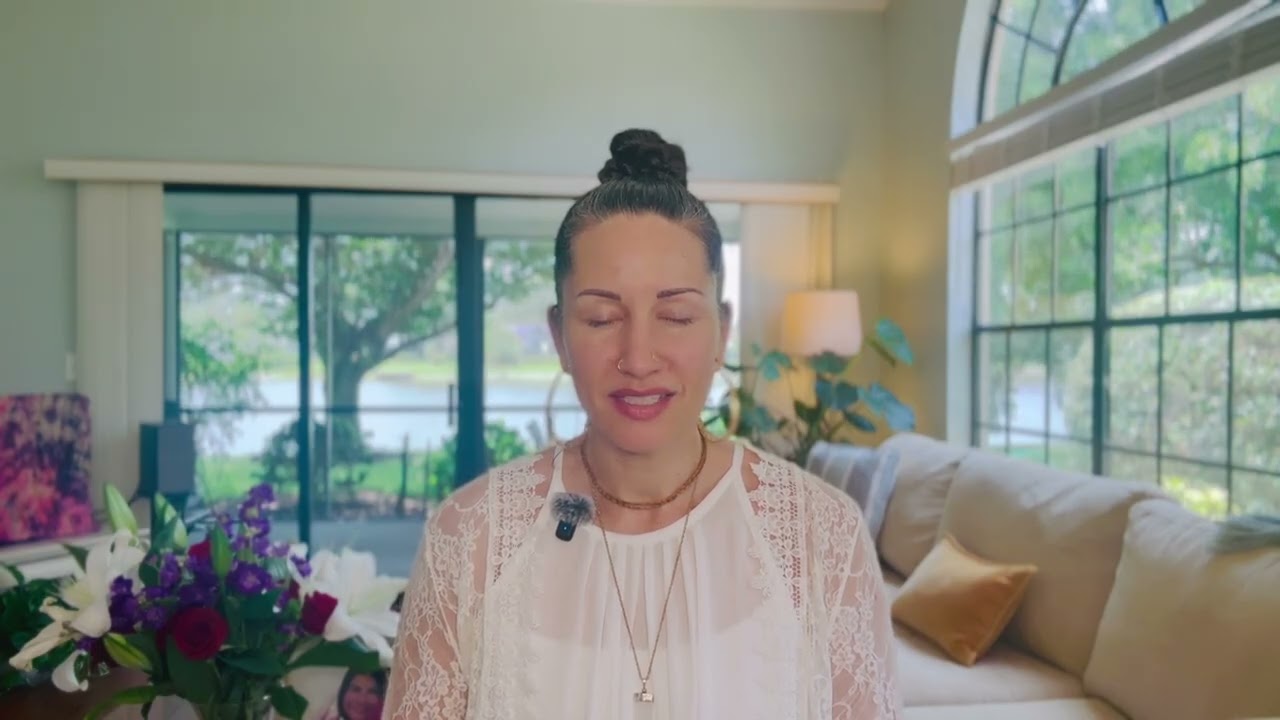
Strip away the production and the idea behind MC Yogi's "Chakra Beatbox" is simple enough to hold in one breath: take the short seed syllables that Indian contemplative traditions link to the body's energy centers, and put them on a beat. The result is a two-and-a-half-minute piece in which a voice works through Lam, Vam, Ram, Yam, Ham and Om in a spoken, percussive pulse rather than a sung melody. It is a small track, but it sits at an interesting junction of mantra chanting and vocal percussion, and it rewards a closer listen than its running time suggests.
The auto-generated captions are rough. They catch fragments of the voice, a few bursts of "Ya ha," and a long run of bracketed music markers, so this is not a transcript you can quote from line by line. What the captions do reliably is place the named syllables in order. The first recognizable words arrive around the 25-second mark, and "Lam" appears at 1:04, followed closely by "vam," "r" and "y h" between roughly 1:07 and 1:13. "Om" shows up near 1:37, and the captions close on repeated fragments of "r" and "la" around 1:43, before the music runs out at the end of the clip.
That ordering matters. The track moves through the syllables as a sequence, not as a single chant repeated for atmosphere. Each sound gets its own slot in the pattern, which is the same discipline a drum fill uses when it walks down the kit.
The video's own description on YouTube gives the lineup plainly: "Lam, Vam, Ram, Yam, Ham, Ommmm." Those are bija mantras, or seed syllables. In the widely taught system of seven chakras, Lam is commonly linked with the root, Vam with the sacral center, Ram with the solar plexus, Yam with the heart, and Ham with the throat. Om is often placed higher, associated with the brow and the crown, which is why it closes the sequence. These associations are a convention rather than a single fixed doctrine, and practitioners across lineages describe them in different ways, but the order from the base of the body upward is the structure most listeners will recognize.
The word "bija" means seed. The idea is that a single syllable holds a concentrated quality in compressed form, the way a seed holds a whole plant. You don't translate a bija mantra into a sentence. You sound it, and the sound is the point.
Beatboxing and mantra chanting share more than they first appear to. Both rely on the mouth and throat as an instrument, both work with short, repeatable units, and both depend on breath control and rhythm to hold attention. A bija mantra traditionally gets repeated, often for a set count, and the repetition is part of how it works on the practitioner. A beat does something similar: it loops, and the listener's body starts to lock into the loop.
What "Chakra Beatbox" does is make that overlap audible. Rather than a serene drone, the syllables are given a groove. The practical consequence is that the chant becomes easier to keep going with, and harder to drift out of. For someone who finds a long unaccompanied chant hard to sustain, a pulse gives the breath a frame.
"Lam, Vam, Ram, Yam, Ham, Ommmm. Chant the Chakra's MC Yogi Beatbox from the album Elephant Power." (MC Yogi, video description, YouTube, 2010)
That line from the original upload is the clearest statement of intent the material offers. It frames the track as a chant first and a beatbox second, and it places it on the album Elephant Power. The video was published on November 17, 2010, and it has since accumulated about 316,000 views, which suggests the combination found a steady audience well beyond the people already following the artist.
Three things stand out. First, the sequence is the content: the order of the syllables is the map of the body the tradition describes, so listening through the track in order is a kind of guided pass through the centers. Second, the rhythm is not decoration. It turns a set of sounds into something you can follow with your breath. Third, the piece is short enough to function as an entry point. Two and a half minutes is long enough to hear the whole arc and short enough to try the pattern yourself afterward.
If you want to try it, the most useful approach is to say each syllable slowly first, feeling where it lands in the body according to the convention above, then speed the pattern up until it becomes a loop. Keep the breath steady. The track's own tempo will tell you when you have the rhythm.
This clip is best treated as an opening rather than a complete study. To go deeper, look at the traditional texts and teachers who work with bija mantras directly, since the chakra associations above are a common framework rather than the only one. Then return to the track and hear how a contemporary artist has set the same six sounds to a beat. The gap between those two listenings is where the most interesting part of the work sits.