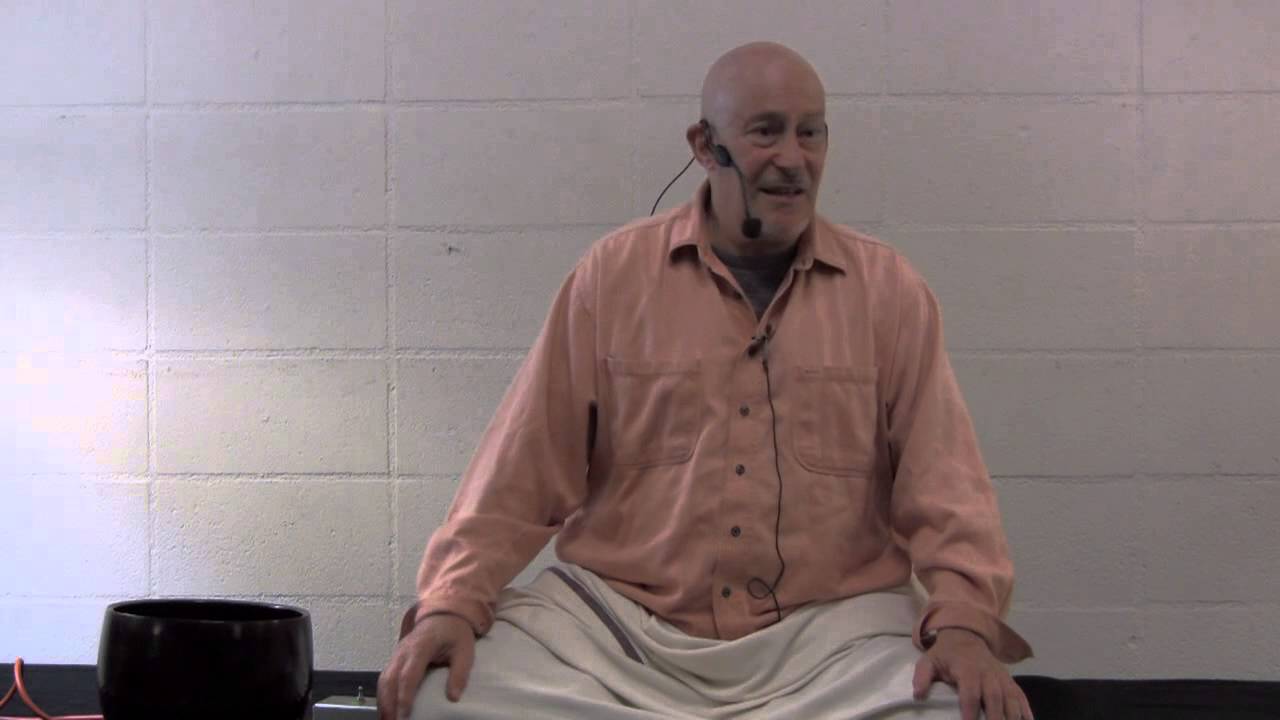
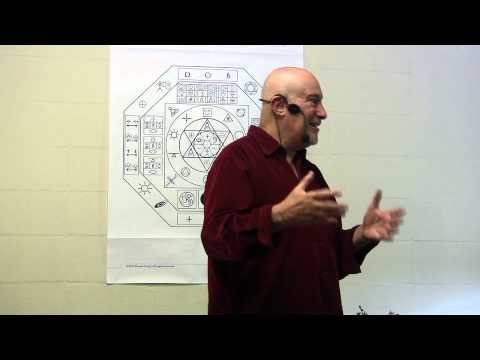
Someone wrote in with a question that sounds like a koan and lands like a dare: what's left after enlightenment, and what's the point? In a short talk filmed in April 2009 at Mt. Carmel Spiritual Centre in Niagara Falls, the meditation teacher Shinzen Young does not rush to answer it. He picks the question apart the way a good session musician picks apart a chart before playing a note, checking the changes, the voicings and the hidden assumptions, and only then playing. What he finds is that the question carries a picture of enlightenment as a light switch, and that picture is wrong. Once that is cleared away, he argues, the rest of the question becomes both answerable and surprisingly warm, ending in a single word he offers for the purpose of the whole path.
Young's first move is to read the sentence the way a musician reads a lyric sheet, looking for what it takes for granted. The phrasing, he says, implies "that there is a single moment of enlightenment and that, basically, enlightenment is this binary system. You're not enlightened, then you are enlightened, and it's these two things." Against that picture he sets his own experience: "it has been my experience that it's not at all like that."
He does not deny that sudden breakthroughs happen. "Although some people have a dramatic moment of enlightenment — it does happen," he says at about the 1:10 mark. But he insists that for most people it is quieter. "For most people, it sort of sneaks up on them. And unless it's pointed out to them, they might not even be aware of quite how enlightened they've become, because they've acclimatized to it." In other words, the change can be so gradual that the person living through it is the last to notice it.
That reframing matters. A binary model asks the seeker to wait for a verdict. A gradual model asks them to keep playing.
The analogy he reaches for is not mystical at all. He points to nature, where "some processes in nature are discontinuous. They jump. Some processes in nature are continuous." Mathematicians, he notes, took a long time to build an advanced calculus able to handle both kinds of function at once. "They had to because the nature of nature is that way," he says. His conclusion follows directly: "since enlightenment is part of nature, it's a natural process."
"It's even called seeing your nature, kensho, 'to see your nature.' So, because it's part of nature, we shouldn't be surprised that there are both sudden and gradual components to the endeavor."
Shinzen Young, talk filmed April 2009 at Mt. Carmel Spiritual Centre, Niagara Falls (at about 2:35)
The point is a practical one. If awakening has both jumps and slopes, then the question "what's left after the jump?" misunderstands the shape of the terrain. There is no single cliff to climb over. There is a landscape, and the seeker is in it.
This is where Young's own history enters the talk, and he is unusually frank about it. He says the sudden experience he had was "the result of systematic cultivation," and that some people have sudden experiences "without even having practiced." In his own case, he says, "I did have a sudden experience — that is true." The experience he calls the no-self, a term he attributes to Buddhism, arrived decades earlier. "I'm sixty-five now, and it was a while back," he says, "But I've had to spend my entire life refining the implications of that, realizing how screwed up I was in so many areas, even after that experience."
He follows that confession with a detail that reads as a deliberate rebuke to any romance about instant transformation. "It wasn't all that many years ago that I saw a psychotherapist, a psychiatrist, an M.D. for 18 months, to work on some behavioral issues that I felt I needed something besides the meditation practice." The implication is not that meditation failed. It is that insight into the nature of mind does not automatically rewire habits, and that the work of living differently can require other tools too.
For Young, then, the after-enlightenment question is less a philosophical puzzle than a description of ordinary life. Even a sudden opening, he says, leaves you "a long, long way to go." The task is to take it into the body and the calendar.
To describe that remaining distance, Young invokes the ox-herding pictures, a Zen series of images in which a seeker searches for an ox, finds it and eventually rides it home. His summary is blunt: "That's just seeing the ox, okay. Look at the ox-herding pictures. You've got to get on that ox. You've got to ride that ox in daily life."
The metaphor reframes the whole question. Seeing the ox is the recognition. Riding it is the lifelong practice of letting that recognition steer ordinary behavior, conversation, work and mood. Young's conclusion is that "there's enlightenment and then there's a lifetime of after enlightenment, if it's a sudden one. So, it's still a lifetime."
When the false binary is set aside, Young gives a candid inventory. "What's left is a whole bunch of screw-ups and bad habits and the effortless flow of emptiness." What makes that sentence compelling is the trajectory he describes. "As time goes on, the effortless flow of emptiness more and more eats up the screw-ups and the bad habits." Over time the balance shifts. "More and more of what's left is less and less something, and more and more doing."
He admits the phrase does not sound especially appealing on paper. "It doesn't sound all that appealing until you actually experience it." Then he makes it concrete with a thought experiment that a musician will recognize as the difference between hearing about a groove and playing inside it. "If you had a choice of living one day that way or living your whole life not that way, you'd say, well, I'll take the one day and you could kill me at the end of the day. That's how good the effortless flow of emptiness is."
Note what he is not saying. He is not describing a state where the self has been erased and nothing remains to do. He is describing a practice where less of the person is performing and more of the person is simply acting from clarity.
The second half of the question, "what's the point?", Young translates into a question about meaning: "What's the ultimate meaning? What's the meaning of the path? What's the purpose of the path?" His response is that the question itself needs examining first. "The funny thing is that you have to work through the need to have meaning." He says he has given talks on that theme, but the short version is that the seeker's hunger for a meaning is itself part of what has to be understood.
His claim is that purpose does not arrive as a conclusion. "As you begin to work through the need to find the purpose, the purpose arises spontaneously." The search for a justification falls away, and something more direct takes its place. This is consistent with his earlier point about emptiness: when less of you is grasping, more of your action is simply what the moment calls for.
Having loosened the question, Young does give an answer, and it is the line that gives the talk its title-level resonance. "Where the ox takes you would sort of be maybe the point of the thing, so, yes, I can put a word to that point." Then, plainly: "That word would be love. That's the point."
It is worth sitting with how he arrives there. He does not begin with love as a sentiment. He begins with the ox, the daily riding of an awakened life, and the slow erosion of self-centered habits by an effortless flow that is, in his words, "how good" it is once you have actually felt it. Love, in this account, is not a reward at the end of the path. It is the direction the path already points.
The talk runs only about seven and a half minutes, but it compresses a whole approach to practice into a few moves. If you want to go further, try the same exercise Young models. Take a big question you carry about spiritual life and examine the assumptions inside its wording. Ask whether the question presumes a switch, a finish line or a verdict. Then ask what changes when you treat the path as a continuous landscape, with sudden openings and long ordinary stretches, rather than a single before and after.
Young's own sequence is a useful map: recognize the ox, get on the ox, notice what the flow of emptiness is eating away, and let the meaning show up on its own. Whatever you make of his final word, the talk offers a standard for judging any teaching about awakening. Does it leave you waiting for a moment that never comes, or does it send you back into daily life, riding?