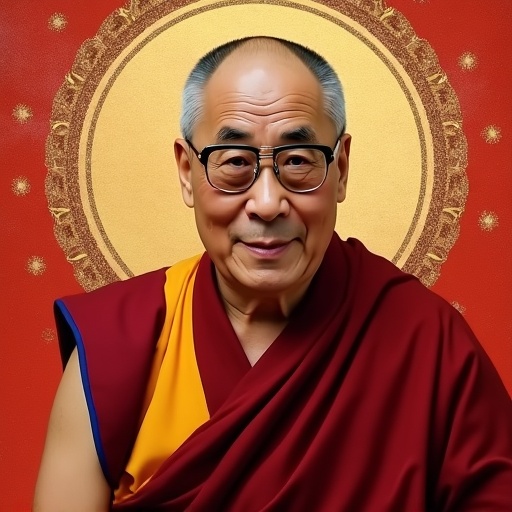
Picture a farm field in a poor village, a woman bent over her work, and a small boy riding on her shoulders. He is pulling her ears, kicking to change direction, and shouting when she does not do what he wants. She keeps working, keeps smiling, and does not get angry. That is the scene the Dalai Lama describes in a roughly 90-second clip recorded on February 6, 2017. It is a joke he tells on himself, and then a plain statement about his mother that carries more weight than its length suggests. Kindness, in this telling, is not a lesson announced from a lectern. It is a daily pattern a child absorbed without noticing, and only grew to understand later.
The clip is brief, and its details are simple. He describes his family as poor, a village family, with no toys or things of that kind. His mother carried him on her shoulder while she went to work in the farm fields or looked after the animals. Because he was carried so often, he grew comfortable up there, and then bold. He would hold his mother's ear to steer her, saying in effect, this way, no, that way. When she did not follow his wishes, he shouted from her shoulders and, in his words, gave her "some punishment." The room laughs at that moment, and so does he.
Then the tone shifts. "So my mother really very, very kind villager woman," he says. "I think I never saw my mother sort of angry face. Always smiling. Very, very kind." That final sentence is where the anecdote lands. The joke was the setup. The point is that the child, however unruly, met a face that did not harden.
The structure matters. He opens with a claim that might sound like a joke ("I used to say to you telling how joke. It's actually true."), so the listener is primed to laugh. He then delivers the evidence in concrete, physical detail: the ear, the shoulder, the fields. Only at the end does he state the conclusion. Good storytelling works this way, and so does good teaching. The image does the arguing before the abstraction arrives.
Notice what the clip does not contain. There are no speeches about compassion, no list of virtues, no instruction to the audience. There is a mother, a child, a field, and a face that stayed kind. The Dalai Lama's choice to tell it this way asks the listener to notice how patience works when it is practiced rather than preached. A mother carrying a toddler through agricultural work is not performing kindness for an audience. She is simply continuing to be kind while the child tests her, again and again.
There is also something worth sitting with in the memory's details. A boy who was pulling ears and shouting was not punished, shamed, or made to feel that his behavior made him unlovable, at least as he remembers it. He recalls the boldness with amusement, which suggests that the response he received was steady enough to let him play. Many adults carry the opposite memory: a parent's anger that they remember more vividly than any tenderness. The contrast in this clip is what makes it stick.
The clip offers no formal method, so any practice drawn from it is an interpretation, not a quotation. Still, its logic is clear enough to apply. Start with the image rather than the idea. When you feel the pull toward irritability with someone who is pushing your limits, ask what steadiness would look like in your body and face, the way the mother's face is remembered. The Dalai Lama does not describe her reasoning or her inner struggle, only her outward constancy. That is a useful reminder: patience is often visible as a settled face before it is ever felt as a feeling.
Second, consider the long view. The child on the shoulder was not a problem to be solved. He was a child being carried. Seeing the difficult moment as part of a longer relationship, one in which the other person is still learning, can soften reactivity. The clip's tone is warm and unhurried even when recounting shouting and ear-pulling, and that warmth is part of the teaching.
Third, notice what gets remembered. Decades later, the Dalai Lama does not recall the shouting as the central fact of his childhood. He recalls his mother's face. That is a gentle question to put to your own memories: which of the people who raised you, or whom you raised, do you remember as kind, and which moments of their steadiness have you never fully acknowledged?
It leaves us with a warm, specific portrait of a mother's kindness set against the modest material conditions of a village childhood. The lack of toys is mentioned almost in passing, but it frames the story: with little to play with, the child's companion was his mother, and her body and attention became his world. The clip does not romanticize poverty. It simply notes that a woman who worked the land still carried her child, still smiled, and still held her temper.
It is also a reminder that the most lasting teachings are often not the ones we are formally given. Children learn kindness by being held through their worst moments. The Dalai Lama's memory is a short, funny, tender demonstration of that fact, and it asks each listener to recall the person who first showed them what steady love looks like.
Watch the clip once for the laughter and once more for the face. Then take a few minutes to write down one moment from your own childhood when an adult stayed calm while you were difficult. Note what their expression, voice, and body were doing, not only what they said. Finally, consider whether there is someone in your life who might be carrying you, or whom you are carrying, and what steadiness would look like from you this week. Small, specific attention, the kind this clip describes, is where the teaching begins.