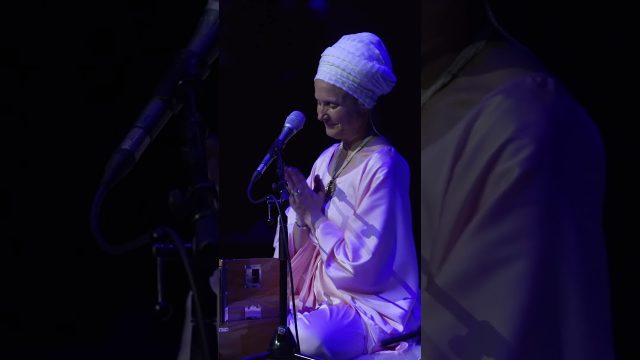
A kirtan singer offers a question back to her listeners: What do you see when you hear the words "lotus sitting on the water"? Not the botanical answer—the metaphor beneath it, the teaching encoded in petals and mud. In Snatam Kaur's reflection on this image from Om Namo, one of her best-known mantras, lies a framework for understanding how spiritual practice meets the texture of living.
The lotus is not incidental to Eastern spiritual tradition. It appears across Hindu, Buddhist, and yogic iconography as a shorthand for enlightenment, purity, and the soul's journey. But Kaur emphasizes something specific about its physical structure that makes it more than decoration: roots that dig deep into mud, a stem that travels through water, and finally a flower that opens in the sun.
"The lotus is this beautiful flower that grows in the water, but its roots go deep into the mud, and the stem travels through the waters, and then the flower then blooms on top of the water out in the glorious, glorious sun. But the roots are in this dark mess." The progression matters. There is no skipping steps. You cannot have the bloom without the mud.
Kaur translates the botanical into the lived: "That's what like being a yogi is like, living in this earth plane, living in life in all the muck and grime of it." She's not romanticizing struggle, nor is she suggesting that spiritual practice exempts you from difficulty. Instead, she's naming the reality that confronts anyone sincere about the path—that incarnation itself, embodiment, presence in the world, comes with friction, with confusion, with the weight of unconscious patterns and unhealed wounds. This "mud" is not a flaw in the system to be fixed before you begin; it is the medium through which transformation occurs.
The practice, then, is not escape. It's cultivation. The essence of who you are—your truth, your self—must rise through these conditions, day after day. "And then having that essence of you rise, rise, rise, rise up through the water, and having that beautiful, glorious celebration of who you are in the beauty of that lotus um out in the sun, out in the light, out in the open for everyone to see."
What arrests in Kaur's teaching is her insistence on the process. This is not a one-time realization followed by perpetual peace. "There's also this equanimity as well because it's a process like day by day by day to get back to that essence of being the lotus." She's describing something closer to a daily recommitment, a return, a recalibration.
And what does that daily work require? Kaur lists the actual mechanics: detachment, flow, release, letting go, and—crucially—coming back. Not dissociation, but healthy distance from the stories and identifications that cloud your truth. Not passivity, but surrender to what is actually happening rather than what you thought should happen. And not perfection, but the capacity to remember your essence and return to it, again and again.
The reflection is framed by song—by Om Namo, the mantra Kaur sings. The lyrics "Lotus sitting on the water / Beyond time and space / This is your way / This is your grace" are not abstract theology; they're an invocation and a compass. By singing them, by letting the words and sound move through your body, you're not just learning about the lotus. You're practicing being it—embodying its structure, its patience, its non-linear unfolding.
This is the particular gift of kirtan, of mantra practice: the teaching becomes a felt experience, not just an intellectual concept. The lotus doesn't have to be understood; it has to be sung into, inhabited, remembered.
If this resonates, listen to Om Namo and sit with the specific image Kaur offers—your roots in what feels dark or difficult, your essence rising through it, your fullest self blooming in the light. Notice where you are in that journey on any given day. The practice is not to skip the mud or to live there, but to know you are part of a larger flowering that requires all of it. That recognition, held gently and daily, is the equanimity the lotus teaches.