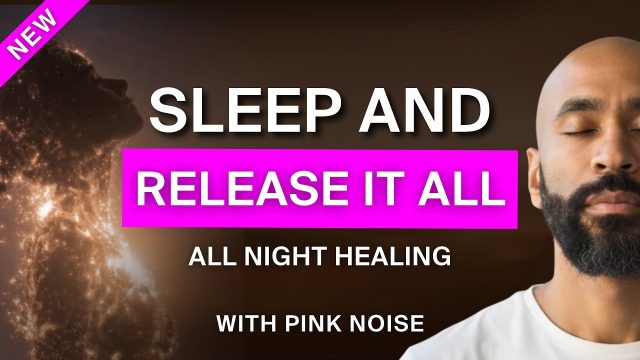
All day you've been holding yourself together, and your body took that literally. That is how Chibs Okereke opens this roughly two-hour sleep meditation, and it sets the premise for everything that follows: the jaw, the shoulders and the long muscles of the back are still bracing long after anyone needed them to. The session, published in late November 2026, is a slow head-to-toe body scan with a breath-first settling, a warm-blanket visualization and a gradual wind-down. It asks the listener to do almost nothing: find where the body is still gripping, allow that grip to ease, and repeat until sleep takes over. What makes it worth a closer look is how little it demands and how carefully it is built around permission rather than effort.
Before any muscle is touched, the session asks you to arrange yourself. Okereke says in the video (around 2:50) that if the pillow needs turning or the covers need pulling up, that should be handled now, so the rest of the practice happens in a body that is already settled. Then comes a quiet inventory of contact: the head on the pillow, one shoulder or both on the mattress, the length of the arm, the hips, the legs and the feet. The point is to notice surfaces that are holding you up, a small act of letting the bed do its job.
Only then does the breath enter. The instruction is deliberately plain: notice the breath without changing anything. Okereke makes a specific observation about the outbreath (around 5:18): "The body already loosens a little every time the breath goes out." The practice is not to make the breath longer or deeper. It is to watch for the small easing at the very end of each exhale, the chest settling and the shoulders sinking a fraction. Over several breaths, the session suggests, the gaps between breaths may begin to widen on their own.
Yawning gets a specific invitation. Okereke describes a yawn as one of the body's own ways of loosening the jaw and tells the listener there is no need to hold one back. Even without a yawn, the face is given its own small task: the forehead smoothing, the eyelids growing heavy, the cheeks going slack. This is the first lesson of the session in miniature. The body already knows how to release, and the job is to stop interrupting it.
The scan that begins around 8:50 in the video runs for nearly half an hour, and its method is simple to state and easy to underestimate. At each place, the instruction is two beats: first find whatever is still gripping, then allow that grip to ease. The route moves from the scalp across the forehead and eyes, through the cheeks, lips, jaw, throat and neck, down the shoulders and arms, into the hands, across the chest, along the back, through the belly and hips, down the thighs, shins and feet. Each stop is brief, but the sequence is thorough, and by the end of the route the listener has been asked to check nearly every region of the body twice: once to notice, once to release.
The session is careful about what it is asking for. Okereke says (around 9:30) that "no muscle has to let go completely. Even a little looser than before is plenty." That single sentence removes the perfectionism that often makes body scans feel like a test. A listener who is still holding some tension in the calves has not failed; they have simply found a place where a little more slack is available. The scan works on degrees, not on switches.
The language of the scan is also worth noticing. Okereke repeatedly describes muscles as things that are working on their own schedule: the scalp "often tighter than we'd imagine," the eyes that have "been working since the alarm went off this morning." These phrases treat the body as a record of the day, which gives a sleep practice a concrete reason to exist. You are not relaxing an abstraction. You are returning the body's effort from the hours that just passed.
The video names three areas for extra attention: the jaw, the shoulders and the whole length of the back. The jaw gets the most detailed treatment. Okereke notes that the muscles that close the jaw "are some of the strongest in the body," and that many people use them all day for "holding on, for concentrating, for biting back words." The instruction is to find the hinge just in front of the ears and let it open a fraction, the lower jaw dropping, the teeth drifting apart, the tongue resting wherever it wants. The session expects the clench to return. In the video (around 15:30), Okereke says a jaw that has been clenching for a long time "won't forget the habit in one night," so each return is treated as an occasion to notice and open again, not as a failure.
The shoulders get a similar patience. The scan asks the listener to notice how high the shoulders are sitting, to let them slide down, then to let them go a little further still. Okereke's observation here is one of the more quietly hopeful lines in the session: most people, he says, find that the shoulders have "more letting go in them than we thought."
The back is given the longest attention. Okereke calls it "the part of us that we hardly ever see," and describes the long muscles on either side of the spine as holding us up "without being asked." The image he uses is two ropes that have been pulled tight all day and are finally given some slack. The scan moves from the space between the shoulder blades down to the lower back, which the listener is asked to check for whether it is braced or held tighter than it needs to be. The belly follows, with a line that captures the spirit of the whole practice: "There's no one to hold the belly in for tonight."
Around the 37-minute mark, the session shifts from the scan into a visualization. The video's description explains that a warm blanket, "fresh out of the dryer," soaks warmth into every tight place. In the spoken section (around 41:16), the warmth is described as spreading down through the body, reaching into the places the scan has just worked on. The visualization gives the listener a sensory image to rest inside, and it turns the earlier instructions from a checklist into something closer to being held.
The description also pairs this stretch with soft 528Hz music, which it calls a healing frequency. The session does not ask the listener to take that framing on faith, and nothing in the spoken guidance depends on it. The words of the practice are the core of the session, and the music runs underneath them as atmosphere. For a listener deciding whether a long audio session is worth the time, that distinction matters: the instructions work without the sound, and the sound is there to keep the room company.
The session is explicit about this. "There's no right way to do this meditation," Okereke says near the start (around 1:32), and "if sleep comes before we've reached the feet, that's fine. All that means is that the body has finished early." The video's description repeats the point: you do not need to listen closely, remember the words or stay awake for the practice to work. Many people, it says, drift off long before the end, "and that is exactly as intended."
That reframing is the most practical idea in the video. Many people approach a sleep meditation as a task to complete, which can make the practice another thing to get right at the end of a difficult day. By placing sleep at the center and the scan at its service, the session removes the pressure to finish. The two-hour length makes the same point from another direction: the recording is built to keep going, so that no listener has to worry about missing the ending.
The wind-down near the end follows this logic. Phrases such as "the thinking slowing down" and "keeping the room company all night" are offered not as instructions but as gentle descriptions of what is already happening. Around 52:47, Okereke speaks the line "My back has nothing to hold up," the kind of short, first-person sentence that a tired listener can take in without effort.
The video's description identifies Okereke as a certified clinical hypnotherapist, stress and burnout coach and mindfulness facilitator, and its target listener is specific: someone who has been "holding yourself together all day," whose jaw, shoulders and back are still tight once they are in bed. The session makes no grand claims about treating conditions. Its promise is smaller and easier to test: a slow scan of the body, extra time for the places people commonly hold, and an invitation to let sleep arrive on its own terms.
The best way to understand this practice is to try a version of it. If you have an evening when the jaw or shoulders feel especially tight, begin with only the breath section: arrange the body, notice where it touches the bed, and watch for the loosening at the end of each exhale. Use the video's chapter markers to return to the jaw, shoulders or back without repeating the whole session. If you find yourself asleep before the feet, the session's own words suggest that is the result it was designed for. Look at the rest of Okereke's catalogue on the channel for other sleep meditations built on the same slow, permission-led approach.