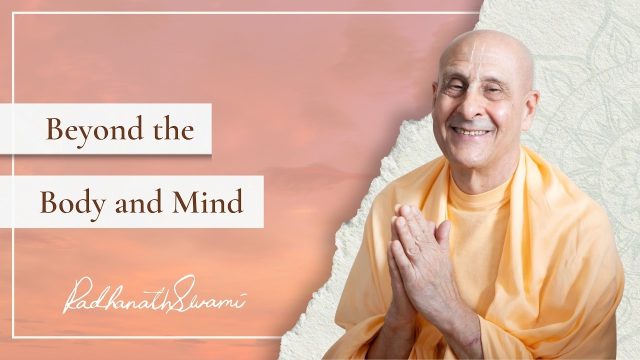
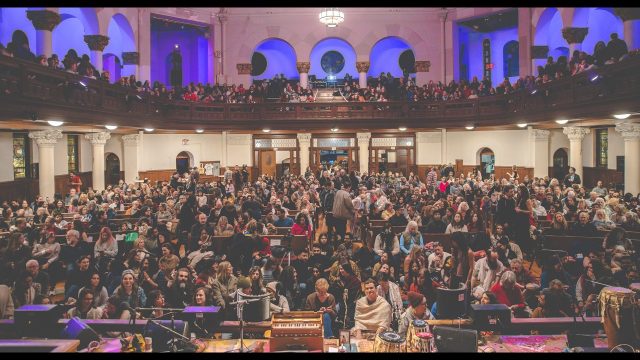
The talk opens with a question that most communities would rather avoid: why will there be disagreements at all? Radhanath Swami, the Bhakti monk and bestselling author, answers it in a single breath, then spends the next twelve minutes showing what follows from that answer. Disagreement, in his telling, is not a malfunction of devotion. It is part of how the universe was made, and the real question is what we do with it. His answer draws on Srila Prabhupada's teaching that we express love through cooperation, on a prayer by Bhakti Vinod Thakur, and on an idea that is easy to say and hard to live: that time itself is one of Krishna's energies, and every moment is an offering he extends to us.
Radhanath Swami's first move is to refuse the idea that spiritual life is a state of perfect agreement. He points to the Shrimad Bhagavatam, which he says describes disagreements even in the spiritual world. The difference is what those disagreements produce. In his words, they "create deeper unity and love, not only for Krishna but for each other." That is a subtle claim. It suggests that conflict is not automatically a sign that something has gone wrong. What decides the outcome is the orientation of the people in the disagreement.
This is where the talk turns practical. True cooperation, as he frames it, does not promise that everyone will think alike. It asks something harder: that we place the desire to please the Guru and Krishna above our own ego, opinions, and preferences. The video description puts the same point in plain terms, that unity "is not the absence of disagreements" but the willingness to rise above them through love, service, and surrender.
The central idea is a hierarchy of considerations. Radhanath Swami says that when we put what will please Krishna above all other concerns, including "the considerations of our intellect, our egos, our social status," then we are practicing bhakti. He is careful about the order. The higher principle does not replace our reasoning or our feelings; it sits above them and governs them. Only then, he says, are we "truly in the mood to serve."
He grounds this in a teaching from Shri Chaitanya Mahaprabhu, who called love for Krishna the greatest of all treasures and "the most inclusive and true satisfying wealth." The logic follows. If love is the treasure, then the thing to protect in any dispute is not who was right, but whether the relationship to the divine and to one another is being served. The disagreement becomes a place where that choice gets made.
Surrender is the word that gives the talk its title, and Radhanath Swami takes care to separate it from resignation. He quotes Bhakti Vinod Thakur's prayer, which begins with the simple declaration "Krishna, I belong to you," and continues: "My mind, my body, my abilities, my wealth, my family, my everything, it all belongs to you, Krishna." He acknowledges that philosophically this is easy to agree with. Everything belongs to God. The harder step is realization, which he describes as going beyond a philosophical understanding.
The argument here is about ownership. Radhanath Swami notes, following Srila Prabhupada's simple explanation, that a true proprietor has control, and that our control is thin. Earthquakes, storms, theft, violence, and time all strip it away. Whatever sense of control we have, he says, is "extremely circumstantial." This is not offered as gloom. It is the setup for a reversal. If we have not really created anything, then the things we are asked to surrender were never ours to hold in the first place, and giving them over to Krishna is simply returning them to their source.
"Krishna says time I am devouring everything."
Radhanath Swami, quoting the Bhagavad Gita in a talk published on YouTube, November 26, 2026
This is the most unusual part of the talk, and the one most worth sitting with. Radhanath Swami takes the Gita's statement that Krishna is time, and that he is death personified, and does not soften it. He lists what time brings: aging, disease, the death of everyone we love, the loss of everything we are attached to, including the body we identify as ourselves. Then he asks the audience, with some humor, how many of them really want to get very old.
The reframing comes next. If we accept Bhakti Vinod Thakur's prayer and see time as Krishna, then dying becomes "a beautiful offering," because it is going to happen regardless. The question left is whether we accept the opportunity that time presents. This is where he brings in Srila Rupa Goswami, who writes that the symptom of a sincere devotee is that they do not waste time, "because time is Krishna." Time is Krishna's energy, and through that energy Krishna can accept our hearts, our lives, and everything else.
To explain how an energy can connect us to its source, Radhanath Swami tells a story he heard from a recording of Srila Prabhupada. Prabhupada described yogis who could, in moments, ride the sun's rays to the sun planet without being burned. Radhanath Swami's point is not about the yogis' feat. It is about the relationship. Through the energy of the sunshine, we can reach the source of that energy. The sun reaches toward us through its rays, and we can connect with it personally through them.
He applies this directly. Everything is Krishna's energy, and bhakti is the practice of understanding this and connecting with Krishna through those energies. Time is one of them. The analogy matters because it shows a single principle working at two scales: the energy is never separate from the source, so any moment we are given is also a point of contact with the one who gave it.
Radhanath Swami is precise about the motivation for not wasting time. For some people, he says, the urge to use time well comes from fear, from the sense that each moment brings us closer to death. He says that is "also good," but that as we move closer to the spirit of bhakti, every moment is understood as a gift. It is, in his words, "a gift of God that he's offering us to give himself." Each moment carries Krishna's invitation: "Here I am. Reciprocate. Remember me in this moment. Please me in this moment. And you directly connect with me in this moment."
He names the holy names of Krishna as the most merciful way to make that connection, because they are a sound vibration that can be chanted at any time. He recounts a moment from Srila Prabhupada's final days in this world, when Prabhupada smiled at a devotee and said that if both of them were chanting Krishna's names, "we're always together." Radhanath Swami's gloss is blunt: when we forget Krishna, time separates us, but when we are actually Krishna conscious, time becomes conspicuous by its absence.
The talk closes where it began, with the idea of exchange. Love means reciprocating gifts. We receive, and we serve. Radhanath Swami calls this the basic foundation of bhakti. Read back through the talk and the structure is clear. Disagreements are built into creation. They become a source of unity when we place a higher principle above ego. That principle is surrender, which means recognizing that everything, including our time, belongs to Krishna and returns to him as service. Service is what turns the disagreement from a wall into a meeting place.
It is worth noting what the video does not develop. The description mentions pilgrimage, and the spoken portion here focuses on disagreement, surrender, time, and the holy names. The idea that unifies the whole talk is the one the speaker returns to most often: the higher principle of pleasing Krishna. Everything else is an application of it.
If this talk resonates, the next step is to take one disagreement in your own life and ask the question the talk poses: what would please Krishna here, above my intellect, my ego, and my status? Then take one ordinary moment of your day and treat it as a gift that is asking to be returned. Radhanath Swami's own method is the simplest: chant, remember, and serve in the moment you are in. Watch the full talk to hear the passages in his own voice, including the prayer and the Prabhupada recollection, and to notice where his emphasis lands.