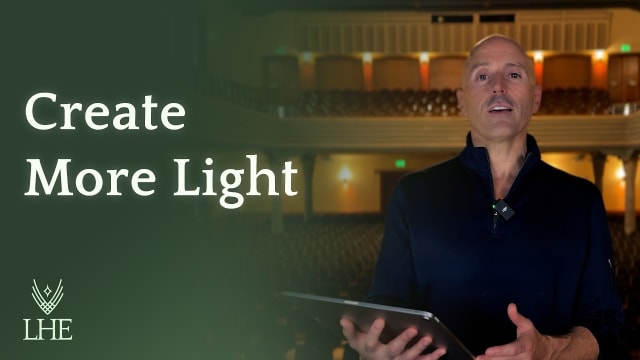
Many of us carry a persistent weight: grief about the state of the world. We scroll through suffering, feel the dysfunction, and wonder if bearing that pain—making it our own—somehow honors those who suffer. The opening broadcast of Initiation 2026, Lee Harris's channeled mystery school, offers a radically different answer. The guides (known as the Zs) argue that you do not bring light to suffering by becoming suffering. You bring it by stabilizing the light inside you.
This distinction cuts to the heart of spiritual activism and personal transformation. For anyone carrying climate anxiety, political despair, or compassion fatigue, the message reframes the work entirely. It's not a call to dissociate from the world's pain, but rather an invitation to stop unconsciously *merging* with it—and instead to tend your own central core of light as an act of service.
The Zs begin with a diagnosis. If you find yourself regularly, or even constantly, in grief about the world's condition, that grief often points to something in your own past timelines—possibly lifetimes in which you were "more aligned with and embroiled in suffering." This is not a judgment. It's an echo. And like any echo, it can be resolved.
The guides don't ask you to stop caring. They ask you to stop *becoming* what you oppose. An activist, a healer, an advocate for the voiceless—these roles remain vital. But the Zs are clear: "You are here to advocate for those who cannot advocate for themselves. You are here as an activist against areas of the world that are causing suffering. You still need to stabilize the light inside you."
The practical implication is subtle but profound. When you're continuously identified with the problem, your nervous system remains in alarm. Your body learns to live as the crisis. Over time, that embeds a low-level coherence with suffering itself—a form of loyalty to the very thing you're trying to change. By contrast, stabilizing your own light creates a different frequency. From that frequency, you emanate differently. Your presence carries a different field. Your choices ripple differently.
The Zs then introduce a concept that may sound unfamiliar: the Lemurian body. They acknowledge upfront that some listeners may never have encountered Lemuria, and they're not interested in convincing anyone who hasn't had that resonance. But for those who do resonate, the idea opens something.
Your Lemurian body, as described, is an ancestral template—not in the genetic sense alone, but in a kind of harmonic and dimensional inheritance. Lemuria, in this framing, was a civilization or dimension characterized by harmonic resonance and profound healing capacity. Crucially, the light in Lemuria was never something accessed through *effort* or *separation*. Your Lemurian body "knew how to merge with light because your Lemurian body never descended from light the way your human body had to."
Earth, by contrast, is built on separation as a core learning. That separation created the need for practices—meditation, breathwork, nature immersion—as bridges back to light. The Zs don't dismiss these practices. They call them "very valuable" and note that people who maintain "regular short doses of light" through such practices "are doing better than most." But they distinguish between *brief visits* to light and a *return to the mainframe*.
What does this mean? Not that you meditate once and become permanently light-embodied. Rather, that there's an older, deeper template available to you—one in which the body itself can remember a state of coherence with light that doesn't require constant effort to access. The goal isn't another practice to add to your routine. It's a kind of recalibration, a return to what your nervous system already knows.
A concern naturally arises: if I become more light, more awakened, more evolved, what happens to my closest relationships? The Zs address this directly, and their answer has real wisdom.
They ask: "Why do you think your closest relationships can't enlighten with you?" It's a rhetorical question meant to challenge an assumption. And yet they acknowledge that for some, the knowing runs deep—certain relationships may not follow you into higher awareness. That's real, and they don't deny it.
But here's the reframe: not all relationships need to evolve at the same pace. Some of your closest relationships might be serving as "grounding energy fixtures" or "identity fixtures"—the structures that keep you anchored, connected, and functional in daily life. The Zs suggest that you can enlighten certain parts of yourself while keeping other parts deliberately stable. The parts you want to remain fixed are "not mistakes. They are helping to stabilize and ground you."
This is a mature teaching. It rejects the narrative that true spiritual development requires you to leave everyone behind or that relationships are obstacles to transcendence. Instead, it recognizes that growth is *uneven by design*. You'll transform in some domains while remaining rooted in others. That's not hypocrisy or compromise. It's wisdom.
The Zs open their message with a central invitation: surrender the old timelines. Allow "the timelines of the past to neutralize." For many listening, this language will stir something—excitement, yes, but also fear, sadness, nervousness. The Zs acknowledge this explicitly and add an important caveat: "You will not do anything you are not ready for. It is not our job to drag you to a place you are not ready to be."
This reframes consent and spiritual transmission. The guides are offering frequency and information, but the uptake is entirely yours. You move into these ideas "as much or as little as you wish" in order to let "some of those old energies in you dissolve." There's no coercion, no demand, no spiritual bypassing. You take what's yours to take.
What does it mean to surrender old timelines? It's the releasing of stories, patterns, and identifications that no longer serve—not through force, but through recognition and agreement. When you see that you've been loyal to suffering, that you've inherited a pattern of grieving the world from past incarnations, you can gently release it. That release creates space for something else to emerge.
Initiation itself is framed as a "channeled mystery school" that shifts and responds each year based on the community that gathers. This is an unusual structure. Rather than a fixed curriculum delivered from on high, the gathering itself—the particular souls showing up, their readiness, their questions—shapes what comes through the channel.
Lee Harris's role is then to ground the channeled material into everyday life, to reflect on themes and make them practical. The goal is explicitly not to mystify but to empower—to help participants "call in and activate your next steps in life."
If this message lands for you, the invitation is not to become perfect or to transcend your circumstances overnight. It's to notice: Where in my life am I unconsciously becoming what I oppose? What grief am I carrying that might belong to an old timeline? What would it feel like to stabilize the light inside me—not as an escape, but as a foundation from which to meet the world?
These questions don't have tidy answers. But they're the questions that open the work. The Zs suggest that your Lemurian body—your ancestral memory of harmonic coherence—is waiting to be remembered. Not as a belief system, but as a felt sense. As you tend that return, the way you show up for the world shifts. That's not spiritual bypassing. That's real power.