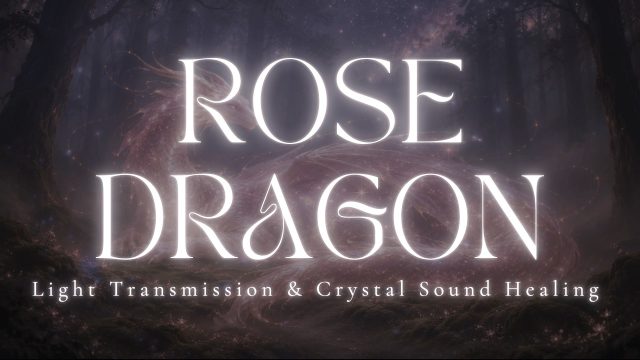
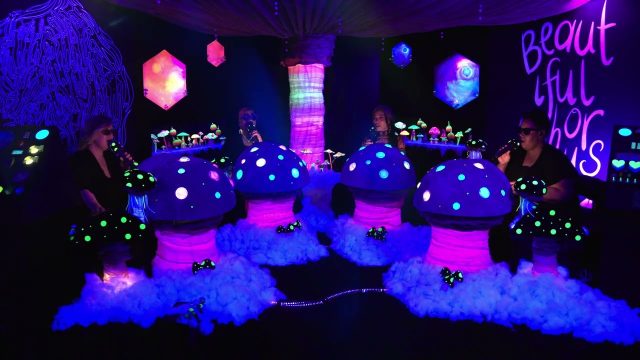
Late in the year, when the trees have let go of their leaves and a person can see a little further through the bare branches, Molly-Anne Chinner asks her listeners to do something simple: find a cosy corner, put on headphones, close your eyes and let the sound come close. That is the invitation at the heart of her roughly eighty-five-minute video, a "light transmission" made for the Full Moon in Gemini. Through light language and the sustained tones of what she calls angelic crystal singing bowls, set within a 432Hz frame, the video offers a container for what she describes as winter dreaming: following "an image, a word or a feeling" to see where it leads, then carrying whatever emerges into the dark months as a seed.
The video's framing begins with the sky. In the description, Molly-Anne Chinner places this full moon in Gemini within the long nights of Sagittarius season. She writes that she loves how Sagittarius "asks us to look towards wider horizons just as the earth is drawing us into the stillness of winter." The pairing is the logic of the whole piece. The season pulls inward, toward rest and darkness, while the sign asks the eye to travel outward.
Gemini supplies the method. In her words, the sign "lends us the curiosity to follow those threads," and Sagittarius "invites us to see how far they might reach." Put together, the full moon becomes less a moment to achieve anything than a permission slip to wander. She frames the dreaming as deliberately open-ended: a chance to "imagine what we might make, where we might go and what we'd love to give more of our days to."
The closing image is the most practical thing in the description. Whatever vision arrives, she suggests, "we can carry it into the dark months like a seed kept warm in the earth, giving it time to take root before the light returns." It is a useful way to think about any winter practice. Insight that is not rushed into a plan has a chance to develop on its own schedule.
A "transmission," in her usage, is a guided sound session rather than a lecture or a song with lyrics. Molly-Anne Chinner describes the work as a space in which "we'll give ourselves a little while to follow an image, a word or a feeling and see where it takes us." The listener is not asked to solve anything. The sound and the spoken or sung material set the conditions for attention, and the attention does the rest.
Light language is the other half of the vocal layer. The description does not define the term, so it is worth being precise about what it is in general. Practitioners of light language typically describe vocalized sounds that are not drawn from a fixed dictionary of words, offered as a kind of sung or spoken tone that carries feeling rather than semantic content. Whether a listener hears meaning in it or simply hears texture is, in practice, part of the experience. Approaching it as sound first, rather than as a language to decode, is the most useful way in.
Her description singles out "the clear, lingering tones" of her crystal singing bowls, and that quality is the instrument's signature. Crystal bowls are typically made from quartz, a material that, when struck or rubbed around the rim, produces a pure, sustained pitch with very little of the complex overtone clatter associated with hammered metal bowls. The tone tends to hang in the air and fade slowly, which is why many listeners describe them as washing over the room rather than sounding from a single point.
That lingering is not a decorative detail. A long decay gives the ear a long time to arrive. When a tone sustains, the listener has a stable point to rest on, and the mind has room to drift without losing its anchor. For a session built around following a feeling "to see where it takes us," an instrument that keeps its note available for many seconds at a time is exactly the right tool.
The title and description both place the work in a 432Hz frame. Most Western music is tuned so that the A above middle C sounds at 440 Hz. A 432 Hz reference pitch sits slightly lower, and it has a devoted following in sound healing circles, where it is often presented as gentler or more natural. The material for this video does not make measurable claims for that tuning, and the honest position is that the evidence for special healing properties of 432 Hz over 440 Hz is contested. What a listener can notice without any claim at all is that a slightly lower reference pitch changes the color of a tone. Some people find that warmer and easier to settle into. That is a matter of listening, not a medical outcome.
The description gives concrete instructions, and they matter as much as the sound itself. Use headphones if you can, so the tones arrive close and full. Find somewhere cosy. Close your eyes. Then, she writes, let the sound come close "as if the Rose Dragon were singing beside you." That last image is an invitation to imaginative intimacy rather than detached listening. It is the same spirit as the dreaming she describes: the listener is a participant, not an audience.
A practical way to approach the session follows directly from her framing:
- Before you press play, choose a single image, word or feeling you want to follow. Keep it small.
- Let the first tones settle before you try to attend to anything in particular. The long decay of the bowls is doing its work in the background.
- When your attention drifts, return to the thread rather than forcing a vision. The transmission is not a test.
- When the sound fades, write down whatever remains, even if it is only a single word. That word is the seed.
- Keep the note somewhere you will see it in the coming weeks, and leave it alone until the light starts to return.
The most direct next step is the one the description asks for: put on headphones, sit somewhere comfortable and listen through once without trying to get anything from it. A second listen can be shorter, with a single image or word chosen in advance. Keep a short written record of what came up, dated, so you can see later which threads you chose to keep following.
If you want more of Molly-Anne Chinner's work, she notes that her music and light language transmissions are available on all streaming platforms. Readers who feel drawn to her ongoing community can also find her invitation to The Blue Rose Temple, her monthly membership for ceremony, sound and community, at mollyannechinner.com/blue-rose-temple. Whatever you choose, the season she describes offers a rare kind of permission: to look past the shape your life has already taken, and to let a vision sit in the dark, warm and unhurried, until it is ready to grow.