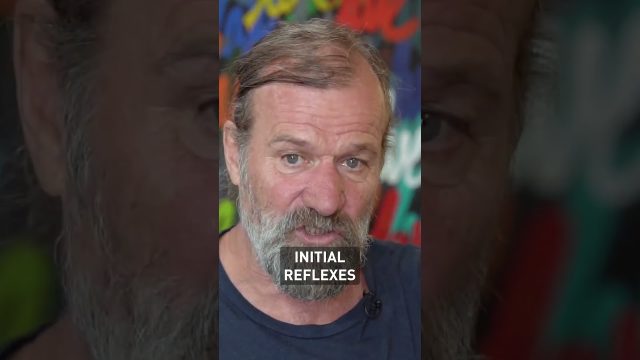
For three decades, the world called him crazy. A man diving under ice, climbing mountains in shorts, holding his breath in ways that defied every medical textbook warning. Wim Hof—known as "The Iceman"—watched spectators gasp as he performed feats that seemed impossible, even dangerous. The crowds came for the adrenaline, the spectacle, the question mark: How is he even alive? But somewhere in those years of being dismissed, something shifted. Hof stopped performing for applause and started asking a more urgent question: Why?
The turning point wasn't a sudden insight. It was accumulation. Looking back on the decades of extreme cold exposure, breath work, and mindset training he'd developed, Hof recognized he'd stumbled onto something that transcended circus appeal. "For years," he explained, "it was more adrenaline for myself, and I did understand what I was doing. But at a certain point it got picked up by performances everywhere, and that became more of a show element." The realization struck him with clarity: he was treating a profound physiological discovery as entertainment.
What began as solo expeditions into extreme cold—ice baths, arctic marathons, the kind of challenges that generated Guinness World Records (26 total, 18 of them Guinness-recognized)—evolved into something far more serious. Hof began to see his own body not as a curiosity to be pushed to its limits, but as a laboratory. The breathing techniques he'd developed, the deliberate cold exposure, the mental discipline required to remain calm under conditions that would trigger panic in most people—these weren't tricks. They were tools.
By 2012, that recognition bore fruit in the form of rigorous scientific scrutiny. Researchers at Radboud University Medical Center in the Netherlands began studying what Hof had been doing intuitively for years. The results surprised even those who'd watched him in action: the Wim Hof Method—a protocol combining specific breathing exercises, cold exposure, and mental training—produced measurable, reproducible physiological changes. Since 2012, over 20 peer-reviewed articles have documented the method's effects, including randomized controlled studies published in PNAS (2014) and other prestigious journals.
"Now we're trying to find something that works against disease, something that fights and combats illness," Hof said, describing the new direction. "We're busy with that now." The language itself marks the transformation. No longer is he speaking of himself as performer, but as researcher—part of a team. "If we can do something for humanity, here together with this team of doctors, professors, and skilled people, and discover something that benefits humanity, then that is naturally many, many times more important than everything I've done in my entire life until now."
The scientific establishment's initial skepticism wasn't unreasonable. A man claiming to control his immune response through breathing and cold sounded like pseudoscience, the kind of claim that fills the margins of wellness magazines and supplement catalogs. But Radboud's researchers approached it with methodological rigor. They designed experiments where variables could be controlled, where placebo could be ruled out, where the nervous system's response to cold could be measured, tracked, and replicated.
What they discovered was that the autonomic nervous system—long considered involuntary—could be deliberately influenced through the Wim Hof Method's combination of techniques. Subjects who trained in the method showed enhanced immune responses, reduced inflammatory markers, and improved stress resilience. The cold wasn't simply a stressor to be endured; it was a tool that, when combined with breath work and mental focus, produced genuine physiological adaptations.
This legitimacy matters because it changes who listens. A circus act attracts audiences seeking entertainment. Science attracts researchers, clinicians, and patients seeking solutions. Hof's earlier frustration with the performative aspect of his work—"It became a bit empty of content, in my opinion"—reflected a deeper recognition: extreme cold as spectacle serves no one but the entertainer.
The Wim Hof Method itself consists of three core pillars. The breathing component employs hyperventilation followed by breath retention, training the body to remain calm under conditions of altered CO2 and oxygen levels. The cold exposure—whether ice baths, cold showers, or immersion—systematically desensitizes the initial shock response and trains the nervous system to maintain composure under stress. The mindset component weaves through both, emphasizing the role of mental discipline and focused intention.
What makes this approach distinct from both traditional meditation and conventional exercise is its integration. Cold immersion alone produces temporary discomfort and adaptation. Breathing exercises alone develop respiratory capacity. Mindset training alone builds mental resilience. But in combination, synchronized and practiced deliberately, they appear to produce effects greater than any single component alone. This synergy is what researchers have been documenting—and what Hof has been experiencing firsthand for decades.
The implications extend beyond personal performance. If the Wim Hof Method produces measurable improvements in immune function, inflammation markers, and stress response, it offers a non-pharmaceutical approach to conditions ranging from autoimmune disorders to depression. The fact that these results have survived peer review and replication suggests we're looking at a genuine physiological mechanism, not a placebo or coincidence.
Thirty years is a long time to be called crazy. It takes a particular kind of conviction—or perhaps a particular kind of lived experience—to persist when the mainstream dismisses you. Hof's journey mirrors that of other pioneers who developed practices later validated by science: the meditation researchers who were scorned before neuroimaging showed measurable brain changes, the acupuncturists who endured decades of skepticism before randomized trials confirmed efficacy.
What distinguishes Hof's arc is that he didn't retreat into alternative medicine mysticism. He didn't lean into the cult-of-personality aspect or build an empire around his own exceptionalism. Instead, he invited researchers in. He submitted his work to scrutiny. He acknowledged, years into his practice, that the showman phase had run its course. "It's done," he said simply. "It's empty of content in my opinion. And now this—this has real meaning."
That transition—from seeking validation through spectacle to seeking validation through science—represents a maturity that extends beyond Hof himself. It suggests a broader recognition that sustainable impact requires both: the initial courage to explore unconventional territory, and the wisdom to submit findings to rigorous examination.
The Wim Hof Method is now available as a structured program, taught through workshops, online courses, and mobile applications. The research at Radboud University continues, with ongoing studies examining applications in clinical populations. For anyone curious about the method, the starting point is typically free resources—a master class, the mobile app, introductory content—before engaging with more intensive training.
The larger takeaway extends beyond the specific technique. It concerns what happens when someone spends decades exploring the edges of human physiology, documents their findings without ego, and submits them to scientific verification. The result isn't a guru dispensing wisdom from on high. It's a collaborator in a larger project: understanding how the systems within us respond to deliberate, intelligent training. That's not spectacle. That's science. And that, Hof suggests, is where the real work begins.