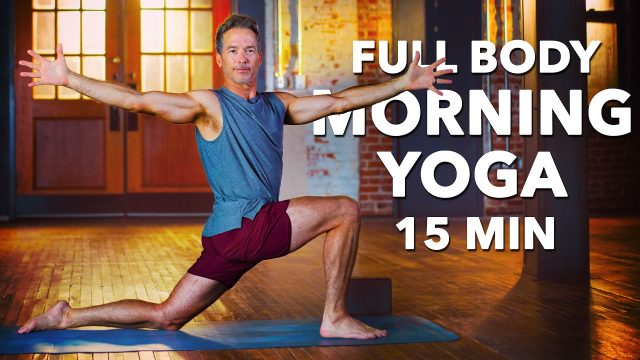
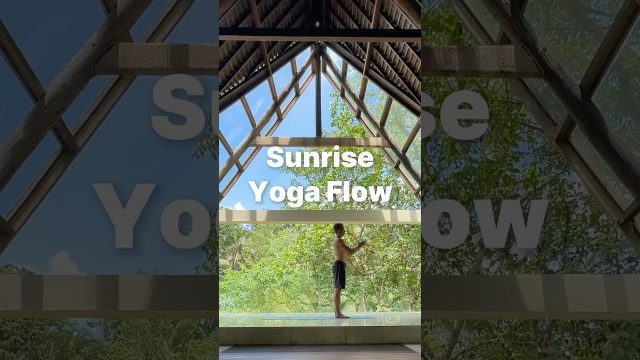
This kind of practice represents a shift in how contemporary yoga addresses what many practitioners crave: not the slow, meditative yin sequences that fill evening wind-down slots, but a dynamic, full-body practice that generates momentum, clarity, and genuine physical transformation. The structure Travis Eliot teaches here—layering breath work with flowing asana sequences and moments of stillness—creates what many call a "power yoga" practice, though that term alone misses the depth of what's happening.
Before any movement, the practice begins with breath. Eliot introduces a technique right away: two sharp inhales through the nose, followed by one exhale through the mouth. This is not casual breathing. The double inhale creates a jolt of oxygen and activates the nervous system in a way that passive breathing cannot. It's the equivalent of waking up your whole system at once—telling your body that work is about to begin.
This breath pattern continues throughout the practice, though it shifts. Each inhale becomes a signal to expand, reach, lengthen. Each exhale becomes an invitation to fold inward, engage the core, consolidate energy. In yoga philosophy, this mirrors two complementary forces: "viana," the energy that expands and radiates outward, and "samana," the energy that consolidates and gathers inward. Rather than treating these as mystical concepts, Eliot links them directly to the mechanical and energetic reality of the practice. When you inhale and reach your limbs away from one another, viana is at work. When you exhale and round your spine or draw your knee toward your chest, samana activates. This is not poetry dressed as anatomy—it is anatomy described poetically, which is how embodied learning actually works.
The first real movement arrives almost immediately. From kneeling, students move to tabletop (all fours), where the first standing sequence begins. Here, Eliot cues a fundamental pattern: lift one leg parallel to the mat while extending the opposite arm straight forward, as if shaking someone's hand. Then, in rhythm with the breath, the limbs stretch away from the body on the inhale, and on the exhale, the elbow and knee curl toward each other at the center of the body.
This simple-sounding movement is actually deceptive in its demand. The core must work constantly to manage the limbs' weight and momentum. The breath becomes the metronome that prevents the movement from becoming rote or rushed. Eliot performs this pattern on both sides, then transitions into plank, the upper-body-strength foundation of nearly every power yoga sequence.
What makes this practice "power" yoga is what happens next: the vinyasa, the Sanskrit term for a flowing sequence that links movement to breath in a specific, athletic way. From plank, the body lowers down with intention. Eliot cues "shift the weight forward as you exhale lower down with upper body strength," which means no collapsing—the body descends as one unit, with the elbows hugging the ribs and the shoulders staying engaged. This is not a relaxed descent; it demands serious upper-body awareness.
What follows is a micro-flow: a move called "open the heart" in which the torso lifts (either cobra or upward dog), the chest peels open, and the body rotates slightly to each side before returning to center and pressing back to downward-facing dog. The dog is not simply a resting position—it's an active pose where students are cued to "walk the dog," pedaling one heel down toward the ground at a time. Eliot notes the practical benefit: this mobilizes the calves and heels, keeping the plantar fascia limber. What could have been glossed over as a simple stretch becomes a moment of genuine physical attention.
The practice then transitions to standing sequences, beginning with chair pose. The cue here is crucial: "squat back into those hips" rather than leaning the torso forward. This distinction fundamentally changes the demand on the quadriceps and glutes. From chair, the arms reach up, then sweep side to side in a controlled, breath-linked motion. The practice builds heat and engagement gradually, refusing to skip steps or shortcuts.
When warrior poses arrive—first the foundational warrior two, then variations—Eliot introduces a teaching that elevates the entire practice beyond choreography. He pauses and says: "The form is just half the equation. You support the form with the formless. Your breath. Your awareness. Your presence. And those two that come together, this is when we start to find more advanced variations of yoga."
This is not a throwaway comment. It's the philosophical spine of the whole practice. Many students chase the shape—the perfect warrior two alignment, the deepest twist. But Eliot redirects them toward the invisible architecture that actually makes the pose work: the continuous connection to breath, the moment-to-moment awareness of sensation, the willingness to meet your physical edges with gentleness rather than aggression. He even introduces the Sanskrit term "dharana"—concentrated focus—and notes that it is the "launching pad into dhyana, or meditation." In other words, when you stop chasing form and start linking movement to present-moment awareness, you are no longer simply exercising. You are meditating in motion.
Once the foundational movements and principles are established, the practice shifts into continuous flow. Eliot invites students to "breathe and flow" with him, and what emerges is a seamless thread of movement: downward dog to forward fold to chair pose, side sweeps, then a step or jump back to plank, a vinyasa, rising to crescent pose (warrior one), then warrior two, and reverse warrior before the vinyasa flows back down. This repeats on the second side.
The beauty of this structure is that by this point, the body already understands the vocabulary. There is no jarring transition from new cue to new cue. Instead, the student can surrender to rhythm and breath, allowing the body to flow while the mind settles into the present moment. This is exactly what yoga, at its best, offers: a tool for bringing the racing mind into alignment with the moving body.
The title of this practice—"Energizing Power Yoga"—may sound like marketing language, but it describes a genuine physiological shift. Twenty minutes of continuous movement, particularly when linked to intentional breath work, increases circulation, elevates heart rate, and mobilizes the nervous system in an activating rather than calming direction. For someone who wakes sluggish, sits at a desk all day, or needs a midday reset, this kind of practice is not aspirational; it's practical medicine.
What distinguishes this approach from mere cardio or strength training is the insistence on staying connected to the breath and the body throughout. Many fitness practices demand that you ignore discomfort, push through sensation, disconnect from the present moment in pursuit of a future outcome. This yoga practice does the opposite: it asks you to inhabit each moment fully, to let the breath guide intensity, and to regard your physical edges as information rather than obstacles. Over time, this teaches a whole different way of relating to the body—not as an object to be conquered, but as an intelligent, responsive partner in your own healing and growth.
If you've completed this 20-minute flow, the natural next step is to build consistency. A single practice is a beginning; a weekly or daily practice becomes transformative. Inner Dimension Yoga offers full-length programs in power yoga, yin yoga, meditation, and breath work, as well as curated calendars designed to give you clarity about what practice to do on any given day. For those interested in deepening their understanding of the philosophy underlying these movements, teacher trainings at the Academy level provide both the anatomical knowledge and the yogic philosophy that explain not just the "how" but the "why" of practice.
The real invitation here is to notice what shifts in your body and mind after a few weeks of regular practice. Does your breath feel longer? Is your mind steadier? Can you access this sense of grounded power and clarity in moments outside the practice? These are the signs that the practice is working—not in some abstract sense, but in the concrete reality of your daily life.