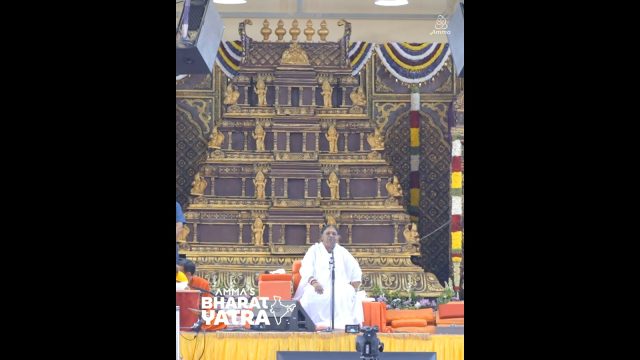
Bengaluru earned its name—the garden city—for the ancient trees that shade its busy roads, some standing for more than three centuries. But in November 2026, the city became something else: a gathering place for thousands seeking not botanical solace, but human connection. After seven years away, a spiritual teacher and humanitarian had returned home to her children, and the city's restless energy—the hallmark of India's Silicon Valley, where young people chase high-tech careers far from family—would pause to remember what matters most.
The occasion was the Brahmasthanam Festival, a two-day event held November 6–7, 2026, in honor of Amma (Mata Amritanandamayi). Welcomed with traditional Purna Kumbham ritual, Bharatanatyam, and Yakshagana performances, the festival would become a living expression of a single guiding principle: compassion is not a luxury—it is a necessity.
The Brahmasthanam, the ashram's inner sanctum, stood as a powerful vessel for subtle connection. Through ancient rituals performed with care, it became a still center in a city built on perpetual motion. Thousands moved through darshan—the sacred practice of receiving blessings in Amma's presence—one by one through the night. Some came with tears. Others with smiles. Many sat in silence, needing only a moment of her gaze to feel seen.
In her benedictory address, Amma spoke plainly: "Compassion is a necessity, not a luxury." The statement cut to the heart of the festival's design. It was not an appeal to generosity or a call to feel good about giving. It was a diagnosis: humanity must recognize the suffering of others and act in selfless service to all living beings—not as an occasional virtue, but as a foundational responsibility. At the same time, she challenged her audience to acknowledge that humankind must take responsibility for its mistakes—the choices that have led to poverty, war, and the destruction of the natural world.
The word "Amma" means mother, but the title earned substance through action. In 2009, severe cloudbursts along the Krishna River basin caused unprecedented flooding across northern Karnataka. Whole villages were swept away. Amma's response was immediate: a 50-crore relief package delivering medical care, food, basic supplies, and temporary shelter. The work did not stop there.
Monks and volunteers traveled to Raichur district, to an isolated island that aid organizations had not reached, where hundreds of survivors waited. Rather than simply rebuild, the initiative hired survivors to take part in construction—offering them work, wages, and restoration of agency. The first 100 houses stood in less than 30 days. By the conclusion of the project, 1,000 new homes had been built on the mainland, elevated high enough to protect against future flooding yet close enough to the river to serve as a water source.
This was not charity framed as benevolence. It was infrastructure rooted in dignity and rooted in the understanding that compassion without structure is sentiment, while compassion without respect is control. The lesson—that aid must honor the agency of those receiving it—would echo through the Bengaluru festival a generation later.
Karnataka's Chief Minister D. K. Shivakumar attended the festival as chief guest, offering his respects and testifying to Amma's "universal humanitarian initiatives that uplift society without any distinction of caste or religion." During the program, families received certificates and financial aid for life-saving treatments at Amrita Hospital in Kochi. The hospital's most visible mission: free heart surgery for children born with cardiac defects.
The scale is staggering. Across India, more than 200,000 children are born each year with a heart defect. For the vast majority, surgery is economically unreachable. Through Amritashri—a dedicated initiative—the hospital has reached out across the country, offering a second chance to children whose families would otherwise watch their condition worsen without remedy. At the Bengaluru festival, families stepped forward to receive not only the gift of surgery but the promise that someone would carry them through it.
Then the women came forward. Hundreds of them from villages across Karnataka—members of AmritaSREE self-help groups (SHGs). Each received a sari from Amma's hands. A sari is a small thing. What it represents is not.
Since 2005, in village after village, women in these groups have learned to save together, to borrow together, and to earn with their own hands. Each SHG receives annual seed funding; each member receives personal financial support. The model is simple and radical: economic dignity emerges not from charity but from the formation of networks where women hold one another accountable and reinforce one another's power. Today, there are 250,000 members organized in 15,000 self-help groups throughout India.
The sari, then, was both recognition and invitation—a visible marker that these women's work is seen, their autonomy honored, and their economic agency essential to the flourishing of their families and villages.
Not all of the festival's work was directed toward immediate relief. AYUDH—Amma's youth volunteers—led a collective anti-drug pledge, mobilizing young people to commit to building a drug-free India. The pledge was accompanied by anti-drug awareness performances and classical dances, transforming prevention into an embodied practice, one that the city's police commissioner, S. Mant Kumar Singh, witnessed firsthand.
"In all fields," he reflected afterward, "not only from religious but social, economic—in every aspect of life, she has touched human beings not only in India but everywhere in the world. I wish that whatever Amma is preaching, whatever Amma is telling, even if 1% we imbibe, certainly the world will be a better place to live in."
The comment reveals something essential: the festival was not presented as a spectacle of benevolence for observers to admire from a distance. It invited participation. The police commissioner, the Chief Minister, the beneficiaries of surgery, the members of self-help groups, the students and teachers who performed Yakshagana in the late hours of the night—all were woven into a single fabric of action. The message was clear: compassion is not performed by the exceptional few. It is a necessity that calls all of us.
In the early hours of the morning after the festival's second day, the buses turned toward Hyderabad, the next city on Bharata Yatra 2026. The garden city's flowers, touched by unconditional love, would begin to bloom in the work their communities would carry forward. Behind it all, as the documentation noted, was quiet seva—food for everyone, a medical post to one side, the unglamorous machinery of care operating without fanfare.
This is the architecture of Amma's approach: compassion is reframed as necessity, not luxury; service is offered through structures that honor dignity; and the work continues not because a single extraordinary figure demands it, but because ordinary people, reminded of their own capacity, choose to tend to the world around them.
If you're interested in understanding how spiritual teaching translates into systematic social change, explore the history of self-help groups and their role in economic empowerment. The model that AmritaSREE employs—combining seed funding with peer accountability—has roots in microfinance movements and cooperative economics. Learning how Amma's initiatives coordinate relief work (like the 2009 Karnataka floods response) with long-term capacity building offers a template for thinking about compassion as infrastructure, not sentiment. Consider also the role of youth organizations like AYUDH in translating spiritual values into prevention work and community action. And if the idea of darshan—the practice of receiving blessings in a teacher's presence—resonates, explore how different spiritual traditions use direct encounter to awaken compassion in the person receiving it.