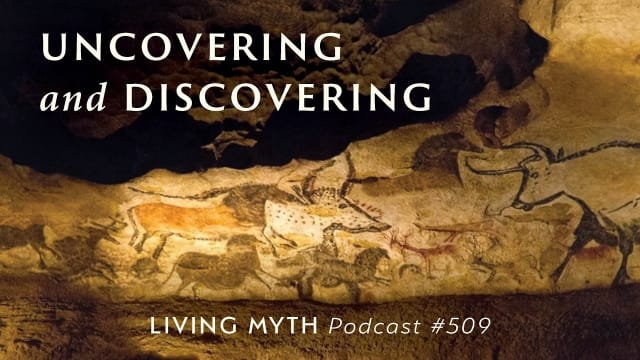
The world we built on the first arc—achievement, aggression, accumulation—is breaking down. It is no longer equipped to meet the crises that now define our time: climate collapse, fractured truth, divisions so deep they feel civilizational. And yet the culture has not yet learned to build from anywhere else. This is the central tension Michael Meade names in this episode of Living Myth, and it frames a reawakening that may be the only resource we have left.
The idea of the two arcs is not new. It emerges from an old imagination of human life that pre-dates both modern materialism and mass technology. What is urgent about this moment is that the second arc—the inward path of spiritual and soul awakening—has been systematically neglected by a culture obsessed with the externals of the first arc, and now that first arc is collapsing under its own contradictions. The question becomes: Can we awaken to the second arc before the entire structure of meaning falls away?
The first arc describes the journey outward into the world. It begins with the first breath and traces the developmental curve of growing up, entering careers, building relationships, establishing status and security in the common world. This arc is fundamentally about *becoming*—becoming educated, employed, married, established. Its energies are oriented toward external achievement and the accumulation of things the world recognizes: money, position, recognition, power.
"A shockingly high proportion of energy in American life goes towards the first arc and its aims of achievement, aggression, and accumulation," Meade observes. This has been the dominant cultural narrative for centuries, especially in the West. Schools, institutions, families, and media all align to push individuals along this path. The first arc has its integrity and necessity—humans do need to grow into functional adults and participate in the world.
But the first arc is only half the story. The second arc bends inward. This is the path through which a person awakens to their inner life, develops a deeper sense of spirit and soul, and encounters what Meade calls "eternal matters" rather than external ones. Where the first arc asks "How do I succeed in the world?" the second arc asks "What is my life *for*? What is the unique spark of purpose planted within me? What am I truly called to become?"
The second arc has been described as a turning toward something greater than oneself. It involves facing the depth of one's own nature and discovering that this personal depth is secretly connected to the soul of the world itself. This is not mysticism divorced from daily life—it is the recognition that authentic living requires alignment with something deeper than ego-driven ambition.
What makes this moment historically significant is that the first arc's governing worldview—the belief that endless growth, technological domination, and narrow self-interest can sustain a civilization—has exhausted itself. The systems built on those foundations are visibly breaking down. The impending climate crisis, the penetrating loss of shared truth and meaning, the fracturing of social bonds, the rise of algorithmic control and mass surveillance—these are not bugs in the first-arc system. They are its logical endpoint.
"The world that was built with those energies in it, is really the world that we have already left behind," Meade says. What he means is that the conditions that allowed the first arc to seem sufficient have vanished. We can no longer ignore the costs. We can no longer pretend that individual success in a dying world is meaningful success.
Yet the culture has no coherent alternative. We continue to push people toward first-arc achievement even as the first arc itself becomes unstable. Schools still train for jobs that may not exist. Parents still measure worth by external markers. The institutions that organize society are still run by people who believe that more of the same—more growth, more technology, more control—will solve problems created by exactly that approach.
This is where the breakdown becomes cultural crisis. Without a living connection to the second arc, without a framework that teaches people to cultivate their inner life and soul purpose, a society becomes hollow. It has the machinery of civilization but not its meaning.
Meade makes a striking claim: when a situation begins to feel like a matter of life and death—and our time increasingly does—the underlying soul is actually close at hand and trying to get our attention. The troubles we face are not simply obstacles to progress. They are, in a sense, invitations. They are the soul's way of calling us toward something more true than what we have been living.
This reframes how we understand obstacles and loss. "When seen from the deeper view of the soul, the challenges and the obstacles we face in life are not simply roadblocks intended to stop our progress altogether. They are more like detours intended to lead us to places of genuine change and growth." A job lost, a relationship ended, a dream deferred, a world in crisis—these are the scraping and pulling forces that can loosen the grip of the small self so that we might awaken to a greater sense of who we actually are.
The gestation period for this kind of awakening is as long as it needs to be. We have to realize, Meade suggests, that we are "carrying corpses from earlier phases in our life" and are often asleep to the things trying to awaken within us. Typically, our inner world must feel stuck or overwhelmed before we can access the life-saving, world-renewing energies natural to our souls. This is not comfortable. It is not what the first arc teaches us to pursue. But it is real.
This is where the argument turns from personal to collective. Meade is not suggesting that the second arc is a luxury for the spiritually inclined or a retreat from the world's troubles. Rather, he makes the case that individual soul-awakening is essential for the survival and health of a culture itself.
The word "culture" comes from the same roots as "cultivation." A meaningful society does not simply provide material security for its people. It creates the conditions in which the inner seeds of life in people can be cultivated—where individuals can discover their own purpose, develop their unique gifts, and experience their lives as mattering. When culture loses this dimension, when it becomes purely transactional, it hollows out.
"The awakening of the individual soul to its inner sense of purpose and aim is essential for a meaningful society. For culture is made and it is remade in the space between the individual and the collective group." This is the precise point where personal and political become inseparable. A tyrant, a mob, a system of mass delusion can only gain dominion when individuals have lost faith in their own inner authority and meaning. What stands against tyranny, terror, and nihilism is the awakened individual—the person who has tasted the reality of their own soul and knows they are connected to something larger than any ideology.
Interestingly, Meade also names the shadow of this truth. The word "cult" comes from the same roots as "culture." A cult, however, is what happens when people surrender their individual awakening to a charismatic leader or a closed system of belief. They lose both personal responsibility and the sense that their individual life has inherent meaning. The antidote to this is not less spirituality but more authentic awakening—more people genuinely connected to their own souls and to the soul of the world, not borrowed consciousness channeled through a human intermediary.
If the first arc is breaking down and the second arc is essential, where does the new worldview come from? Not from the collapsing first arc itself, Meade argues. "A new world view cannot arise from the collapsing of the first arc of life as we have historically known it. It has to arise from the creative side of life, from the deeper sense of life, from the creative levels of the human soul, which are secretly tied to the soul of the world."
This is not abstract poetry. The creative levels of the human soul are where imagination lives—not fantasy, but the capacity to perceive and envision possibilities beyond what the present moment seems to allow. It is the realm of art, music, myth, dream, genuine innovation born from authentic need rather than market demand. When everything seems to be falling apart, the inner arc of imagination and creativity becomes not a luxury but a lifeline.
Meade describes our moment as "betwixt and between a falling arc of imagination or view of life, and a new creative arc that's trying to be born out of the struggle, out of the conflicts, out of the sense of loss, out of the need for renewal." The old story is dying. The new story is being born. And we are living in the labor of that birth.
The second arc inevitably involves what Meade calls "little deaths"—the death of old identities, old certainties, old ways of being. It is not a smooth upgrade. Both the individual and the collective must face inner obstacles if a greater sense of life is to be born. This is the nature of genuine transformation: something must end so that something truer can begin.
The common confusion is that this process is optional or pathological—that we should be able to reach fulfillment while keeping everything we have already built intact. But that is not how transformation works. "Because we are complex and potentially conscious beings, the individual project of our lives involves more than one arc of existence." We cannot simply add spiritual awakening to a life constructed entirely on first-arc principles and expect the system to hold. At some point, the second arc asks us to release, to let go, to die to what we thought we were.
This is why Meade speaks of times of loss and trouble as potentially closest to the soul. "Typically, we come to know our own souls when the chips are down. When there's nothing else to do but find a greater sense of self and a bigger imagination of the purpose and the meaning of both individual and collective lives." The external world's crises are not separate from inner spiritual crises. They are linked. The falling apart of the outer world can be the opening through which the inner world finally becomes real.
At the heart of this teaching is a conviction that each person carries something irreplaceable. Meade calls it the "divine spark seed of life" planted within us at birth. This is not earned. It is not granted by the culture or validated by achievement. It is simply ours, our original inheritance. The second arc of life is the process of awakening to this spark, learning its nature, and aligning our lives with what it requires.
This spark has its own aim, its own direction. Meade speaks of this as destiny—not fate (which is what happens to us), but destiny (what we are called to become). We must suffer the issues of the times and struggle with our own fate in order to learn the specific shape of the spark given to us. This is why spiritual awakening is not escape from the world's troubles. It is deepening into them, finding what in us is called forth by what is required of this time.
The practical question that emerges from this teaching is not "How do I escape the first arc?" but rather "How do I awaken to the second arc while still living in the world?" The answer is not retreat but integration. The goal is not to abandon external life but to live it in conscious alignment with inner purpose and soul calling. The second arc does not negate the first; it gives it meaning and direction.
If you recognize yourself in this teaching—if you sense that something deeper in you is calling for attention, if the external measures of success feel hollow, if the crises of the time are stirring something in you that wants to serve and create—then the second arc is not an abstract concept. It is your invitation. It begins, as Meade suggests, by allowing something timeless to break the spell of time, by connecting to the deep imagination and enduring stories that can reunite us with the pulse of nature and the heart of culture. The soul is always closer than we think. The question is simply whether we are ready to awaken to it.