Transcript
[0:39] Respected Mahāsaṅgha, venerable monks,
venerable nuns, hello everyone.
[0:51] How many of you here that understand the
word
[0:58] dukkha? Suffering,
[1:04] huh? Okay.
[1:10] So, that suffering, we understand all kind
of sufferings, right?
[1:16] And how many of you that actually
[1:22] can bear that suffering through your
[1:32] life.
[1:40] Are you the… Have you ever listened to my
talk, uh, during the
[1:46] Walk for Peace? Okay, so I guess, um, if
we are learning
[1:52] the Buddha teachings, we kind of
[1:58] know about the, um, suffering, which is
dukkha.
[2:03] But I don't think many of us that really
know how to manage
[2:09] it, know how to overcome it. That is why
we suffer
[2:15] so much, and there's so much chaos around
us and in this world.
[2:25] But there's one thing that all of us have,
but we don't know
[2:32] how to open it. We don't know how to use
it.
[2:37] Do you know what it is? Do
[2:43] you know what it is that you—all of us
have?
[2:47] But we don't know how to open it.
[2:51] We don't know how to use it.
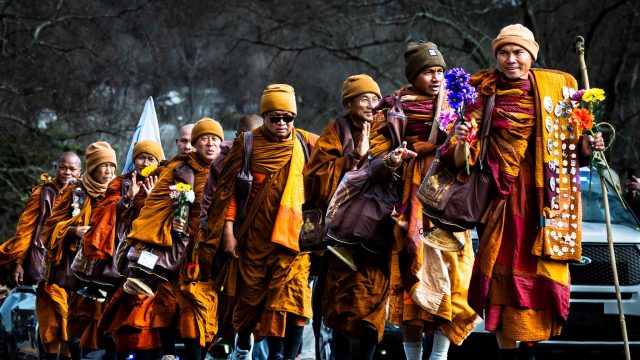
[2:56] The peace we carry within. Oh, it’s up
there: peace that we have.
[3:08] But how do we use it? We carry.
[3:12] When we say we carry it, we carry what?
[3:17] We've been carrying something in our life
for many years already.
[3:22] We carry all kind of suffering.
[3:27] While peace is already there, how come we
cannot use it?
[3:32] How come we don't know how to take it out
and use it?
[3:38] Is it because we never pay attention to
it?
[3:41] Because we don't think that we are capable
of having a peaceful life.
[3:54] See, we have all kind of doubts.
[3:57] We have a lot of things in our life that
we are able to
[4:03] make our life better, but we don't—we have
never, or we don't
[4:09] even try to live a better life, so that we
become a victims
[4:15] of all the problems around us and in this
world.
[4:21] Whatever happened out there is affect us.
[4:30] And the more the world is advancing
technologies, the worse we will become.
[4:39] Do you believe in that? Why do
[4:45] I say that? It's because we are always
chasing.
[4:52] We always chasing the world.
[4:56] As I always say, this world is spinning,
everything are spinning, and we
[5:02] are human being. We also spinning after
that.
[5:07] We are trying to chase after the world
because we
[5:13] afraid that we will be left behind.
[5:19] And so every morning you rush out your
door.
[5:24] You rush out to your car, you rush to
work.
[5:30] And then you work, you rush to finish your
job.
[5:35] And then you rush for lunch. You rush to
work
[5:41] again. You rush to go home. You rush to
cook.
[5:46] You rush to take a bath. And then you rush
to clean up, and then
[5:52] rush to bed.
[5:53] We repeatedly doing this every single day.
[5:58] Every single day we rush like this.
[6:01] So how many of us that really take time to
[6:07] reflect, take time to slow down?
[6:17] We continue chasing, and we continue
rushing and rushing every single day.
[6:22] We rush to do everything. We rush to eat.
[6:25] We rush to sleep, and then we rush to—to
funeral,
[6:33] end of this life. And then we start
another life.
[6:38] We start to rush again. We rush
[6:44] to born, waited inside of the mother's
womb for nine months and
[6:50] ten days. And then when we out, we cry, “I
have had long enough.
[6:56] I suffer so much inside of that mother's
womb.
[7:00] Now I'm already out. I going to rush
myself to die—to
[7:07] death again.”
[7:08] Then we repeat our life just like that
every single life.
[7:13] So what do we learn? We experience all
kind of suffering in our
[7:19] daily life within our head.
[7:28] But do we really see that we are suffer
within our head?
[7:32] Just within our head. I'm not talking
about anything else.
[7:35] Just within our head, which means our
thoughts.
[7:42] How many of us that still live with all
those things that happen
[7:48] like ten years ago? How many of you still
[7:54] struggle because what happened yesterday,
and a week
[8:00] ago, a month ago, or even before you
arrived here,
[8:07] because of your family members, your loved
ones, your job, someone that bump
[8:13] into you, someone that saying something
that hurts?
[8:19] We still live with those, isn't…?
[8:26] We live with all those.
[8:30] We afraid when we let go of all those, we
have nothing else
[8:36] to hold. That's why we always hold it
tight.
[8:41] And ask yourself, is it tired?
[8:44] Are you tired of holding it so tight?
[8:50] Because the more you holding it tight, the
more you be exhausted.
[8:58] We didn't realize that.
[9:02] So once we experience some type of
suffering, then you try to stand up again
[9:08] and walk away. And then you enjoy.
[9:11] You forgot about those days that you
[9:19] already suffer so much about it.
[9:22] And here again, you work the way to go
back to those old
[9:28] days again and make the same mistake over
and over.
[9:33] And then when so much—too much in our
[9:40] life that we cannot bear those feelings
anymore, then we react
[9:48] so badly that we hurt ourself even more.
[9:55] But we didn't realize. So what is peace?
[10:03] Peace is something that you will be
relaxed.
[10:07] You feel happy. You enjoy your moment.
[10:10] You don't feel any type of burden.
[10:14] You don't feel any type of suffering.
[10:17] Peace is something that you can stay
within for at least a moment.
[10:24] Peace is something that you can see your
suffering, but you are not
[10:30] suffering.
[10:37] Earlier, when the interview, there's a
question asked me: the peace that in
[10:43] all Buddha teaching is about Parinibbāna
versus the peace in social harmony.
[10:49] And I said, without the peace in social
harmony, there's no Parinibbāna peace.
[10:57] If you cannot have a peaceful day, don't
expect a Parinibbāna peace.
[11:06] In order for you to get something bigger,
you always start with something
[11:12] smaller. When we don't know how to run,
don't run.
[11:18] We need to learn how to crawl first, learn
how to stand up first, and then we
[11:24] learn how to walk. After that, we can run.
[11:27] But many of us, we don't want to do that.
[11:31] We want to run. We want everything to be
fast.
[11:36] As I always say, because we eat so much
fast food.
[11:43] That's why we always wanted
some—everything fast.
[11:49] And so, what if—what if you can just slow
down?
[11:58] What will you see if you slow down?
[12:06] How many of you that see your breath?
[12:16] Nobody. Well, I
[12:22] have to ask you this question because it's
very serious.
[12:27] Without this breath, will you still alive?
[12:34] No, right? We would die.
[12:37] This breath stay with us for many years of
until now.
[12:42] Never leaves you, isn't it? The shadow
will
[12:48] leaves you when there's no light, no sun.
[12:51] But this breath will not never leave you,
even when you go to
[12:57] bed to go to sleep. But how many of you
[13:03] actually see your breath? Or you just
breathe like a robot,
[13:09] like a machine.
[13:17] And of course, we breathe like a machine.
[13:21] We never pay attention to our breath.
[13:24] We—you never know that your breath is
short or long.
[13:30] You just breathe, and sometimes you can't
even catch up with it.
[13:36] Is that true? Everything will
[13:42] leaves us because of impermanence.
[13:47] But one thing that will follow you from
the beginning into the end,
[13:53] which is your breath. But you never take
care of it.
[13:59] Sadly, you never take care of it is
because you never pay attention
[14:05] to it. Because we always rush doing
everything else, taking care
[14:11] of this outer body without taking care of
the inner body.
[14:20] We feed this body with food and all kind
of high-quality food
[14:26] and high protein and all those things.
[14:29] At the end, everything come out the same,
and same smell.
[14:37] Is that right?
[14:39] But something in the body, which is what
really need in
[14:47] this life, yet we never pay attention.
[14:54] So how do we have peace? How can we have
peace
[15:00] when we are not paying attention to what
happen in—within our breath?
[15:06] You know, in—I went to Bhutan for the 108
projects, that invited
[15:12] by the King of Bhutan. So I arrive
[15:18] here from Bhutan. The first time ever that
I travel, and I had
[15:24] to admit to the, uh, hospital for
emergency because of my lung and
[15:31] my heart. And some—I experience short of
breath.
[15:39] That is when—that I already experience
before the walk.
[15:44] Without this breath, we suffer so much.
[15:48] And when we fight for it, that is when you
value your breath
[15:54] so much.
[15:56] In United States, when I admitted to the
emergency, they put, you know, machine,
[16:01] and they put tubes into my mouth, my nose.
[16:04] That is when I suffer so much.
[16:09] And I know this breath is so valuable that
without it we will die.
[16:15] We don't have this life anymore.
[16:17] Of course, I know all this, but then I
experience it within this body when I'm
[16:23] in the hospital. And so in Bhutan, the
same, admitted to emergency, and that
[16:29] is how I experience.
[16:33] And I started to think about people.
[16:36] If all the people in this world continue
fighting, continue chasing,
[16:42] while there's something so meaningful
[16:49] for their life and they still not care to
check, to work, to
[16:55] live with it, which is this breath, then
it's so
[17:01] sad. And because of that, that is why
[17:07] so much chaos going on in this world,
because we are careless about
[17:13] this inner body, which is our breath, our
mind.
[17:19] The more we chase in the outside world,
the worse we will be.
[17:27] Of course, we will have materials.
[17:30] We will get a lot of materials.
[17:33] But what about our inner—inner body, which
is our mind?
[17:38] We go out of our ways a lot. Earlier I
mention just our
[17:43] thoughts. How many of
[17:49] us that actually can manage the thoughts
when pop up?
[17:56] Do you see your monkey mind? How does that
monkey react?
[18:06] How it works? That monkeys keep on jumping
back and forth,
[18:12] here and there, from this branch to
another branch, isn't it?
[18:16] And then just one thought, one simple
thought.
[18:21] When that monkey arrives, and it adds a
lot of flowers, a lot of
[18:28] fruits, a lot of juices, a lot of things
into it.
[18:33] When just one simple thought pop up, our
minds start to add more ingredients
[18:39] into it.
[18:42] One thought, and then we following that
thought from
[18:49] the beginning until the end, and then
another thought take place.
[18:54] We follow that thought again, follow it
again and again and again.
[18:59] At the end, we have nothing. I always
refer to the monkey when
[19:06] enter into the cornfield. When the monkey
enter into the cornfield,
[19:12] the monkey grab this corn, stick it here,
and use his left hand, grab that corn,
[19:18] stick it here. Keep doing this.
[19:20] When the monkey get out of that cornfield,
the whole field damage.
[19:26] The monkey only have two corn in his
hands.
[19:32] Our minds are the same. We grab
everything.
[19:40] We grab every little thing, even a very
minor thing that your friend or your
[19:46] family—family member do or say.
[19:49] You grab it and you insert in it.
[19:52] You recorded it and you live with it.
[19:56] End up with just suffering, nothing else.
[20:01] So the monkey is like that. Our mind is
the monkey, cannot stay
[20:07] still. So when the mind is working
constantly
[20:13] and continuously without stopping, how can
we live peacefully?
[20:24] Do you know how can we live peacefully?
[20:28] It's hard, isn't it? What if—what if
[20:34] we let go of everything for a moment and
breathe?
[20:44] How many of you already practice
meditation?
[20:49] Okay. A lot of us here practice
meditation.
[20:53] What method, may I ask? Through your
breath, or ānāpānasati?
[20:59] Loving-kindness. Samādhi, samādhi.
[21:03] Okay, so we have different kind of methods
[21:11] we practice, right? Doesn't matter what
method we practice,
[21:18] thoughts always there, isn't…?
[21:20] So when the thought pop, what do…?
[21:25] Let go, huh? Observe. Observe.
[21:32] Within one hour of meditation, how
[21:40] much time that you are able to observe and
let go
[21:46] of that thought, of those thoughts?
[21:51] — Not so much. — Maybe a minute or two.
[21:57] And then we add ingredient into it.
[22:00] And then we sit in there and paint the
whole life, right?
[22:05] Just one thing. And then we add colors
into it.
[22:09] We add flowers, we add all kind of thing
into that painting.
[22:13] And then when the bell hit, one hour
finished, we open our eyes.
[22:18] “Oh, that is so wonderful meditation,”
with all kind of thoughts.
[22:26] “I finished my painting, a wonderful
painting of my life.”
[22:31] That's how we meditate. How wonderful.
[22:39] And so how do we manage it? How do we
focus and concentrate?
[22:45] And how do we observe the thought and let
it go?
[22:51] Is because a lot of the time you see all
those as your
[22:57] relatives. You don't see them as your
guest.
[23:05] If you see those thoughts, those problems
as your relatives,
[23:13] it means you will interact with it long.
[23:20] But if you only see them as your guest,
and you don't interact with so much,
[23:26] after you talking with your guest, they
have to leave your house, isn't it?
[23:31] They can't stay with you. But your family
members have to stay with you.
[23:37] So if you see all those thought as your
guest, mean
[23:43] they comes and goes, then you be fine.
[23:49] But no, we don't want to see them as
guest.
[23:53] You want to serve them tea. You want to
serve them biscuit, all kind
[23:59] of cheese, a lot of things.
[24:05] That is why we suffer.
[24:12] And yet peace is already with us, but we
locked it up.
[24:18] You put them in a box, you lock it up.
[24:24] Never know how to open it and use it.
[24:28] You probably already lost your key.
[24:34] And so now, mindfulness is a key.
[24:40] Mindfulness is a key to open that box to
feel peace that you've
[24:46] been carrying with you for many years.
[24:54] And mindfulness is something that is so
simple, that you mindful with your
[25:00] thought, you mindful with your speech, you
mindful with your actions.
[25:05] And in order for you to be mindful, you
have to slow down.
[25:13] Learn how to crawl. Learn how to walk.
[25:16] Learn how to stand up and walk, and then
run later.
[25:21] Because we are not slowing down, that's
why we cannot see.
[25:26] Same thing when you walk through your
neighbors, when you drive through your
[25:32] neighbors, you see just house.
[25:35] You only see house. You see nothing.
[25:39] But when you take your time and enjoy your
walk in your neighbors, you would
[25:45] see a lot more things. So when you slow
down, you can see
[25:51] your breath. You can see what's going on
inside.
[25:59] But that's not it. You have to take time
to
[26:05] practice every single day in order for you
to free peace and open
[26:11] it up and free it. Live this life to
[26:17] practice mindfulness, to know what you
doing, what you thinking, and what
[26:23] you say. Otherwise we gonna repeat ourself
[26:29] from mistake, and we going to put ourself
into suffering every single time.
[26:39] So mindfulness is through your breath.
[26:43] Right here, that earlier that I mentioned,
we never pay attention to this
[26:49] while it's already here. Never leaves you,
and it's still going
[26:55] to be with you until our last moment.
[27:02] Then that's it. Move to the next life.
[27:05] But for right now, it's still with you.
[27:08] Why can't we take care of it? Why can't we
live with it?
[27:17] If we can just take our time, focus on our
nostril when seeing the
[27:23] breath going out and going in, just
passing through this nostril.
[27:28] And then when thought pop up, we just
observe the thought without interacting
[27:34] with it. And then another
[27:40] monkey pop up. You observe it, knowing it,
continue
[27:46] with your breath, and it will gone—be
gone, disappear by itself.
[27:54] That is how we practice.
[27:57] But there's something more, even bigger,
that all of us are in a
[28:03] big danger that we are not aware
[28:09] of. Do you know what it is? Your daily
activities.
[28:17] You multitasking yourself every single
day.
[28:24] Multitask. You read, and your lover is
right on this table.
[28:32] You know who is your lovers? Your
cellphone.
[28:39] Go to the bathroom, you bring your lover
with you.
[28:44] You eat, you have your lover with you.
[28:48] Everything, you have your lover by your
side.
[28:51] And then when you go to sleep, your
partner is right there, but you live with
[28:56] your lover, isn't it?
[28:57] When you wake up in the middle of
[29:03] the night, what happen?
[29:09] You reach for your lover, which is your
phone, and surf the internet,
[29:15] and check to see who commented your status
overnight.
[29:20] That's how we live our life, and we
depends on it.
[29:29] How many phone numbers that you actually
remember by heart now?
[29:38] Four. Two. How many phone number
[29:44] that you remember by heart back then?
[29:47] A lot. A lot.
[30:02] We don’t use this anymore. We don’t use
this anymore.
[30:04] We use technologies and depend on it.
[30:08] How many of you already call the internet
company and complain and shout
[30:14] at them when the internet went down?
[30:21] You cannot live without it, isn't it?
[30:26] This is how we live. We sidetrack, we
multitask.
[30:33] When we say mindfulness, we eat, but we
talk.
[30:36] We eat, but we watch and we listen at the
same time.
[30:40] When we read, when we do some work, yes,
your phone is right there, and it's
[30:46] messaging come in. Somebody call in, and
then you pick up the phone.
[30:51] Now you forgot about what you've been
doing.
[30:54] When you go shower, you turn on the music.
[30:59] So who is showering and who is listening
to the music?
[31:06] When we focus here, it means that we are
not focusing putting soap on
[31:12] our body, isn't it? Even when you wash
dishes and when
[31:18] you cook, you still listen and watch.
[31:21] How can we have a peaceful day when we
always sidetrack like that?
[31:30] And then when we go online, supposed to
have a peaceful day, when we go online,
[31:35] we see all kind of news and a lot of
problem online.
[31:39] And then we react. When we react, we
suffer.
[31:45] We create problem for ourself.
[31:47] That's how we live.
[31:53] But what if? What if you just doing only
one thing
[31:59] at the time without multitasking yourself?
[32:01] Only one thing at a time. Would
[32:07] that change? It will be a big change for
you because
[32:13] that's how we train ourself. That is how
we focus.
[32:18] That is how we concentrate. Change the old
habit to
[32:24] a new habit.
[32:29] But in order for us to do all that, you
have to be mindful.
[32:33] When you are rushing, you cannot remember.
[32:37] That's why you need to slow down to train
yourself again from the
[32:43] baby, like a baby. Train it from there and
go up.
[32:48] Whenever you are cooking and you about to
turn on the music, or you about
[32:53] to turn on the YouTube to watch, remind
yourself, “Oh, I am cooking.”
[33:03] When you're eating, you turn on something
to listen, to watch: “Oh, I
[33:09] am eating.” That's how we train ourselves
little by little.
[33:15] But if we don't pay attention to it, if
you don't want to change, you don't want
[33:20] to make a determination for yourself that
“I need to change myself to have a
[33:25] peaceful day, peaceful life,” then you
will repeat yourself like that every
[33:30] single day until the end of this life.
[33:36] So, peace is already there with us.
[33:39] We carry it for a long time. All we need
to do is
[33:46] just free it by practicing mindfulness.
[33:49] Do not multitask. One thing at a time.
[33:53] See your breath, practicing mindfulness,
breathing, or even walking, even doing
[33:58] your thing.
[34:03] And the only one thing that I suggest and
I ask everyone to go
[34:09] to do, which is the peace that I share
every time, everywhere I
[34:15] go for the Walk for Peace from Texas to
Washington, in
[34:21] United States and in Sri Lanka, that I say
every night
[34:28] before we go to bed, with the old habit,
we always surf the web,
[34:34] the social media, before we go to bed.
[34:37] Now, let's change. Keep your phone away
from you for an hour before
[34:43] bed. One hour before bed. You
[34:49] try it. When you watch something and you
see something that is suffering, you
[34:55] cannot go to sleep. You cannot put
yourself to sleep because the mind
[35:01] is wandering and keep on thinking about
it, right?
[35:06] So let it go for one hour before bed.
[35:12] Then go to sleep.
[35:14] When you wake up in the middle of the
night, it doesn't matter why you
[35:20] wake up, please don't touch your phone.
[35:23] If you cannot get back to sleep, just lie
in there, and then
[35:29] breathe. Focus on your breathing until you
fall asleep again.
[35:35] Then after that, when you wake up, the
first thing in the morning
[35:41] when you wake up, please don't grab your
phone again, okay?
[35:46] Don't grab your phone. Don't do anything
else.
[35:50] Just lie there, do some breathing, and
then get down.
[35:54] Get off your bed.
[35:56] How many of you, when you get off the bed
and leave the
[36:02] bed that way? Okay, it's messy.
[36:08] Now it need to change. Make your bed nice
and neat.
[36:13] This is how you train yourself mindfully
when you making your bed.
[36:22] Mindfully doing it. That's how you change,
how you practice mindfulness.
[36:28] Okay. Nice and neat. Go to the bathroom to
do your own
[36:34] business. Do you need to know what to do
in the bathroom?
[36:39] He shake his head. He say he need to know.
[36:44] Well, don't take your phone with you to
the bathroom for sure, okay?
[36:50] Instead of five minutes in that bathroom,
if you have your phone with you, you
[36:55] could spend a lot of time in there.
[36:57] Let's imagine today, these day, we have
2,500 guest here, participants here.
[37:03] How many bathroom we have? Not many,
right?
[37:07] Now, let me ask you one thing.
[37:12] Earlier I went to the bathroom.
[37:15] I saw it's fancy bathroom in the male
side.
[37:18] It has five toilets. I believe four or
five.
[37:23] Imagine five of us going in there, shut
the door,
[37:30] get your lover out and whispering with
your lover, checking all kind of
[37:36] social media and then sending text
messages.
[37:40] Sometime people talk, too. And I wonder
what the other side would hear
[37:46] about it. Some water dripping.
[37:49] Something going on. How can they talk that
way!
[37:51] But they do! They talk. But
[37:57] you don't know,
[38:03] many people are suffering outside waiting
for that toilet to do the
[38:10] same. “When is my turn?” That’s what—is my
turn.
[38:16] See? So instead of five minutes, we could
spend fifteen minutes in that toilet.
[38:22] For what?
[38:23] And if you are not mindful, you drop your
lover into that bowl.
[38:30] Now you have to spend money to buy a new
lover.
[38:37] But how—that's how we live. We continue
doing that.
[38:41] So go to the toilet, do your own thing,
and then come out.
[38:46] Now this is what you have to do here.
[38:50] Get a piece of paper and a pen.
[38:56] A piece of paper and a pen. Write out the
statement.
[39:01] Say, “Today is going to be my peaceful
day.
[39:05] Today is going to be my peaceful day.”
[39:08] Is because our mind is
[39:14] always chewing trash.
[39:21] We keep on chewing trash. Trash means all
those unhappy things, all
[39:27] those suffering things, all those
happening in our life.
[39:32] We keep on chewing it over and over.
[39:35] We live with it. So before we chew all
those trash again over
[39:41] and over, please rewire your mindset by
[39:47] writing down the statement. Say, “Today is
going to be my peaceful day.”
[39:53] Mindfully writing that down: “Today is
going to be my peaceful day.”
[39:58] After that, read it with your eyes.
[40:01] Eyes and mind pairing with each other.
[40:05] Mindfully reading it over and over: “Today
is going to be my peaceful day.
[40:11] Today is going to be my peaceful day.”
[40:14] Finally, read it out loud: “Today is going
to be my peaceful day,” to
[40:20] stated that to the universe that today is
my day.
[40:24] No one can mess it up except yourself.
[40:33] No one in this world could mess your day
up except yourself.
[40:39] You have to know this.
[40:43] After that, doing the meditation, the
breathing method, and then throughout your
[40:49] day, be mindful with everything you do.
[40:55] Be mindful with your thoughts, your
speech, and your action.
[41:02] Doing one thing at a time. Do not
multitask yourself anymore.
[41:07] That is how you live a peaceful day.
[41:10] That is how you carry peace within,
because if we don't prepare ourselves
[41:19] for the day, all kind of problem will
come, and when it comes,
[41:25] you react.
[41:30] I have to tell you that this world will
always
[41:34] throwing lemons and bitter melons and
rocks at
[41:40] you. They would never stop. And the more
you react, the happier
[41:46] they are. So instead of getting angry when
people
[41:52] throwing trash at you,
[41:58] throwing lemon and bitter melons and rocks
at you, do three things.
[42:03] If they throw lemons at you, make some
lemonades for yourself.
[42:08] Vitamin C.
[42:11] If they throw bitter melons at you, cook
it, consume it, because bitter
[42:17] melons cure diabetes. If they throwing
rocks at
[42:23] you, collect it, decorate your meditation
garden.
[42:29] Don't react, because the more you react,
the suffer you are and the happy they
[42:34] are. Just like when people trying to
tickle you,
[42:42] they laugh, right? You also laugh, isn't
it?
[42:46] But they laugh in an enjoyment—enjoy,
[42:52] but you are laughing in a suffering way,
isn't it?
[43:01] So why would we let ourselves suffer?
[43:04] It makes no sense. So
[43:10] don't react when the world is throwing
trash, lemons, bitter melons, and
[43:17] rocks at you. Instead, showing them
kindness,
[43:23] showing them that you are at peace.
[43:26] Once you live at peace, your family member
will be happy and also
[43:32] at peace. Imagine your partner would
never—would like to talk to you
[43:39] when you are angry, isn't it? But your
whole family would like
[43:45] to interact with you when you are smiling,
when you are kind.
[43:50] So peace is already with you. Please live
with it.
[43:55] Replace that suffering. Seeing sufferings
as bitter melons, lemons, rocks.
[44:03] Transform it into medicine, transform it
into juice, transform it into a—a
[44:09] garden instead of reacting with anger.
[44:12] Thank you so much, and may you all be
well, be happy, and be
[44:18] peaceful.
[44:21] Sādhu, sādhu, sādhu.