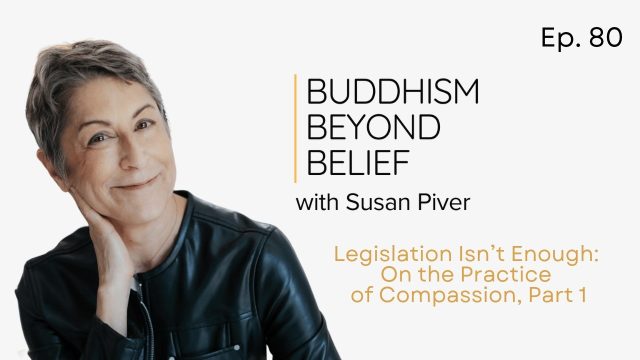
Compassion gets a lot of press in spiritual circles, and Buddhism is famously built around it. But there's a persistent misunderstanding about what compassion actually is. It isn't niceness. It isn't performing kindness or managing your feelings to seem caring. According to Buddhist teaching, compassion arises from a fundamentally different place: from being awake.
In the Buddhist lineage Susan Piver was trained in, compassion is understood as arising in two forms: relative and absolute. Relative compassion is the everyday version—caring about others' wellbeing, noticing when they're struggling, responding with something genuine rather than performed. But the foundation of that caring isn't sentiment; it's clarity.
Being awake means paying attention to what's actually happening—in yourself, in another person, in a situation—without the filter of what you think you're supposed to feel or do. From that place of genuine attention, you can choose to offer something or not. That choice, made from clarity rather than obligation, is compassion. Sometimes that offering looks soft. Sometimes, Piver notes, it looks fierce. What matters is that it comes from connection to reality, not from a script about how to be a good person.
This distinction matters because niceness often masks reality. It can smooth over real problems, avoid hard conversations, or protect the person being "nice" more than it helps the person receiving the gesture. True compassion might mean saying something difficult. It might mean setting a boundary. It might mean not engaging at all. The shape it takes depends entirely on what awakeness reveals to be true in that moment.
To explore the distinction between relative and absolute compassion more deeply, and to understand how softening toward yourself opens the door to genuine compassion for others, listen to Piver's full teachings on the topic in her podcast and dharma talks.