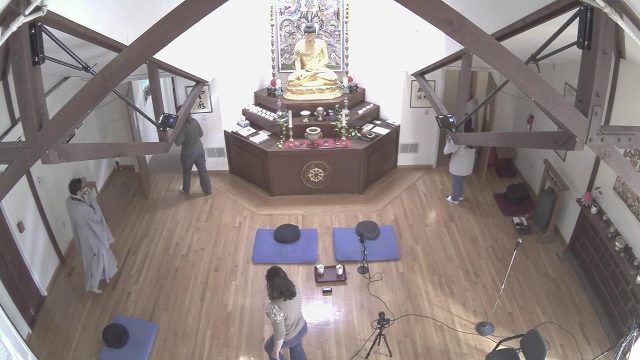
In a brief talk clip from Providence Zen Center, the teacher Kwan Haeng Poep Sa Nim retells an encounter with the Zen master Huang Po, who is recorded in the transcript as "Wang Po." A student has been asking which mind is the real one, the enlightened mind or the unenlightened mind. Huang Po answers that the very distinction is an illusion that hides the true self. The teacher then offers a practical redirection: rather than arguing over which mind is real, ask where this thinking comes from, or who is it that is thinking this. The whole clip runs about ninety seconds, but it packs a complete method of Zen questioning into a few sentences, and it is worth slowing down to hear what it is doing.
The story opens with a familiar kind of spiritual problem. Someone has been given a talk and asks the master about "this enlightened mind" and "this non-enlightened mind." The premise is that a person can become enlightened, and then the question becomes what happens to the ordinary mind that remains. It is a tidy, reasonable-sounding question, the kind a serious student asks after absorbing a few teachings. It assumes there are two minds on the table, and the only task left is to sort them and choose the correct one.
Huang Po does not sort them. In the teacher's telling, the questioner answers by pointing to a scripture, a book that says there is an enlightened mind and a non-enlightened mind. Huang Po, who is described as very educated and very well versed in the sutras, says the reader has misunderstood. In the teacher's words, the sutra "points to the fact that the enlightened mind and the non-enlightened mind are both illusions," and that they "cover your true self."
"That sutra points to the fact that the enlightened mind and the non-enlightened mind are both illusions and they cover the your basically cover your true self." (Kwan Haeng Poep Sa Nim, Providence Zen Center video, about 0:45)
The teacher adds a small, human detail: he sent that answer along to the person who had asked, and the person thanked him for it. The laughter in the recording suggests the story lands as a bit of Zen humor. A pointed correction is delivered, and it is received with gratitude, which is itself a reminder that the student's real problem was never a shortage of information.
The core of the teaching is that the question is built wrong from the start. Asking which mind is real assumes that you already stand somewhere outside both minds, able to inspect them and rank them. The enlightened mind and the unenlightened mind become two objects, two concepts to be compared. Once they are objects, the mind is doing what it always does: it turns experience into things it can label, weigh, and argue about.
This is why the teacher says the matter can be dissolved rather than answered. The conversation "which mind is the real mind" can run indefinitely, with new scriptures, new distinctions, and new doubts. Huang Po's reply cuts the whole frame, saying in effect that the frame itself is the cover. Whatever is being argued about is an illusion in the sense that it is a made thing, a conceptual overlay, not the thing it claims to describe.
It helps to notice how natural this trap is. Most of us are trained, by school and by religious study alike, to resolve questions by finding the correct answer in a book or from a teacher. Zen is pointing at a different kind of question, one that does not get resolved by adding another concept on top of the existing ones.
After the story, the teacher turns to the practical part. He says that if you have this as a conversation, "which mind is the real mind," there are some things you can do. The first option he names is to ask "what am I?" He then says that a better approach is to ask where the thinking comes from.
"Better yet is where does this thinking come from? Okay? Or um where is this thinking coming from? Or who is it that's thinking this?" (Kwan Haeng Poep Sa Nim, Providence Zen Center video, about 1:14)
The shift here is from content to source. The usual move in thought is to examine what the thought says. The redirection asks instead about the place from which the thought arises. The thought "this is the enlightened mind" or "this is the unenlightened mind" is one more thought in a stream. Asking where it comes from turns attention back toward the one who is doing the thinking, and that is a very different activity from weighing one idea against another.
The teacher's wording is also careful. He does not say the thought is wrong or that you should stop thinking. He invites a question, and the question works like a turn of the head. It moves attention from the object of thought to the thinking itself.
The teacher says that either of the two forms of the question, "where is this thinking coming from?" or "who is it that's thinking this?", will get you "right to the matter." He presents "what am I?" as a legitimate option, but he ranks the thinking-focused question higher, and the reason is worth weighing. "What am I?" can quickly become another abstract question, one that invites an answer in words. It can turn into a search for a definition of the self, which is exactly the kind of conceptual construction the story has just exposed. A question about the source of thinking stays closer to direct experience: there is a thought appearing right now, and the question points at the place it appears from.
This is also why the teacher says you "don't have to ask that silly question." The phrase "which mind is the real mind" is silly not because the student is foolish, but because it chases a problem that does not hold together once you look at it closely. The question about the thinker dissolves the knot rather than untying it strand by strand.
It would be a mistake to read this as a trick that delivers an answer. The clip does not tell us what the thinker turns out to be, and it does not claim a final conclusion. What it gives is a direction. Hold the question, look for where the thinking is coming from, and notice what happens when you do.
The clip is short and does not lay out a full practice, so anything beyond its wording is interpretation rather than the teacher's instruction. With that caveat, the pointer suggests a simple habit. When you catch yourself locked in a debate about your own spiritual state, such as whether you are awake enough, whether your mind is clear, or which of your thoughts counts as real, pause and bring in the question. Ask where this thinking is coming from. Ask who is doing the thinking. Then let the question stay open rather than rushing to a clever answer. The clip's own logic suggests that the answer is not something to be composed in words. It is something to be seen directly.
This is the practical gift of the teaching. Most of our confusion is maintained by treating our mental categories as settled. The enlightened, the unenlightened, the real, the false: each is a label that feels like ground under our feet. Huang Po's answer, as the teacher retells it, pulls out the floor under those labels, and the question about the thinker gives the attention a place to rest.
If this short clip has raised more questions than it answered, that is consistent with the teaching itself. The teacher is not handing over a finished doctrine. He is pointing at a question and inviting you to keep it alive. The video description notes that Kwan Haeng Poep Sa Nim is scheduled to give a Dharma talk at Providence Zen Center, available to attend in person or online. Hearing a longer treatment of the same themes from the teacher himself is the natural next step. Meanwhile, the most useful thing to take from this ninety seconds is a single question to carry into an ordinary moment: when a thought about your own mind appears, where is it coming from, and who is it that's thinking this?