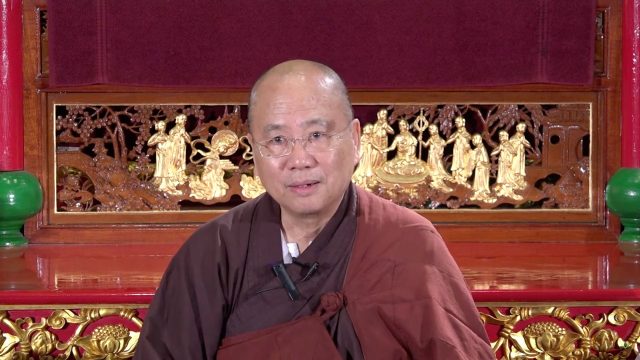
When a Chinese American expresses deep anxiety about U.S.–China tensions spiraling toward war, the response from a Korean Buddhist teacher is not what the worried questioner might expect. There is no geopolitical roadmap, no list of policy interventions, no appeal to diplomatic channels. Instead, the teaching begins inward: the mind itself is the terrain where war is either prevented or enabled. This reframing—from external crisis management to internal cultivation—is the spine of what Ven. Pomnyun Sunim, a Seon master and humanitarian activist, offers in a direct dharma exchange about preventing global conflict.
Sunim's opening instruction is unambiguous: "First and foremost, in the midst of this situation, we must first cultivate peace within our own minds." This is not spiritual bypassing—the teaching does not minimize the real danger of war or dismiss geopolitical complexity. Rather, it identifies a psychological trap. If we cannot maintain peace within ourselves, Sunim warns, "it is inevitable that we become resentful toward either country. This lack of peace could even drive us to act violently in the name of peace." The irony is sharp: anxiety about conflict can itself become the seed of conflict, manifesting as blame, prejudice, or reactive aggression directed at one nation or another.
This insight draws on classical Buddhist analysis of how afflicted mental states generate destructive action. The teaching is practical: before we can engage wisely in any peace movement, we must understand our own mind clearly. That clarity requires us to "develop an accurate understanding of what is truly happening in the world." Accuracy—not ideology, not fear, not tribal loyalty—is the ground on which ethical action rests.
Sunim offers historical perspective to dispel the sense that war between superpowers is inevitable. He traces the pattern across human history: "If we look back at the history of humankind, the top two countries or groups often end up in conflict or competition. In most cases, this has led to war, but not always." The critical word is "not always." The Soviet Union and the United States emerged as rivals after World War II, locked in ideological and military competition for decades. Yet when the Soviet system collapsed, war did not follow. The rivalry dissolved without the catastrophic military clash that many feared.
This precedent is neither guarantee nor prediction, but it opens a space of possibility. The current U.S.–China situation, Sunim acknowledges, "is arguably more tense and less amicable than that rivalry." The two nations are genuine competitors. Yet they also "share significant commonalities and areas of mutual interest." Sunim's assessment is sobering but not deterministic: "In my opinion, there is a 50:50 chance that this situation could result in war or simply continue as a competition." Conflict is not written into the structure of great-power relations; outcomes depend on human choice.
Sunim turns to the war in Ukraine as a concrete example of how ordinary people can intervene at scale. The mechanism is clear: "The way to stop the war in Ukraine would be for the Russian people to organize anti-war protests within Russia. If a strong anti-war movement gains momentum inside Russia, it could help end the war without any one side being completely defeated." This is not abstract idealism. History shows that wars lose political sustainability when citizens actively withdraw consent. An anti-war movement inside the aggressor nation itself—where the state apparatus is most present and repressive—can erode the will to fight.
Applied to U.S.–China tensions, the logic is parallel: "To resolve the tensions between the U.S. and China, people in both countries, Americans in the U.S. and Chinese citizens in China, need to lead anti-war movements within their nations." For the Chinese American questioner—belonging to neither nation yet connected to both—this poses a particular ethical responsibility and a particular cost.
Sunim does not hide what speaking against war inside a nation locked in conflict requires. "When two countries are in conflict and competition is severe, having an anti-war or anti-conflict movement within your country might lead to significant criticism or rejection from others within the country." In China, peace advocates risk being branded a "traitor to your country." In the U.S., they face charges of disloyalty. These are not minor social penalties; they cut at identity and belonging.
And yet the teaching does not flinch: "Even knowing these difficulties, we must be proactive and engage in peace movement." The call is to act anyway, not despite the cost but with clear eyes about it. This is courage in the classical sense—not the absence of fear, but action taken in the presence of real danger.
Sunim's final teaching cuts through the paralysis that often accompanies large-scale crises. When a person feels dwarfed by geopolitical forces beyond their control, despair can masquerade as realism. Instead, Sunim reframes: "It is more important to take even small actions, no matter how small they may seem, rather than being overly worried or anxious about what might happen." The instruction is not to ignore danger but to distinguish between psychological rumination and effective engagement. Small actions—conversations, organizing, bearing witness, refusing to demonize—are real interventions in the field of consciousness and politics.
This teaching flows from a recognition found throughout Sunim's humanitarian work: that scale and complexity need not paralyze. Jungto Society, which Sunim founded, has built a model of engaged Buddhism rooted in "sharing and simple, sustainable living." The same ethic applies to peace work. You cannot single-handedly prevent war between superpowers. You can cultivate peace in your own mind, speak truthfully within your own nation, and join others in collective witness and resistance. These are the levers available.
For anyone watching the world spin toward greater geopolitical tension, Sunim's dharma offers a map that is both inward and outward. The teaching invites introspection: Can you maintain equanimity in the face of genuine danger? Can you see clearly, without the distortion of fear or tribal loyalty? And it invites action: Where in your own nation can you add your voice to the case for peace? What conversations can you have? What communities can you join? What understanding can you deepen so that you speak from wisdom rather than anxiety? The Chinese American questioner left the exchange grateful—not because the crisis had been solved, but because the path had been clarified.