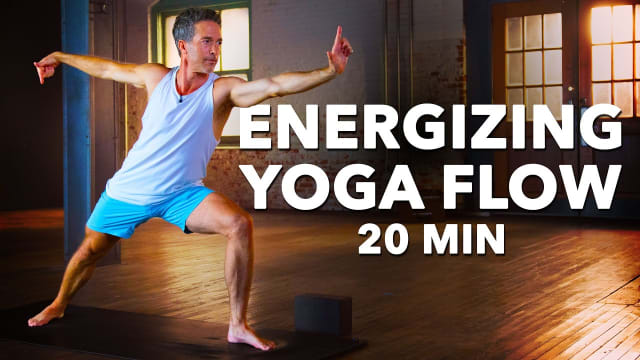
Chi flow is built on a simple but profound principle: let your breath choreograph the movement. This practice layers breath-work and dynamic sequencing into something that feels less like following instructions and more like being guided by an internal current. When you synchronize each transition—each reaching gesture, each fold, each pivot—with the inhale and exhale, the body enters a state of continuity. What might otherwise feel like a list of postures becomes a river.
The opening of this chi flow establishes the essential pattern immediately. As you inhale, the right hand reaches back and taps the outer left ankle—a subtle awakening of the lower body and the hip socket. That reach is not forced; it follows the breath. On the exhale, you return to the top of the mat, grounding the movement with intention. The inhale creates expansion; the exhale creates return. This call-and-response between breath and body is the heartbeat of chi flow.
The practice continues with this dialogic quality throughout. Left hand reaches back on the next inhale. Exhale brings you back to center. Then a bigger stretch: "Big inhale, stretch back, create a little bit more stretch," and on the exhale, "walk or spring, top of the mat." Notice the choice offered—walk or spring. Chi flow invites you to meet yourself where you are. Some days the breath feels spacious enough for a spring; other days a walk honors the body's honest rhythm. Either way, you are listening.
Once you've arrived at the top of the mat, the flow shifts into a more vigorous architecture. A flat back position—hips tilted forward, the spine long—invites an inhale that opens the heart and lengthens the entire front body. The exhale brings a forward fold, releasing the head and neck with the cue to simply "let it go." This toggle between extension and surrender repeats throughout the practice, training the nervous system to cycle between effort and ease.
What follows is a series of arm sequences that move chi downward through the body with what the instruction calls "present mind." The right arm sweeps up on the inhale, then crosses over and down on the exhale. The left arm mirrors this. These movements are not arbitrary; they engage the intercostal muscles, mobilize the shoulder girdle, and create a subtle internal massage that moves stagnant energy. By the third cycle, both hands draw upward together, the palms rotate, and the arms reach all the way overhead—a moment of full extension and gathering before the next transition.
The swan dive—that graceful descent from arms overhead to a forward fold—marks a turning point in the sequence. It is an elegant name for what is essentially a momentum shift from vertical extension into horizontal work. The inhale reaches the spine long in a flat-back position, and the exhale steps or springs the feet back to plank pose. This moment asks something different of the body: weight-bearing, core engagement, the foundation of an entirely new phase.
What begins as a plank then unfolds into a series of alternating lunges. Right foot bends in on the inhale; on the exhale, the body lowers (slowly, with control). The left foot mirrors the movement. This alternating pattern warms the hip flexors, strengthens the legs, and continues the dialogue between breath and body that has been established. Each repetition is not punishment or quota; it is simply the next natural progression of chi moving through the body.
The sequence concludes with a brief visit to cobra pose—"sweet back massage," as the instruction tenderly names it—and then exhales into downward-facing dog. The dog pose is itself a full-body reset: a moment of inversion, of decompression, of returning to the breath. It is both ending and new beginning, which is the nature of any true flow.
What makes this chi flow work is not the complexity of the poses but the coherence of the breath underneath. Each transition is small enough to feel manageable, yet the cumulative effect is comprehensive. Ankles wake up. The spine lengthens and folds. The arms carve energy through space. The legs build heat. The nervous system learns, again, that movement and stillness are not opposites but partners in the same rhythm.
The original instruction includes a seemingly casual detail: "soften into the transitions." This is not a minor note. Many practitioners move from one pose to the next with a kind of mechanical efficiency, as if the pose itself is the prize and the journey between poses is merely administrative. But chi flow asks something different. The transition—the moment of stepping back, the descent of the arms, the fold forward—is where the actual flow lives. To soften into it is to let the body release any armoring or bracing and instead become a channel for the chi itself.
This softness does not mean collapse or passivity. It means meeting effort with a kind of ease, the way water moves. It means that even as your legs build strength in a lunge, your shoulders can drop away from the ears. Even as your core engages in plank, your breath can remain full and round. Softness and strength are not in conflict; they are the two wings of the same bird.
The beauty of a short chi flow like this one is that it asks very little and offers very much. You do not need a perfect understanding of anatomy or a background in yoga philosophy to benefit. You simply need to show up, to let your breath guide the rhythm, and to trust the intelligence of your own body as it moves. Some days the practice will feel energizing and mobile. Other days it will feel grounding and calming. The same sequence, breathed differently, becomes a different medicine.
Save this flow for those moments when you need to move but do not want to overthink the movement. Use it as a warm-up before a longer practice. Use it as a standalone offering to yourself on a morning when time is short or energy is scattered. Use it as a reminder that the body is never static and that chi—that animating life force—is always moving through you, waiting only for your breath to orchestrate its journey.
This chi flow is designed as a standalone practice, but it also serves as an introduction to larger movement sequences. If you find yourself drawn to this style of breath-synchronized flow, consider exploring longer vinyasa practices or chi kung sequences that build on these same principles. Inner Dimension Yoga offers extended practices that develop these movements further. The key is consistency: return to this or similar sequences regularly, and notice how your relationship to your own body's wisdom deepens. Chi flow is ultimately a conversation between you and your own animating life force—and like any conversation, it grows richer with practice.