A short contemplative practice built around a set of sacred words, offered for one purpose: a deep exhale. Danielle LaPorte's video "CALMING Sacred Word Set" runs just under nine minutes, and its description gives the instructions in a single line: read the words once, then listen to them three times, and bless any fears that come up along the way. A downloadable PDF of the words is linked from the description, so the text can be read on the page as well as heard. This article was prepared without a transcript of the spoken audio, so it draws on the title and the description the teacher published with the video rather than on the words as they are spoken. What follows is an honest account of what the practice asks for, why its structure makes sense, and how to approach it without overreaching.
The title and description frame this as a set of words meant to be used for calming, and the description names the intended effect directly. In the teacher's own words, as published in the video description: "This sacred word set is designed for a deep exhale." That is the whole stated aim. The set is not presented as a lesson, a teaching to be mastered, or a belief to adopt. It is a tool for slowing down, and its success is measured by what happens in the body and breath while the words are present.
That distinction matters. Much contemplative material asks for understanding. A piece designed around the exhale asks for something closer to attention. You are not meant to analyze the words while they play. You are meant to let them land, and let the breath follow them out.
Breath practices across many traditions give the exhale a special role, and this is general context rather than a claim the video makes: a slow, lengthened out-breath is commonly associated with settling the body and easing the sense of urgency that tightens the chest and shoulders. Anyone who has sighed deeply after a stressful moment has felt a version of this. The inhale tends to gather energy; the exhale tends to release it. A practice oriented toward a deep exhale is therefore pointed at letting go rather than building up, which suits a piece whose stated purpose is calm.
The word "deep" in the description is doing real work. It asks for a full, unhurried release, not a polite puff of air. If you notice yourself rushing the exhale to get to the next word, the practice has already become a performance, and the simplest correction is to stop, take one slow breath, and resume.
The instruction "read once, listen three times" implies a sequence, and the sequence is the most practical part of the description. Here is one way to honor it, offered as a suggestion rather than as the teacher's own method:
- The first reading. Read the words silently, on the page, to get their shape and rhythm. Do not try to feel anything yet. This is orientation.
- The first listen. Play the audio and let the words wash over you. Keep the breath easy. Notice where your attention wanders and bring it back without scolding yourself.
- The second listen. Pay closer attention to the exhale. Let each out-breath be a little longer than feels natural, and let the words set the pace.
- The third listen. Listen for what remains once the novelty has worn off. This pass is often the quietest, and it is where the practice tends to do its settling work.
Repetition is the point. Three listens let the words move from unfamiliar sound to something you recognize in your body, and the familiarity is what makes it possible to exhale without bracing.
The description includes a second instruction that is easy to pass over: "Bless any fears that come up." This is not a request to suppress fear or argue it out of existence. It is an invitation to meet fear with a gesture of goodwill, to acknowledge it as something that has arrived and to offer it a kind of welcome rather than a fight. Many people find that fear loosens its grip once it is met this way, because the resistance that usually feeds it has nowhere to push.
Blessing a fear does not require believing it is true, and it does not require the fear to leave before the practice is finished. The instruction is to let any fear that surfaces be included in the exhale, not excluded from it. If a fear is strong enough to make the breath catch, pause, let the breath come back on its own, and continue.
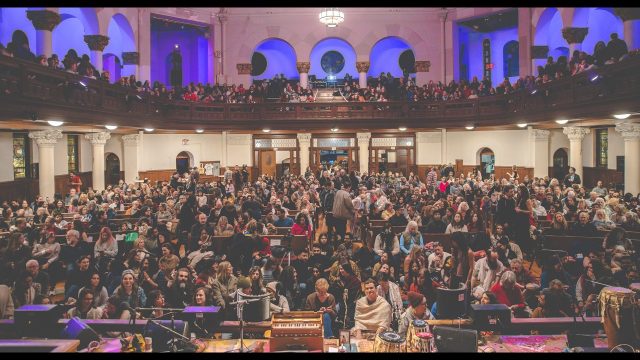
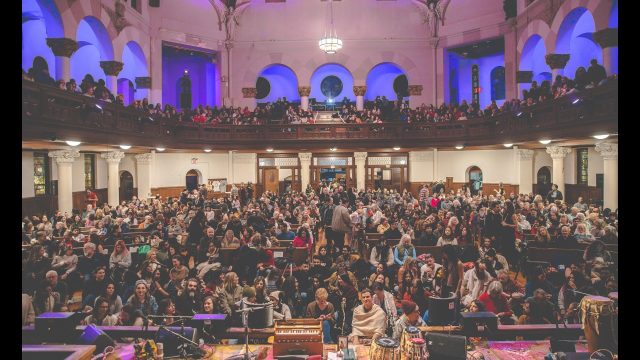
The video description points to a larger rhythm of work. It states: "Every Equinox + Solstice we do a free LIVE meditation. That's 4x a year." The same description notes that thousands of people gather for these sessions and provides a registration link. For a viewer, this matters because the calming practice in this video can be understood as one small, self-guided piece within a longer relationship to live contemplative gatherings, rather than a standalone product to be consumed and forgotten.
If you want to work with this practice, start with the source. Watch the video itself, since the spoken delivery, pacing, and tone are the parts that no written summary can carry. Download the sacred words PDF from the link in the description at daniellelaporte.myflodesk.com/calming, and read the text once before you listen. Set aside a few minutes when you will not be interrupted, and try the three-listen sequence for a week to see what changes in your exhale. If you want a live experience, the description also links to registration for the free Equinox and Solstice meditations at daniellelaporte.myflodesk.com/solstice-equinox. Go to the original video for the exact words and instructions, and let your own breath be the final judge of whether the practice is working for you.