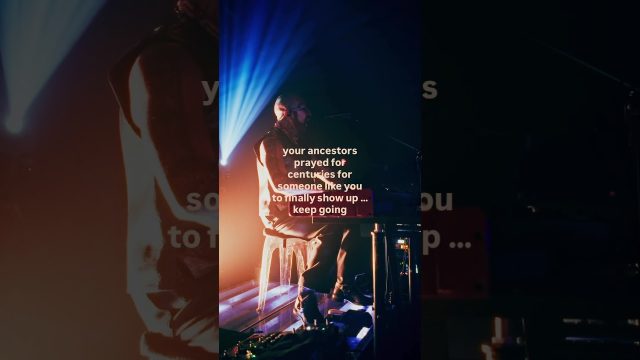
The stage at Portland is alive. A crowd answers a call-and-response—"When I say Hoogan, YOU SAY HEY"—the gathering's voice rising in unison. It's a simple mechanic, a chant older than rock and roll, yet what lives in it is the opposite of conformity. This is Nahko and Medicine for the People at work: the invitation to keep being your authentic self, not despite the collective energy, but within it.
Authenticity is not a fixed trait you possess and defend against the world. In the context of Nahko's broader teaching and musical practice, it emerges as an active, relational process—something you practice, refine, and offer into a shared space. When a crowd responds to a call, each voice that joins is a small declaration: I am here. I am real. I am part of this.
The Portland moment captures something essential: authenticity doesn't wither in community. Instead, it finds its ground. The call-and-response form—rooted in African-American musical and spiritual tradition, and woven through indigenous and global ceremonial music—treats the individual voice and the collective response as inseparable. You are invited to be fully yourself because the gathering depends on your presence, your truth, your sound.
In a culture that often frames authenticity as a lonely resistance against conformity, this is a necessary reframing. The screams and cheers you hear are not drowning out the self—they are affirming it. The energy of that crowd becomes a mirror that reflects back: your authenticity matters here; it is needed.
Staying true to yourself, in this frame, is not about opting out of community. It is about showing up as fully as you can and trusting that the gathering—when it is held with intention and care—will make space for your realness rather than demand you shrink.
For deeper exploration of how authenticity lives in community, ceremony, and artistic practice, explore Nahko and Medicine for the People's larger body of work—from their album releases to their live performances and teachings on indigenous healing and activism. The call-and-response you hear in a 30-second clip is an entry point to a lifelong practice of presence, accountability, and collective truth-telling.