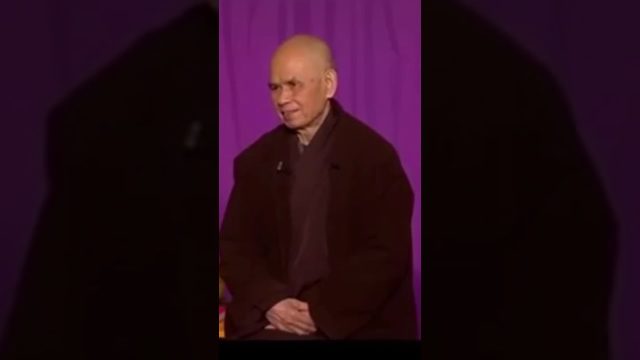
Walking at dusk, you see a coiled shape across the path and your body jumps before your mind has named anything. A snake. Then the shape resolves into a rope, and the pounding heart slowly settles. In a short excerpt from a Dharma talk recorded on October 19, 1993, Thich Nhat Hanh uses that ordinary moment to make a claim about where suffering actually lives. It is not in the snake that never existed, and it is not in the rope. It is in the perception that produced the snake. His teaching is that most of our suffering grows from wrong perceptions, that we routinely blame other people for pain that starts in our own minds, and that the remedy is a sustained practice of stopping, calming, and looking deeply, because good intentions alone are not enough.
The excerpt opens with an image that repeats three times. In Buddhist meditation, he says, we learn to touch our body as a river, because the body is always changing. We learn to touch our feelings as a river. And we learn to touch our perceptions as a river too.
The river image matters because it removes the illusion of fixed solidity. A river is never the same water twice, yet it is recognizably a river. Applied to the body, this is the simplest form of impermanence: what you were carrying in your shoulders an hour ago is not what you carry now. Applied to feelings, it means a pleasant or painful mood is a current, not a permanent condition of your life. Applied to perceptions, it means the way you read a situation, the story you tell about a person's tone of voice or a sound in the dark, is also moving water. That is the reason perceptions can be touched at all. You cannot examine a stone that is fused to your skin, but you can look at a current that is passing through you.
This is the first shift the teaching asks for. Most people treat their perceptions as transparent windows onto reality. Thich Nhat Hanh asks the practitioner to treat them as something that flows, shaped by conditions, and therefore open to inquiry.
The central example is the one the film opens with, and it is worth slowing down on. "Walking in the twilight, we may mistake a piece of rope as a snake. And we scream. That is a wrong perception. That kind of perception is very usual in our daily lives." — Thich Nhat Hanh, Dharma talk recorded October 19, 1993 [0:86]
Notice what the example does not need. There is no villain. No one has lied to you and the rope has not misbehaved. The light is poor, the mind is primed by fear, and a perception arrives fully formed and feels like fact. The scream comes before any reasoning. That sequence, reaction first and explanation later, is what makes the example so useful. Thich Nhat Hanh is not describing an exotic error made by unusually foolish people. He is describing the ordinary machinery of perception that operates in every household, every workplace, and every argument.
He also gives the error a precise name and a precise weight. "The Buddha taught us that most of our suffering come from our wrong perceptions," he says near the beginning of the excerpt [0:37]. The claim is not that every painful moment is an illusion. It is that a large share of the pain we experience is generated by how we have framed what is happening, and that this framing can be examined and corrected.
The most consequential part of the teaching is the step from perception to accusation. "Our perceptions are very often wrong," he says. "And because of that we accuse the other person, we accuse other people as the origin of our pain. In fact, our wrong perceptions are the cause of our pain" [0:56 to 0:81].
Here the rope becomes a relationship. A friend who does not reply to a message is a snake in the path. A colleague's silence in a meeting becomes proof of contempt. The mind builds a narrative, then points at the person inside it. Thich Nhat Hanh's point is that the pain is real, but its origin has been misplaced. The accusation feels like the diagnosis, when it is often the symptom of a misperception that has not yet been checked.
He makes the same argument in plainer terms later: "So misunderstanding is the root of our suffering. And when we misunderstand, we accuse the other person as the root of our suffering" [3:21]. The logic is uncomfortable because it removes the comfort of certainty. If the other person is not the source, then the work of relief starts inside your own perceiving.
This does not mean that other people are never harmful, nor that you should suppress your reactions. The teaching is about where to look first. Before you act on the story that someone has wronged you, you are invited to ask whether the story itself is accurate.
If wrong perceptions are the problem, what is the method? Thich Nhat Hanh describes Buddhist meditation as the practice of "calming, stopping, concentrating in order to look deeply into the heart of things." He is explicit about the order: "If you don't stop, if you don't calm, if you don't concentrate, you have no energy for looking deeply" [2:22 to 2:55].
He names the two halves using the traditional terms. The first is samatha, which he glosses as stopping, calming, and concentrating. The second is vipassana, which he translates as deep looking. He says the first can be done through sitting and breathing mindfully [2:39], and that together these aspects of practice help you "discover the true nature of what is." The insight that follows, he says, "will be able to liberate you from your own suffering" [3:13].
The sequence matters. A person caught in a startle cannot investigate the rope. Their attention is already burning, and whatever they see is filtered through alarm. Samatha is the discipline of lowering that heat, of pausing long enough that the mind is no longer a runaway current. Only then does vipassana have clear water to look into. The two are not rival techniques. One creates the stillness in which the other can see.
For a reader new to the practice, this is the most actionable part of the excerpt. You do not need to resolve every perception before you breathe. You breathe first, then look.
The final movement of the excerpt turns from the individual to the relationship, and it contains a sharp observation. "According to the practice, you have to help each other," he says. "You have to come together and deal with your real enemy, wrong perceptions" [3:35 to 3:45]. The enemy, in other words, is not the person across the table. It is the misperception that both of you are carrying.
Then comes the line that gives the teaching its edge: "The willingness to reconcile is not enough. The willingness to make peace is not enough. We need practice" [4:03 to 4:07]. Good will is a starting condition, not a method. Many people sincerely want reconciliation and still repeat the same accusations, because the perception driving those accusations has never been looked at. Without practice, good intentions can coexist with an unchanged habit of reacting.
He then lists the practice in concrete, domestic terms: "Walking, meditation, sitting, breathing, eating in mindfulness, drinking tea in mindfulness, flower watering, the energy of mindfulness cultivated by that daily practice, these things you can do. We all can do" [4:07 to 4:25]. The list is deliberately ordinary. Mindfulness here is not reserved for retreat halls. It is available while watering plants or drinking tea, and the energy it builds on those small occasions is the same energy that later allows you to notice a rope before you scream.
The excerpt is short, but it offers a usable sequence. When a strong reaction arrives, notice it as a current, the way the body, feelings, and perceptions are all described as rivers. Pause before you name the cause. Breathe until the alarm loosens its grip. Then look at the perception itself: what did you see, what did you add, and what would be different if the rope were only a rope? Only after that question has had room should you decide what the other person did.
The teaching does not promise that wrong perceptions will disappear. It asks you to recognize them as ordinary, to stop treating each one as proof of someone else's guilt, and to keep returning to practice. That return, repeated daily, is what Thich Nhat Hanh means by the energy of mindfulness.
This excerpt is one of a series of short films drawn from Thich Nhat Hanh's teachings, co-produced by the Plum Village App and Earth.fm in 2026 and directed by Miguel Sánchez. The film is excerpted from a longer Dharma talk recorded in 1993, and the full talk is the best next step if you want the surrounding context for these passages. Read it slowly, and try the practice the excerpt describes: the next time a moment of fear or certainty arrives, pause, breathe, and ask what your perception is made of before you decide who is responsible.