BrightStar
BlogMy Tickets
BlogMy Tickets
Saved events
Help & contactSign UpLog in
Events
  • Browse All Events
  • Yoga
  • Meditation
  • Breathwork
  • Qigong
  • Sacred Music
  • World Music
  • Medicine Music
  • Sound Healing
  • Ecstatic Dance
  • Ceremony
  • Plant Medicine
  • Energy Healing
  • Satsang & Wisdom
  • Tantra
  • Retreats
  • All Categories →
Destinations
  • Bali
  • Sedona
  • Los Angeles
  • Costa Rica
  • Tulum
  • Byron Bay
  • San Francisco
  • Austin
  • New York
  • San Diego
  • Denver
  • Seattle
  • Portland
  • Miami
  • London
  • Maui
  • Boulder
  • All Cities →
Platform
  • For organizers
  • Join the Movement
  • Sell Globally
  • For Creators
  • For Teams
  • For Writers
  • For Teachers
  • For Kirtan Artists
  • For Studios
  • For Festivals
  • For Retreat Centers
  • For Nonprofits
  • Brand Ambassador
  • Free Ticketing
  • Pro
  • Amplify
  • The Ecosystem
Features

Ticketing and checkout

  • Ticket categories
  • Assigned seating
  • Custom questions
  • Coupon codes
  • Smart pricing
  • Ticket sharing
  • Waitlist
  • Flexible refunds
  • Digital waivers
  • Tip jar
  • Donations and sliding scale
  • Embed widget
  • Mindful checkout
  • Recurring events
  • Private sessions
  • Online courses
  • Summits
  • Rooms and stays
  • Ticket scanner

Marketing and growth

  • Abandoned cart recovery
  • Visitor recovery
  • Upsells and add-ons
  • Affiliate engine
  • Upsell affiliate network
  • Brand ambassador
  • Meta retargeting
  • Verified buyer network
  • Outbound email marketing
  • Email sequences
  • SMS and WhatsApp
  • Event upsell network
  • Direct mail campaigns
  • SEO engine
  • Syndication
  • Event sharing
  • Custom event pages
  • Artist profiles
  • Link in bio
  • Event blog
  • Blog newsletter

Payments

  • Payments, powered by Stripe
  • Buy now, pay later
  • Apple Wallet
  • Multi currency

Data and operations

  • Team access
  • Message center
  • Reports
  • Analytics reporting
  • Performance reporting
  • Customer data
  • Integrations
  • Switch from another platform

AI

  • Assistant
  • AI FAQ assistant
  • All Features →
Company
  • About
  • FAQ
  • Contact
  • Blog
  • Glossary
  • Guides
  • Inspiration
  • Help Center
  • API Docs
  • Brand Assets
  • Press
  • Terms of Service
  • Privacy Policy

Events

  • Browse All Events
  • Yoga
  • Meditation
  • Breathwork
  • Qigong
  • Sacred Music
  • World Music
  • Medicine Music

Destinations

  • Bali
  • Sedona
  • Los Angeles
  • Costa Rica
  • Tulum
  • Byron Bay
  • San Francisco
  • Austin

Platform

  • For organizers
  • Join the Movement
  • Sell Globally
  • For Creators
  • For Teams
  • For Writers
  • For Teachers
  • For Kirtan Artists

Features

  • Community Network
  • Abandoned Cart Recovery
  • Ticket Categories
  • Recurring Events
  • Assigned Seating
  • Affiliate Engine
  • Waitlist / Notify
  • All Features →

Company

  • About
  • FAQ
  • Contact
  • Blog
  • Glossary
  • Guides
  • Terms of Service
  • Privacy Policy
Read more

Events

  • Sound Healing
  • Ecstatic Dance
  • Ceremony
  • Plant Medicine
  • Energy Healing
  • Satsang & Wisdom
  • Tantra
  • Retreats
  • All Categories →

Destinations

  • New York
  • San Diego
  • Denver
  • Seattle
  • Portland
  • Miami
  • London
  • Maui
  • Boulder
  • All Cities →

Platform

  • For Studios
  • For Festivals
  • For Retreat Centers
  • For Nonprofits
  • Brand Ambassador
  • Free Ticketing
  • Pro
  • Amplify
  • The Ecosystem

Company

  • Inspiration
  • Help Center
  • API Docs
  • Brand Assets
  • Press

Ticketing and checkout

  • Ticket categories
  • Assigned seating
  • Custom questions
  • Coupon codes
  • Smart pricing
  • Ticket sharing
  • Waitlist
  • Flexible refunds
  • Digital waivers
  • Tip jar
  • Donations and sliding scale
  • Embed widget
  • Mindful checkout
  • Recurring events
  • Private sessions
  • Online courses
  • Summits
  • Rooms and stays
  • Ticket scanner

Marketing and growth

  • Abandoned cart recovery
  • Visitor recovery
  • Upsells and add-ons
  • Affiliate engine
  • Upsell affiliate network
  • Brand ambassador
  • Meta retargeting
  • Verified buyer network
  • Outbound email marketing
  • Email sequences
  • SMS and WhatsApp
  • Event upsell network
  • Direct mail campaigns
  • SEO engine
  • Syndication
  • Event sharing
  • Custom event pages
  • Artist profiles
  • Link in bio
  • Event blog
  • Blog newsletter

Payments

  • Payments, powered by Stripe
  • Buy now, pay later
  • Apple Wallet
  • Multi currency

Data and operations

  • Team access
  • Message center
  • Reports
  • Analytics reporting
  • Performance reporting
  • Customer data
  • Integrations
  • Switch from another platform

AI

  • Assistant
  • AI FAQ assistant
Get the app
Download on theApp StoreGet it onGoogle Play
© 2026 BrightStar. All rights reserved. BrightStar Selection · Photo credits · Changelog ·
Inspiration

Guru Brahma Guitar Chord Guide for Beginners

Jai Uttal
Jai Uttal
Oct 3, 2016
4 min read

From Jai Uttal

Watch · 4
This guitar lesson breaks down the chord structure for Guru Brahma into manageable shapes. The song uses a repeating progression of B minor and D for the intro, shifts to E minor, D major, and G major 7th for the verse, and ends with a slide from G major 7th to B flat major 7th. A capo on the second fret raises the pitch to suit the singer's voice. No exotic voicings required—these are foundational chords accessible to intermediate and advancing players.

Read · 7 sections

What Are the Basic Chords in Guru Brahma?

The song's architecture rests on two distinct sections. The intro cycles through B minor and D major, played repeatedly (approximately four times, though the exact count is flexible). This opening establishes the harmonic foundation and gives players time to settle into the groove before the verse begins.

The verse introduces more harmonic movement. After the intro repeats, the progression shifts: E minor leads to D major, followed by G major 7th, and resolves back to D minor. This sequence repeats twice before the final phrase, which requires a single chord change—sliding the G major 7th shape up three frets to reach B flat major 7th.

How Do You Play the Intro Section?

The intro alternates cleanly between B minor and D major. If you already know these basic chord shapes, you're ready to start. The movement between them is straightforward—no barres or complex finger stretches. The rhythm isn't specified in the lesson, so listen to the recorded version on "Return To Shiva Station" to absorb the timing and feel. Repetition—playing the intro four times—gives your muscle memory and ears a chance to lock into the song's emotional tone.

What Changes in the Verse?

Once past the intro, the verse deepens the harmonic landscape with four chords: E minor, D major, G major 7th, and D minor. The presence of the 7th extension (G major 7th) adds a touch of color beyond simple triads; if you're unfamiliar with this voicing, it's worth looking up in a chord reference or online diagram. The teacher notes it's "not hard"—meaning the shape is learnable without advanced technique. The verse repeats twice, creating space for singing or instrumental soloing before moving to the outro change.

What Is the B Flat Major 7th Change?

The final harmonic moment arrives when you slide the G major 7th shape up three frets. This produces a B flat major 7th chord and marks the outro or ending phrase. Because you're moving the same finger shape (a transpose rather than a new position), the physical movement is simple—lift your hand as a unit and shift it up the neck. This kind of sliding voicing technique is common in folk and devotional guitar and conserves mental energy by reusing familiar shapes.

Should You Use a Capo?

The teacher recorded the version on "Return To Shiva Station" using a capo on the second fret. This raises the pitch and places the song in a range that suits their voice. If you're singing or playing solo, experiment with a capo between the first and third fret to find what feels natural for your vocal range or ensemble. Without a capo, the progression is the same—only the absolute pitch changes, not the relative relationships between chords.

How Does This Fit Into Kirtan and Devotional Music?

Guru Brahma is a Sanskrit mantra or invocation, likely addressing Brahma, the creator in Hindu cosmology. Kirtan—call-and-response devotional singing—relies on guitarists who can hold a harmonic foundation while singers (or a congregation) layer melody and voices on top. These simplified chords provide that foundation without requiring complex jazz voicings or fingerstyle technique. The song's repetitive structure aligns with kirtan's meditative and cyclical nature, where phrases loop to deepen presence and communal resonance.

Where to Go From Here

Start by drilling the intro progression (B minor to D major) until you can switch smoothly without thinking. Then add the verse chords one at a time: E minor, D major, G major 7th, back to D minor. Once the changes feel automatic, listen to the recorded version and match your rhythm and pacing to the original. Experiment with a capo to locate the pitch that suits your voice. If the G major 7th is unfamiliar, spend a few minutes with a chord chart to build the muscle memory. As you internalize the progression, you'll free mental space to focus on the melody, the breath, and the intentionality behind singing a sacred mantra.

]]>
Comments

Loading the conversation…

Transcript

[0:01] hey everybody how's it going I wanted to

[0:04] show you the the simplified chords for

[0:07] Guru Brahma uh here they are starts with

[0:11] the B

[0:13] minor and the

[0:15] [Music]

[0:19] D this is the

[0:22] intro so it goes a bunch of times

[0:25] probably four or

[0:29] whatever B

[0:31] minor then to D then for the

[0:36] verse

[0:39] [Music]

[0:45] a so that's E

[0:49] minor D major then G major

[0:55] 7th you might have to look in a book or

[0:57] something to get that but it's not hard

[0:59] and then back to the D Minor so that

[1:01] repeats twice I mean happens

[1:05] [Music]

[1:25] twice then the last one

[1:28] changes my sh

[1:30] Guru so that's the same position it's

[1:33] the G major 7th so slide it up three

[1:36] Frets to the B flat major 7th that's

[1:39] easy Once you got the G major 7 just go

[1:41] [Music]

[1:45] there back to the

[1:49] [Music]

[1:53] beginning

[1:58] urur oh

[2:02] etc etc etc so on the CD return TOA

[2:06] station I use a capo on the second fret

[2:09] so it's uh a little bit higher a little

[2:11] bit nicer for my voice but here it is

[2:13] and I I hope that helps

The Artist in This Story

Jai Uttal

Jai Uttal

Kirtan Artist

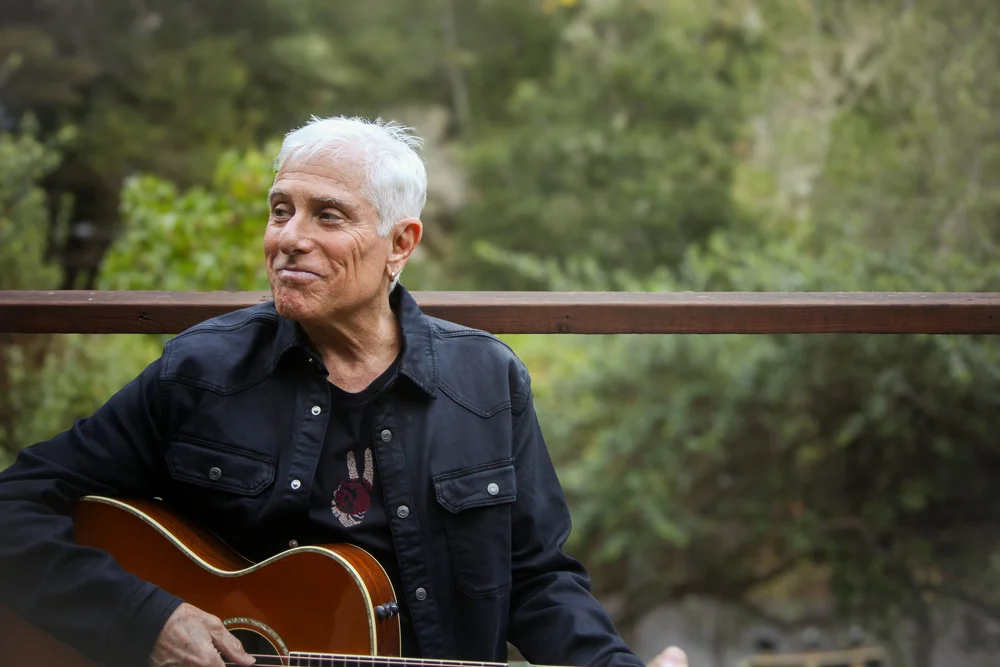
Grammy-nominated kirtan artist who pioneered the fusion of Indian devotional chanting with Western rock, jazz, and reggae. A disciple of Neem Karoli Baba, he has led kirtan worldwide for nearly five decades.

View profile
Explore Topics
Kirtan guitarChord progressionGuitar lessonBhakti musicCapo technique
Frequently Asked Questions

Frequently Asked Questions

The intro uses B minor and D major, repeated four times. The verse progresses through E minor, D major, G major 7th, and D minor, repeating twice. The outro slides the G major 7th shape up three frets to B flat major 7th.

A capo is optional. The original recording uses a capo on the second fret for a higher pitch suited to the vocalist's range, but you can play without one—the chord shapes remain the same, only the absolute pitch changes.

The exact voicing isn't detailed in the lesson, but G major 7th is a standard chord found in most guitar references or online chord databases. Once learned, you can slide it up three frets to create the B flat major 7th ending.

Guru Brahma is a Sanskrit invocation likely addressing Brahma, the creator deity in Hindu philosophy. In kirtan, it's sung as a devotional chant with call-and-response vocals layered over a repeating harmonic foundation.

The intro repeats approximately four times, though the teacher notes flexibility—the exact count depends on the recording and the ensemble's feel during performance.

Start with the intro (B minor to D major) until you can switch smoothly, then add verse chords one at a time. Listen to the recorded version and match the rhythm, and experiment with capo placement to find your voice's natural range.

You might also like

View All
Where Souls Meet: Shiva, Self-Concept, and Sacred Chanting
Inspire

Where Souls Meet: Shiva, Self-Concept, and Sacred Chanting

Ram Dass explores how devotional chanting transforms ego-based identity into soul awareness, merging with the Divine through bhakti practice…

8 min read
Hanuman Chalisa for World Peace: Ancient Chant for Modern Times
Inspire

Hanuman Chalisa for World Peace: Ancient Chant for Modern Times

Jai Uttal leads a devotional rendering of the Hanuman Chalisa, a 40-verse Sanskrit hymn invoking strength, clarity, and peace through kirtan…

9 min read
Kirtan as Mourning: Grief and Presence in Devotional Practice
Inspire

Kirtan as Mourning: Grief and Presence in Devotional Practice

A live kirtan honoring Shyam Das explores how chanting the Maha Mantra holds both longing and presence—the dual nature of bhakti when rememb…

8 min read
Zâhid Bizi Ta'n Eyleme: A Four-Century-Old Verse in Istanbul
Inspire

Zâhid Bizi Ta'n Eyleme: A Four-Century-Old Verse in Istanbul

A one-minute live clip from Istanbul shows Sami Yusuf singing "Zâhid Bizi Ta'n Eyleme," a verse about a love that cannot be counted. Here is…

3 min read
See allYou might also like→

Continue your journey

More wisdom and gatherings from across the BrightStar directory.

More Articles

Browse the full library of teachings, interviews, and guides.

Back to all articles →

Teachers & Artists

Explore the lineages, musicians, and guides of the conscious world.

Explore artists →

Find an Event

Kirtan, retreats, sound baths, breathwork, festivals — happening soon.

Browse events →