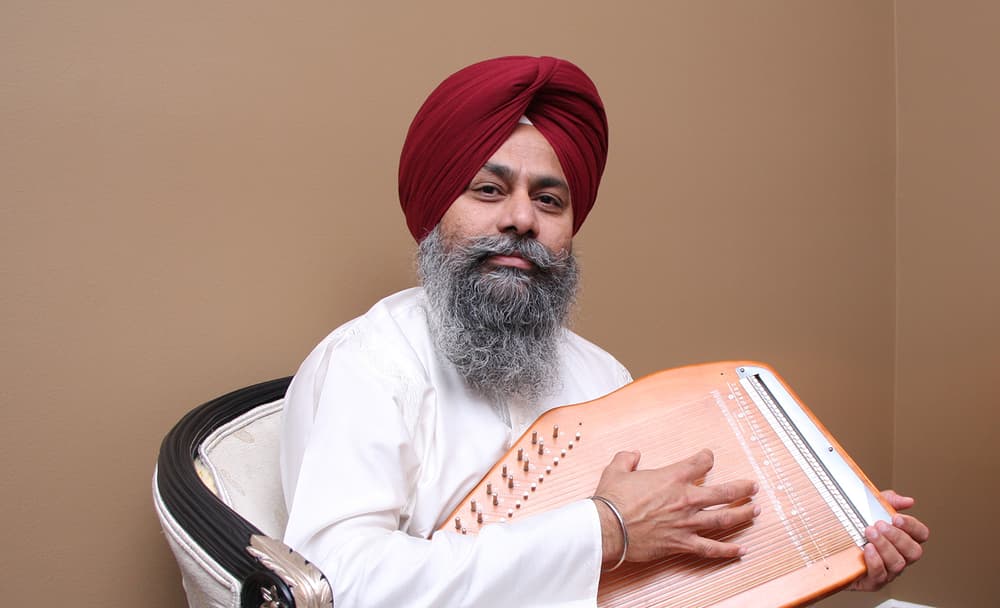
Professor Paramjeet Singh performs the devotional composition "Laggi Ji Tere Kaalje," written by poet Dr. Surjit Patar, sung in raag Pilu and its related raag Patdeep. This performance demonstrates the integration of classical Hindustani raga structure with Punjabi poetic devotion, exploring how musical form and spiritual language converge in traditional Indian vocal music.
Raag Pilu is a fundamental raga in the Hindustani classical music tradition, characterized by its warm, intimate emotional quality and its accessibility across different times of the day and seasons. The raga has been central to Indian classical music for centuries, appearing in the compositions of major classical musicians and forming the basis for numerous devotional pieces. In the context of Punjabi spiritual music, Raag Pilu carries particular significance because it bridges the formal classical tradition with the vernacular devotional singing that has long been part of Punjab's spiritual heritage.
The performance of "Laggi Ji Tere Kaalje" in Raag Pilu by Professor Paramjeet Singh exemplifies how classical raga discipline can serve as a vessel for devotional expression. Rather than treating the raga as a purely technical exercise, the singer uses its structural properties—its characteristic note sequences (swaras), its emphasis on specific notes, and its inherent emotional contours—to deepen the spiritual message embedded in the poem.
Patdeep, also spelled Patdeep or Patnaya, is a variant or closely related melodic structure within the Pilu family of ragas. The use of both Raag Pilu and Patdeep in a single performance suggests a compositional approach that explores different facets or developmental stages of the same melodic material. This practice, common in Indian classical music, allows performers to expand the emotional and structural possibilities of a single thematic core.
By moving between Pilu and Patdeep, Professor Paramjeet Singh creates what might be understood as a musical progression or deepening—the composition doesn't remain static within a single raga framework, but rather evolves and transforms, much as a spiritual practice itself might deepen through stages of understanding. This structural choice reflects a sophisticated understanding of how musical form can mirror the inner journey that devotional poetry describes.
Dr. Surjit Patar is a distinguished Punjabi poet and writer whose work has made significant contributions to contemporary Punjabi literature. His poetry often engages with themes of love, devotion, identity, and spiritual longing, written in accessible yet profound language that connects with Punjabi cultural traditions while maintaining literary depth. By selecting a composition based on Patar's work, Professor Paramjeet Singh engages with contemporary Punjabi poetic expression rather than limiting the performance to classical or traditional compositions alone.
The title "Laggi Ji Tere Kaalje" (which translates roughly as "I have become attached to your heart" or "I am devoted to your heart") announces an intimate devotional theme—the speaker or singer is expressing a state of attachment or merger with the divine beloved. This kind of emotional and spiritual intimacy is central to bhakti (devotional) traditions across India, and it finds particular expression in Punjabi sufi-influenced poetry and music.
In Indian classical music, a raga is not merely a scale or mode, but a comprehensive system that includes characteristic ascending and descending note sequences (arohana and avarohana), emphasized notes (vadi and samvadi), characteristic melodic phrases or figures (mukhda), and an overall emotional temperament or rasa. When a vocalist like Professor Paramjeet Singh performs a devotional text within a raga framework, they are not imposing an arbitrary musical structure onto the poem—rather, they are using a system whose emotional qualities and melodic logic support and amplify the devotional message.
Raag Pilu, in particular, is known for its capacity to convey both tenderness and intensity—qualities that serve devotional expression particularly well. The raga's characteristic emphasis on the middle register of the voice, its use of soft microtonal inflections (meends and khatkas), and its overall intimate quality allow the performer to create a space where the listener can feel the emotional vulnerability and sincerity of the devotional sentiment. The formal discipline of the raga provides the container within which genuine emotional expression becomes possible rather than sentimental or self-indulgent.
Professor Paramjeet Singh's background as a performer (indicated by his title and active presence across multiple platforms) suggests extensive training in classical vocal technique. Such training provides the technical foundation that allows a vocalist to navigate the precise intonation, rhythmic sophistication, and expressive nuance that raag-based performance demands. Without this foundation, the attempt to sing in a specific raga would collapse into approximate or generic vocalization.
The vocalist's role extends beyond technical execution to interpretive choice. Within the structural framework of a raga, a skilled performer has significant freedom to explore, to linger on particular emotional moments, to emphasize certain melodic contours, and to create space for the listener's own inner response. In devotional music particularly, this interpretive freedom becomes a form of service—the performer is not displaying technical mastery for its own sake, but rather creating conditions under which the listener might access their own devotional capacity.
Punjab's musical heritage has historically integrated classical Hindustani forms with folk traditions, qawwali (sufi devotional music), and devotional kirtan. The performance of a contemporary poet's work in a classical raga framework represents this ongoing synthesis. Rather than treating classical music as separate from or superior to vernacular expression, this approach demonstrates how they enhance and inform each other. A poem written by a modern poet becomes vehicle for classical exploration; classical musical discipline becomes vessel for contemporary spiritual consciousness.
This integrative approach also reflects the historical reality that much of what we now categorize as "classical" Indian music emerged from devotional contexts. The ragas themselves were originally developed, in part, to support the expression of different emotional and spiritual states associated with different times, seasons, and modes of worship. By performing contemporary devotional poetry in these classical forms, Professor Paramjeet Singh reconnects the music to its spiritual roots while demonstrating its continued relevance.
A listener encountering "Laggi Ji Tere Kaalje" performed in Raag Pilu and Patdeep should expect a performance that honors both musical precision and spiritual sincerity. The five-minute duration suggests a composed piece rather than an extended improvisation (alap, jor, jhala) in the traditional concert format, which means the focus remains tightly on the poetry and melody rather than extended raga exploration. This approach makes the devotional message more immediately accessible while still maintaining the essential character and emotional quality of the raga.
The listener will encounter not a performance that prioritizes virtuosity or technical display, but rather one that uses technical mastery as a foundation for emotional and spiritual communication. The classical elements—the precise intonation of the raga, the rhythmic discipline, the melodic sophistication—serve to deepen rather than distract from the devotional sentiment expressed in Patar's words.
For those interested in exploring this performance more deeply, familiarity with the characteristic phrases and emotional qualities of Raag Pilu can enhance listening. Online resources and instructional materials about Hindustani ragas can provide context for understanding how the vocalist is structuring the melodic material. Additionally, exploring other compositions by Dr. Surjit Patar or other contemporary Punjabi poets can provide literary context for understanding the kinds of spiritual questions and devotional expressions that animate current Punjabi cultural consciousness.
Those drawn to devotional music traditions might also explore qawwali, kirtan, and other forms of devotional singing across India to understand the broader landscape within which this performance exists. Professor Paramjeet Singh's other performances and compositions, available through his YouTube channel and website, provide opportunities to hear how these musical and spiritual themes are explored across different ragas and poetic texts. The integration of classical form and devotional content that characterizes this performance represents an ongoing living tradition rather than a museum piece—one that remains vital to contemporary spiritual and artistic expression in Punjab and beyond.