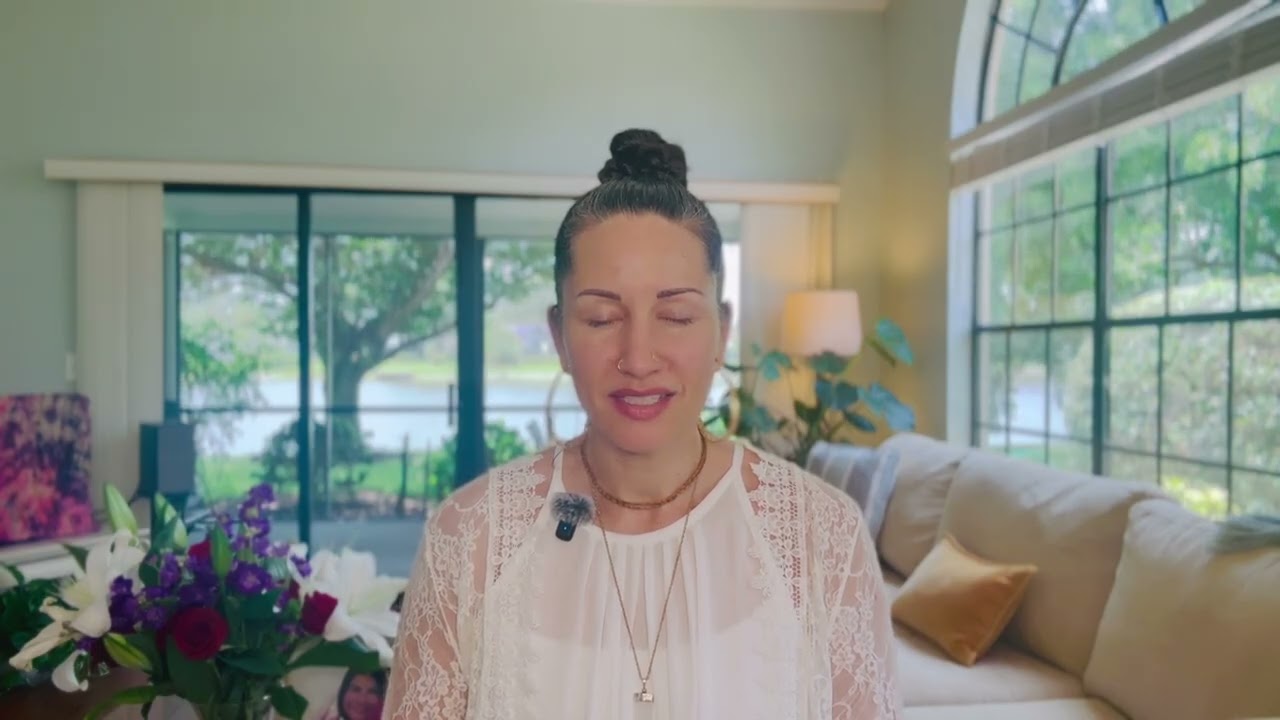
A guided couples meditation posted to YouTube on Valentine's Day 2022 asks two people to sit knee to knee, hold hands, close their eyes, and move their attention through a deliberate sequence: from the room and the breath, to the heart, to a shared memory, and finally into a long gaze at each other. Running about twelve and a half minutes, the practice is built less on philosophy than on order. It starts with what the senses can already reach, narrows to the warmth of a partner's hands, lifts into imagery of the first time two people met, and closes with eye contact and an invitation to let whatever emotion surfaces move through. Read closely, it is a compact piece of relational practice that treats connection as something you enter through the body before you try to describe it.
The practice opens with a simple instruction: grab your partner, sit facing each other, and let your knees touch. The guide, Yogi Bryan, frames the whole session as something shared from the first breath: "welcome to this guided meditation... this is a couple's meditation so grab your partner, grab your loved one, say hey, it's time to meditate." That opening line matters because it makes the practice explicitly dyadic. You are not meditating alongside someone. You are meditating with them, and the instructions keep returning to what the two of you are doing at the same moment.
The first layer of attention is the environment. Listeners are asked to notice the sounds inside the room, then the sounds outside it, and to let those sounds relax them further. Then the attention drops into the body: the warmth of the partner's hands, the partner's energy, the sound of your own breathing, whether you can hear your partner's breath, any smells you notice, the air on your skin. Nothing here is abstract. Each cue asks for a concrete sensation, and that is the point. Sensory anchoring pulls attention out of narrative thinking and into present contact, which is where most couples are actually relating to each other when they are not distracted by plans, arguments, or screens.
There is also a quiet instruction about the conscious mind. The guide asks listeners to "allow your conscious mind to surrender" and to "let go." For many people, that is the hardest step, because the analytical mind is what usually steers conversations with a partner. The script does not ask you to stop thinking forever. It asks you to stop steering for a few minutes, so that something else can come forward.
Around the three-minute mark, the cue shifts from the hands to the chest: "bring your awareness to your heart space," followed by the image that anchors the middle third of the practice. Listeners are asked to "just feel the energy in your heart space" and to "connect to your partner's heart like a laser beam." The image is vivid and a little playful, but it does real work. It gives two people a shared target. Instead of thinking vaguely about "our relationship," both partners are directed to the same region of their own bodies and to a line of attention running between them.
This is a useful design choice for anyone who finds couples meditation awkward. The heart is a familiar, non-clinical reference point across many traditions and everyday speech. By placing attention there, the script turns affection from an idea into a location you can return to during the rest of the session.
The most distinctive move in the meditation comes next. Around the four-minute mark, the guide says: "I wonder if you can imagine the first time you met. See it in your mind's eye, feel all the feelings. I want you to see... that first moment you two met." Then the prompt shifts: "imagine the happiest moment that you two have had."
Memory is a reliable route back to emotional tone. A specific scene, such as a first meeting or a shared high point, can recall the feeling of a bond more quickly than an abstract statement like "I love you." The instruction is precise about what it wants: not a summary of the relationship, not a list of accomplishments, but the feelings attached to a single moment. Partners who have been together for years often find that these memories have been filed away and rarely visited. The meditation asks them to take one out and look at it together, in silence, with their hands joined.
The visualization that follows is the part of the practice most likely to feel unusual. Listeners are asked to notice where in the body they feel this energy, and then to let a color appear. The guide is explicit about the freedom involved: "it could be any color, it could be multiple colors, it could be transparent, it can even have polka dots." The permission matters. A rigid image can become a performance. An open one lets each person work with what actually arrives.
The color is then guided upward, out of the body, over the head, and into the room. "This color fills the entire room," the guide says, "fills all the way up to the ceiling from wall to wall, and it just rains down on both of your bodies." The effect is to give a private feeling a shared shape. Two people sitting close together are placed inside the same field of light, so the warmth they have been noticing is no longer only inside each of them. It belongs to the space they are both in.
After the imagery, the meditation changes register. The guide tells listeners that when they open their eyes, they will gaze at each other. "It may feel awkward," the guide says, "but embrace it. This is your partner. All these feelings you feel are here in the present moment." Laughing and giggling are explicitly allowed. The script treats the discomfort of eye contact as part of the practice, not an error to be corrected.
"You'll soon start to notice your breathing will sync up... and you inhale your partner in, and when you exhale your partner exhales." (Yogi Bryan, Couples Meditation for Love, Connection, and Presence, around the 8:20 mark)
The guide predicts that the two partners' breathing will begin to align. The phrasing is worth noticing. It does not instruct you to sync your breath. It says you will notice that it happens. That difference shapes how the practice feels: the synchrony is presented as something that emerges when attention is steady, rather than a goal to be forced.
Later in the session, the guide asks listeners to feel "all your chakras connecting together," like "laser beams from you to your partner," and to send "all the good vibes, all the loving energy" through the eyes and through the chakras. Chakras are energy centers described in several yogic and tantric traditions, usually arranged along the spine. Whatever one believes about them, in this script they function as a visual vocabulary: a way of imagining warmth moving through specific points of the body and out toward another person. The language is poetic rather than anatomical, and it is best approached as a frame for attention rather than a claim about physiology.
The meditation's most important instruction may be the simplest. "Allow any emotions that come up," the guide says. "Don't fight it. Allow it. Embrace it." Couples often avoid moments of unexpected feeling because they fear what will follow: tears, irritation, grief about something unresolved. The script anticipates that possibility and asks listeners to stay with it rather than stepping away. The breath, the held hands, and the gaze all remain available as anchors while feelings move through.
The close is gentle. Listeners are invited to open their eyes, give their partner "the biggest hug," and share with each other what they experienced. "Thank you so much for meditating with me today," the guide says near the end of the video. The practice ends where it began: with two people, in the same room, paying attention to each other.
The video is best treated as a template rather than a sacred text. Its sequence is the useful part: anchor in the senses, move to the heart, recall a shared moment, let an image expand the feeling, meet each other's eyes, and make room for whatever arises. Couples who want to try it can set aside about fifteen minutes, sit without screens, and follow the order the guide uses, pausing where it feels natural to talk afterward. The video's description also credits DTO Music for the soundtrack and points viewers to the teacher's website for information on events, workshops, and trainings, if you want to explore more of the guide's work.
If the awkwardness of the eye gaze is the hardest part, that is worth noticing too. The script expects it. It asks you to stay, to laugh if you need to, and to keep looking. A short session like this one rarely resolves a relationship, but it can give two people a shared, specific experience of being present, and that is a practical place to begin.