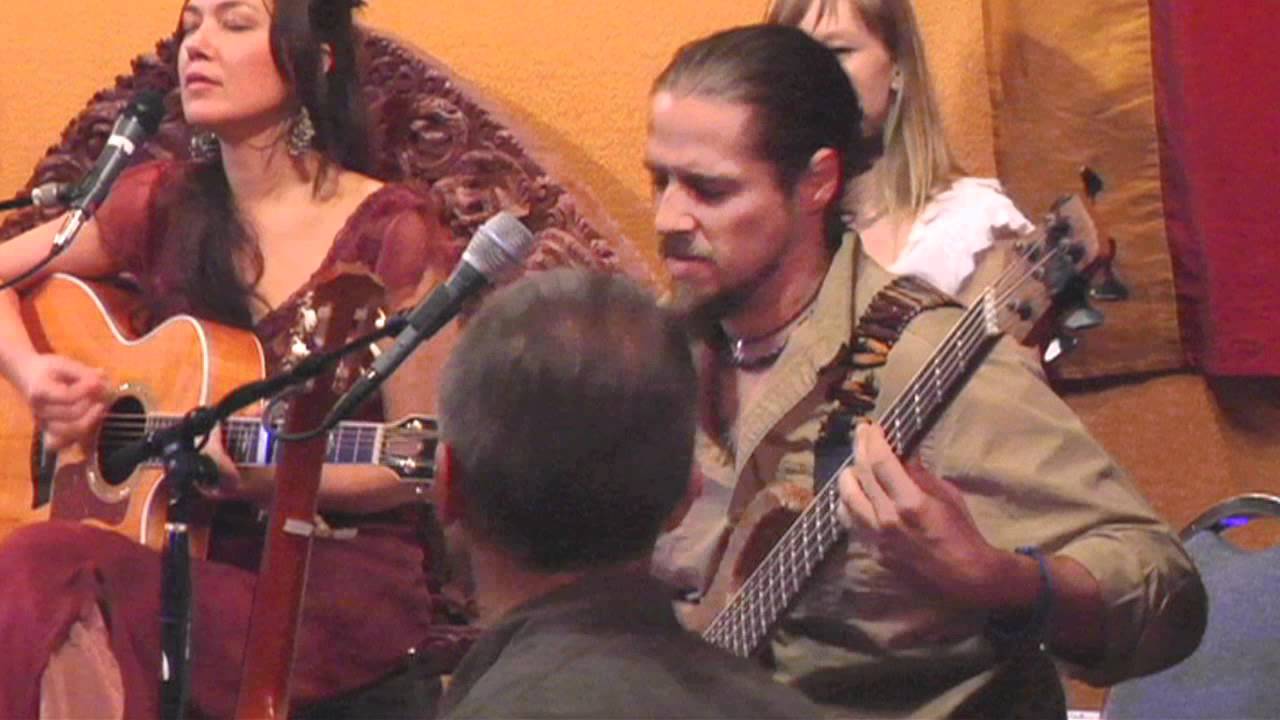
A live recording from the Song of the Soul Tour, performed in Berkeley, California and posted to Tina Malia's channel in August 2011, opens on a single voice over applause. "I love it. I absolutely love it," she says, before calling the music "really, really beautiful to listen to and to be a part of." Then the band takes over for roughly eleven minutes of two devotional pieces, "Sarva Mangala" and "Apenas Sale Aurora," performed by Tina Malia and GuruGanesha. The video offers almost no explanation. What it offers is sound: a short refrain that comes back again and again, voices lifting over a dense bed of music, and applause that marks where one section gives way to the next. This piece takes that thinness seriously. It sets out what the video actually gives a viewer, what the speaker says and when, and what a reader can and cannot learn from a fragmentary transcript.
The video's own description places it within a larger event. Spirit Voyage Live Events presents "Song of the Soul," starring Tina Malia and GuruGanesha, and this clip was taken from their performance in Berkeley. The uploader points viewers toward more recordings from the tour on Tina Malia's channel, so the video is best understood as one window onto a touring program rather than a standalone release. Near the top, the speaker names the tour directly: "Song of the Soul Tour. What a thrill. So much fun. So beautiful. My heart is full." That line is the closest the recording comes to framing its own purpose, and it is an expression of feeling rather than a description of the material.
Listen for the words that surface through the music and a pattern emerges. Around the 88-second mark, a phrase resembling "no more to take" is sung and repeated over several bars, returning at roughly five-second intervals and again near the 215-second mark as "no more today." Repetition of this kind is a central tool in devotional singing: a short line, sung until the room has learned it, lets listeners move from following the melody to joining it. The writer's reading is that this recurring line functions as the anchor of the performance, the place a listener can grab hold of when the surrounding music becomes dense. That reading is interpretation, not something the speaker states on the recording.
Quite a lot less than the length of the video suggests. The transcript that accompanies the clip is fragmentary. Fragments such as "up in the sun," "shambble deity," and what seems to be "Shiva" appear without enough context to reconstruct a full line, and several passages are simply tagged as music or applause. Those fragments are useful as signposts (the word "Shiva" surfaces near the 157-second mark, and "deity" close to the 584-second mark) but they should not be quoted as lyrics. Anyone who wants the words to "Sarva Mangala" or "Apenas Sale Aurora" should look for an official lyric sheet or the tour's recorded release rather than trust these captions. The video also does not gloss the titles. A reader hoping for a translation of "Sarva Mangala" or a note on the language of "Apenas Sale Aurora" will not find one here.
The applause is structural. It arrives at about the 77-second mark, again around 341 and 350 seconds, and closes the video at 645 seconds. Each break gives the room a moment to respond before the next passage begins, which is how a live performance differs from a studio track. A listener watching at home is, in effect, sitting in the audience for those pauses. The speaker's comment that the musicians are "all loving each other so much" is worth noting too. It is the only remark on the performers' relationship with one another, and it is delivered as an observation of warmth on stage rather than a claim about technique or arrangement.
The video was published on August 15, 2011, and by the time this piece was written it had been viewed 178,126 times. That number suggests the recording continues to reach people who came to these songs through the tour or through the channel, long after the event itself. A reader who arrives now should expect a live document rather than a polished production: the sound is immersive, the framing is minimal, and the most valuable thing the clip offers is the experience of a room singing one line together.
Watch the full eleven minutes with attention to the refrain, and note where the applause falls so you can feel the performance's rhythm. Then explore the other recordings from the tour on Tina Malia's YouTube channel, which the description identifies as the place for more music from the Song of the Soul Tour. For the lyrics and translations that this video does not provide, look for official release notes or lyric sheets from the artists before quoting any words. Listening first, and reading second, is the right order for a recording like this one.