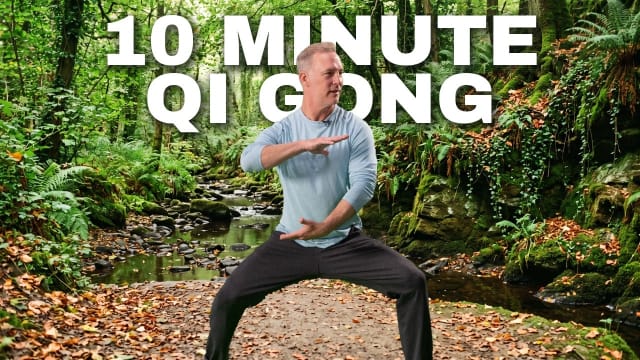
Lee Holden opens his ten-minute morning qigong routine the way many teachers open a class: hands resting over the lower belly, a quiet invitation to breathe. "Good morning," he says, and within seconds the practice has a clear shape. It moves from the center of the body outward, then upward, starting with breath in the lower abdomen, passing through the hips, waist, and lower back, working the neck, shoulders, and chest, and finishing with a slow, rising movement called The Fountain. Nothing in the sequence is complicated. What makes it worth studying is the order: each step prepares the body for the next, so by the end the routine has taken a body that is stiff from sleep and asked it to move, circulate, and settle. This is a guide to what Holden asks you to do at each stage, why he asks for it, and what he says you may notice when it is finished.
The first thing Holden does is name the target. "Let's bring our hands right here over the lower belly center," he says. "This is called dan tien, which means elixir field." The dantian is a term from Chinese qigong and internal practice for a region in the lower abdomen that practitioners treat as a reservoir of energy. In the video, Holden does not dwell on theory. He tells you to breathe into the area, slowly, through the nose, and to feel the belly move.
Holden describes this breathing as something he does for himself before he even gets out of bed: "Sometimes before I even get out of bed, I do some dan tien breathing, some deep abdominal breathing just to get my energy awakened in a steady way." The word that matters in that sentence is steady. The breath is not meant to be a jolt. It is a slow, even opening, and Holden's instruction is repetitive for a reason: go slow, inhale and exhale through the nose, and keep your attention in the belly.
"Breath is energy. And this routine is going to give you a lightning flash of vitality. That's what we say in chi gong." (Lee Holden, Holden QiGong morning routine video, 0:58)
He also makes a comparison that frames the whole practice. "Usually in the west, right? We drink a cup of coffee. Well, this will give you energy without a caffeine crash, a natural boost of energy." (Lee Holden, same video, 1:06) That is a claim about how the practice feels, not a measured outcome, and it is worth reading as an invitation rather than a promise. The point is that the energy he is describing is meant to come up gradually from within, the way a slow breath does, rather than from a stimulant.
Once the breath has settled, Holden asks you to bend your knees and turn from the hips and waist. The reasoning is physical and plainly stated. "When you sleep, the lower spine gets stiff," he says. "That's why you see people getting out of bed. Everything's stiff. So, this is going to oil the joints and get you ready for the day."
The movement is called Knocking on the Door of Life. As you turn, the back hand knocks across the lower back, and Holden describes the forearm as crossing a specific pressure point. "We're activating a key pressure point for energy, which is called the door of life," he says at 1:33. The point, in his description, sits in the low back, and the knocking is meant to wake it. He is clear that the tapping should be firm but not punishing. "When you make contact with those points, do it fairly strong if you can. It shouldn't hurt, but it should feel like your body is waking up."
Holden adds one more element that is easy to skip: the head. "You can even gently turn, look over your shoulder, get the movement into your upper back and neck." The turn is not only in the waist. It is a gentle rotation that carries through the whole spine, so the knock is a way of moving the body into an upright, twisting shape rather than a single tap in one place.
After the first knock, Holden moves into what he calls a qi massage. The motion is a repeated tapping, up and down, along the lower back. "Knock up and down on all of these pressure points right here in your lower back," he says at 2:58. The route runs from the kidney area down to the tailbone. Holden is specific that this section can be more vigorous than the first, but the limit he sets does not change: "It shouldn't be painful, but you should feel it. Wake up those pressure points."
The qi massage is a useful example of how Holden pairs force with restraint. He wants a clear sensation, enough to notice and enough to wake the area, but he never asks you to push through pain. A reader who tries the routine should treat that line as a rule, not a suggestion.
After the tapping, the routine turns to length. Holden describes the movement as a lower back exercise and a stretch in one: float the arms up, bend the knees, tuck the tailbone under, then reach up one arm and then the other. "Picking cherries lengthens the spine. It gets rid of stiffness out of the lower back, and it's just a wonderful, gentle stretch to wake the body up." The image is simple, and the instruction stays with the breath. "Slow breathing through the nose. Get that spine lengthened and aligned."
The sequence has a logic that is easy to miss if you only follow the arms. The tuck of the tailbone and the bent knees keep the lower back from arching as you reach, which means the lift travels up the spine instead of collapsing into the hips. Holden is asking for a lengthening, not a bend or a backward lean.
The routine then shifts to the upper body, and here Holden lowers the intensity on purpose. He takes the arms out to the sides, presses the palms down, and asks for an ear toward the shoulder. "Go very gentle. Just ease into it. These muscles are sensitive so you don't have to stretch them in a strong way. You don't have to over stretch them." Then he rolls the head forward and back, slowly, and repeats on the other side.
His reason for the gentleness is an idea that runs through the whole video, and it may be the most interesting one he states. "When you free up tension, your body will naturally have more energy," he says at 5:20, in his explanation of the stretch. "You're not using your energy to hold these contractions. You get that energy freed up and moving into circulation." In this framing, tension is not neutral. It is a drain. Releasing it is not only comfortable; it returns energy to the body.
Holden sets a sequence of tapping on the upper back, shoulders, and chest, and each one has a stated purpose. For the upper back, he asks you to hold one elbow and slap the top of the opposite shoulder with the other hand. "Free up the tension. Activate the energy. These points right here are good for clear thinking." He then repeats the other side, and returns to the idea that the morning calls for focus. "So, in the morning, we want to have focus and clarity of mind. This will bring chi or energy up into your head and brain."
The chest tapping that follows is vigorous and uses the same logic: wake the points, breathe into them, and let the energy move. Holden asks for deep breaths between sets and then a pause. The point of the tapping is not to exhaust the body but to make it feel awake.
The routine ends with a flowing movement called The Fountain. The name is a picture of the energy Holden wants to raise. "Imagine you're tapping into a wellspring of energy and getting the energy to rise and fountain around." The sequence starts with the hips gliding back, an inhale as the energy rises, and an exhale as the arms open to the sides. Holden stresses the speed: "Notice that I'm going slow. When you go slow, you bring an abundance of calm, clear energy in. When you go slow, your mind slows down. Body slows down, the mind slows down."
He then reaches for an image he calls central to qigong flow. "In Qigong practice, flowing movements are like water, like this beautiful stream here. Let your body flow and move like water." He quotes Bruce Lee, whose line he repeats in the video: "Move like water, my friend. Move like water." (Lee Holden, same video, 8:38) Holden then asks the viewer to imagine the change in the body: "If you were water, how would you move different? Would you feel this ripple of energy up your spine? Your arms and shoulders would relax."
The Fountain is repeated, and the final pass is what Holden calls a meditative state. "These flowing movements are meditative. Slow down your breath. Slow down your body. And your mind becomes more present." It is a good point to see the whole routine's arc: the first minutes were about waking, and the last are about settling.
Holden does not ask for a dramatic result. He asks you to stand with the hands at the sides, close the eyes, and take a slow breath. "You feel a little tingling and buzzing," he says at the close. "The chi has become activated and circulating." (Lee Holden, same video, 9:49) That language is his own, and it describes a felt experience rather than a measurable change. The description accompanying the video frames the goal the same way: that you may feel "more awake, at ease, and ready to meet the day."
The useful takeaway is the structure. A ten-minute routine that starts with breath, moves through the spine and neck, taps the back and chest, and ends with a slow rising flow is not random. Each step gives the next one something to work with. A reader who wants the most from it should follow the order, keep the breath comfortable, keep the stretches gentle, and keep the tapping firm without pain. Those three rules are the ones Holden repeats most often.
Watch the full video and follow it once without stopping, so you can feel the arc of the sequence before you try to memorize the cues. Then repeat it on a second morning, paying attention to the breath at the start and the slow pace of The Fountain at the end. If you want more guided practice, the video's description points to a video class subscription with Lee Holden for building a regular routine, and Holden himself says the practice is meant to be done consistently. Start with the ten minutes, and let the habit be the point.