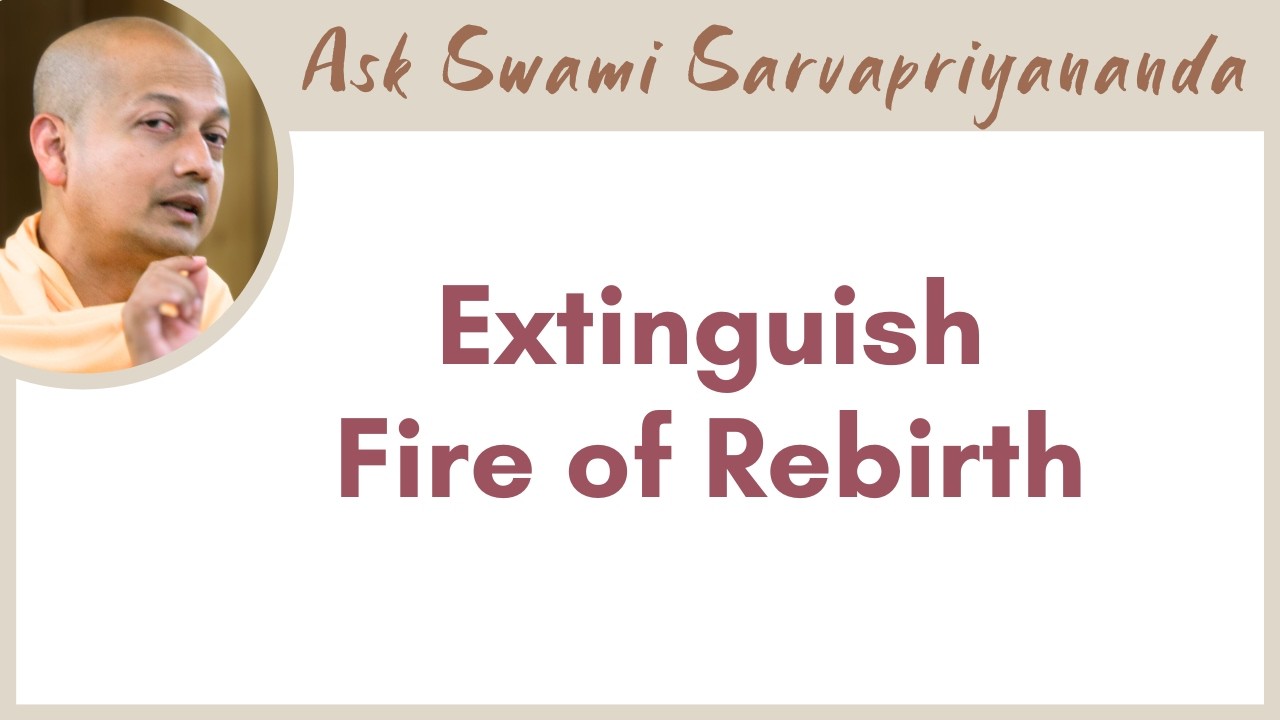
The video runs under two minutes, and nearly all of it is a prayer. Swami Sarvapriyananda stands before the release of a new book and offers it on behalf of the whole team, invoking the teachers of his lineage and asking that the knowledge inside "light up our hearts." Yet the book being introduced is a serious piece of philosophy: the Dṛg-Dṛśya-Viveka, a classical Vedanta text that opens with one question, who is the one who sees, and what is merely seen? The publisher's description says the text is attributed to Vidyaranya and that the book draws on a twelve-part lecture series in which the Swami works through that question slowly, from the eye outward to the Self. This article is about that question, and about why a short blessing at the start of a book points so directly at it.
The clip opens mid-invocation, with the Swami's voice already in the room. In the first seconds (22s) he is reciting a name, and the transcript is garbled there, so the exact words cannot be reliably reproduced. At 68 seconds the prayer comes into focus: "On behalf of the whole team, I offer it to Sri Sri Thakur." He then names the others in the lineage he is addressing, and the transcription of those names is also uneven, so we will not guess at them here.
What matters is the shape of the gesture. The Swami does not present the book as his own accomplishment. He asks the teachers to bless the people who worked on it, and he asks the blessing extend to "all of us present here." At 88 seconds he says of the book, "this knowledge which flows through these books," which frames the text as something that moves through a tradition and through its readers rather than something owned by an author. Then, at 97 seconds, he hopes the knowledge will make lives "into a blessings for ourselves and blessings to those around us." The video closes with "Om. Peace. Peace. Peace." at 103 seconds, and a brief "Very good" at 106 seconds.
For readers coming to Vedanta for the first time, the blessing is a useful key. In this tradition, a text is not finished when it is printed. It is meant to be read, reflected on, and eventually tested in one's own experience, and the invocation asks that this happen.
The central move of the Dṛg-Dṛśya-Viveka is a distinction between dṛk, the seer, and dṛśya, the seen. The description of the book states the method plainly: it begins with "the simplest observation that the eye sees but is not the Seer." That sentence carries the whole argument.
Consider what you actually observe. You see a chair, a color, a thought passing through the mind, the rise and fall of your breath. Each of these appears to you. Each can be named, described, and set aside. The eye itself is something you can look at in a mirror, and so it belongs on the side of the seen. Following the same logic, the body, the senses, and finally the mind become objects of awareness rather than the awareness itself. Whatever can be known is, by definition, known by something else.
The text's question is therefore not "what do I see?" but "what is it that sees, such that nothing it sees can be the seer?" The answer the description gives is that the Seer is pure witnessing Consciousness, the same reality the scriptures call Brahman. The inquiry is meant to be carried out by the reader, not simply accepted on authority, which is why the lecture series moves in patient steps.
Abstract arguments about the Self can slip away from experience, so the Vedanta teachers have long relied on images. The publisher's description says the book is "rich with story, dialogue, and illustration," and it names three of them: the rope mistaken for a snake, gold appearing as ornaments, and water rising as waves.
The rope and snake image describes how something real can be misperceived as something else in dim light. The rope is actually there; the snake is a projection layered over it. The lesson the book draws from this kind of image is that the superimposed object does not have its own independent existence apart from the substrate it appears on. Gold and ornaments make a related point: a bracelet is only gold in a different shape, so its name and form change while its substance does not. Water and waves make the same point about the mind and the world, with the wave appearing as a distinct thing while never being anything other than water.
These images do not prove the conclusion by themselves. They give the reader a way to hold the claim while the inquiry proceeds. The description's own phrasing, that Vedanta is "explained not as abstraction but as something to be seen, here and now, by the one who is seeing," suggests the images are meant to be checked against direct observation.
The description also names two further pieces of the inquiry: Māyā, and the three states of waking, dreaming, and deep sleep. Both are standard components of the Vedanta method, and the book places them along the same path.
Māyā is presented as the power that makes the seen appear to be the seer, or makes the rope look like a snake. The three states offer a natural test case. In waking life, the world appears as objects. In dream, the objects are internal and yet still seen. In deep sleep, there are no objects at all, and yet one who was present in all three states continues to be. The inquiry asks the reader to notice that the witness is common to all three, and so cannot be identified with any of them. This is a direct, experiential route to the same conclusion the earlier steps reach by logic.
The description adds that meditation is part of the practice. The point is not to think about the seer once and move on, but to keep returning to the one who is aware of every experience, until that awareness becomes the ground of one's attention.
The publisher's description claims that the text "still speaks directly to anyone asking, quietly or urgently, What am I, really?" That claim is the book's promise, and it is the reason the Swami's prayer asks that the knowledge "shine brightly in our lives." The question is not historical. It arises in any reader who has noticed that their own experience is always filtered through something they cannot quite see.
What makes the text durable, on the account given here, is that it does not ask the reader to believe anything new. It asks the reader to look again at what is already present, the one who sees, and to notice that this one is never the object of seeing. The description calls this "Vedanta explained not as abstraction but as something to be seen." Read this way, the two minutes of blessing are not a preface to the philosophy. They are the first gesture of the same inquiry: asking, before anything else, who is offering, who is receiving, and who is present to both.
The video is a short invocation, so the full argument lives in the book and the lecture series it draws from. The publisher's materials point to a flipbook preview on the Vedanta Society of New York website, to the book's listing on Amazon, and to the Society's lecture collections, including the scriptural and topical series. Start with the opening question, and keep it with you: who is the one who sees, and what is merely seen? The text's own method suggests that the best answer will come from looking, not from reading alone.