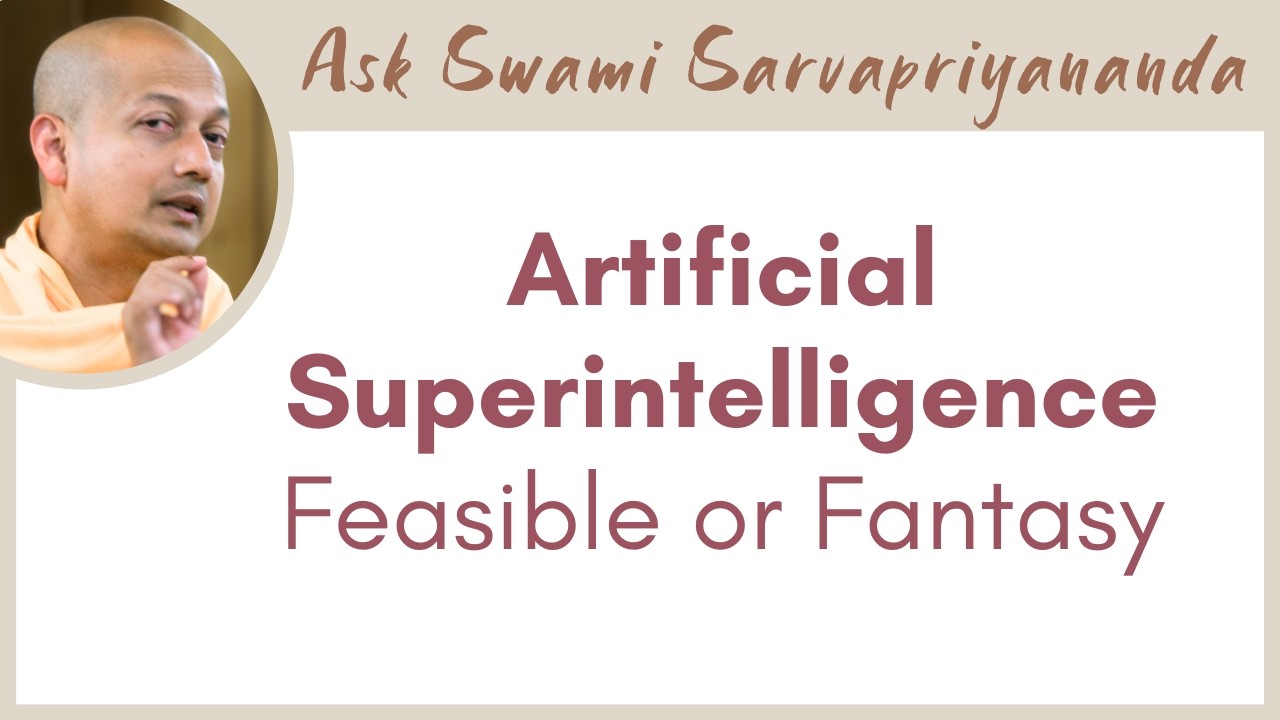
Somewhere in the Greater Washington DC area, a man who describes himself as a physicist is rehearsing for a conversation he expects to have years from now. He has two grandchildren, and he knows their questions will come. "With children I have to be very precise, very accurate," he tells the Ask Swami session of the Vedanta Society of New York, held on 15 June 2025. So he brings a question to the session: can we design a generalized, belief-agnostic template for karma, one a child could grasp? Swami Sarvapriyananda's first answer is that the template already exists and is called causality. From there he works outward, distinguishing what can be shown from what must be accepted, sketching a cartoon with a chariot, a trailer and a basket of tools, and arguing that children learn ideals by watching and imitating far more than by listening to arguments. The result is a short clip with a long reach, because it touches on how any tradition hands its deepest ideas to the next generation.
The questioner is not asking for a lecture on the metaphysics of action. He is asking for a method. He admits he is "in a very troubling situation" in many conversations with his grandchildren, and he says he is "posing this question for myself" as preparation. His framing is practical. In his mind, karma is something to be worked at with "boots on the ground" in pursuit of moksha, liberation. The question he wants tested is whether there is a version of karma stripped of religious commitment, one that a skeptical child and a devout grandparent could both examine.
That is a harder request than it sounds. Most explanations of karma begin with a text, a teacher or a lineage, and ask the listener to take the framework on trust. The questioner wants to begin somewhere else. He wants an entry point that does not depend on who the child's family believes.
Swami Sarvapriyananda's answer is yes, with a caveat. "The answer would be yes, it already exists," he says. "And it is called, everybody knows about it. It is called causality. Cause leads to effect. Actions have consequences." He adds that this understanding is not a special achievement of any culture. It is shared by all living beings. "Babies understand it, some causality. At least the higher animals understand it."
Karma, in his account, is an extension of that everyday perception. Once you notice that actions have effects, the doctrine goes one step further: "whatever effects we are seeing in our lives are produced by past actions." The idea is not exotic. A child who touches a hot stove learns causality in an afternoon. Karma asks whether the same logic reaches across a longer span, into the conditions of a whole life.
"So based on causality, karma is an extension. The idea that our actions have effects and whatever effects we are seeing in our lives are produced by past actions." (Swami Sarvapriyananda, Ask Swami session, 15 June 2025, 2:15)
This is a useful starting point for a parent or grandparent, because it lets you begin with something the child has already seen. The stove, the broken toy, the friend who is kind after being treated kindly: each is a small case of cause and effect, and each can be the opening move of a longer conversation.
Here the speaker is careful, and his care is the most important thing in the clip. He answers the questioner's second question directly: no, the template is not entirely agnostic, and it is not belief-agnostic either. "If it was, it would be part of empirical science. There is a part of it which has to be taken on faith. That's why it is part of religion."
This distinction matters for anyone teaching children. Causality is observable: you can drop a glass and watch it fall. But the claim that a present circumstance was produced by a past action, across many lifetimes or across hidden chains of consequence, cannot be tested the same way. Swami Sarvapriyananda is drawing a line between what can be shown and what must be accepted, and he refuses to blur it. A template that pretended to be pure science would collapse the first time a child asked a hard follow-up question.
Yet the speaker also notes something striking about how the Indian traditions treat karma. "All of Hinduism, in spite of all the tremendous differences in doctrines, all of Buddhism, Jainism, Sikhism, in fact all the Indian religions," he says, "they accept karma without any question. It is sort of axiomatic." Why? His answer returns to the same root: "It is basically based on causality. It is sort of common sense that causes and effects are linked." Traditions that disagree about nearly everything else meet on this shared ground, and the ground is common sense, not doctrine.
He also says there is "a very wonderful way of looking at the problem" that goes beyond the clip. That fuller treatment is worth seeking out in the Vedanta Society's lecture archive, because the short answer leaves much unfolded.
This is where the grandfather's idea becomes concrete, and where Swami Sarvapriyananda engages with it as a working problem rather than a thought experiment. He says he is "thinking like this," and then gives three key bullets. The image he offers is a vehicle with parts that a child could draw and label.
- The chariot. "Think about something like an autonomous chariot of consciousness which is governed by spirituality or the Gospels of the masters." The chariot is the self moving through life, steered by higher ideals. The word "autonomous" suggests the traveler is in charge, not the road.
- The trailer. The second element is "some kind of entity which is primarily meditation," one that "will really guide us to do the karma." He pictures it as a trailer, "marked meditation trailer," attached to the chariot. Meditation here is not a separate hobby but the part of the vehicle that decides how action is carried out.
- The basket. Inside the trailer is "a basket," and in the basket "are the tools." He names them: "mind, brain and action related entities. Primarily sensors in our body and accessories." He leaves the accessories open. "You can elaborate all kinds of things on that accessories."
What makes the image work is the spatial logic. Karma, in this picture, is not a verdict handed down from outside. It is what happens when a vehicle moves, carries its tools, and acts in the world. A child can point to the chariot and ask where the steering is, or to the basket and ask what goes inside. The drawing invites questions that the drawing itself can begin to answer.
The speaker's most practical advice comes almost as an aside, and it reverses the questioner's plan. He had imagined explaining karma to his grandchildren. Swami Sarvapriyananda tells him to stop explaining and start drawing. "I am with you on this. You need to draw the cartoon though. Don't give this explanation to your grandkids. Draw the cartoon and give it to the kids to play with."
"Draw the cartoon and give it to the kids to play with. It is true. They absorb, children absorb stories, absorb pictures. It stays with them in the mind." (Swami Sarvapriyananda, Ask Swami session, 15 June 2025, 4:39)
The reasoning is specific to children. "The children do not listen. They imitate," he says. "So, if you look what they find around themselves, they imitate that. Too much instruction, argumentation, it doesn't work at the children's level. What works is what impresses them, inspires them." The lesson is that a clear argument is often the wrong tool. A drawing a child can handle, color and carry around does more than a paragraph the child will not read.
There is also a quiet humility in this advice. The grandfather is treating the cartoon as something to be played with, rewritten and extended by the child. A template that a child can alter is a template that the child owns.
The clip's most hopeful claim concerns what he calls the "pre-critical age." Children, he says, "have the advantage of being actually being quite pure and noble inside for a while until they grow up. So, you can take advantage of that and inspire them." The window is real but finite, and the method is specific. "Positive, noble, high ideals, if you put before them in the form of stories, songs, in the form of pictures and modeling it yourself in our own lives, in front of them, they will remember it."
Notice what is on that list. Stories, songs, pictures and example. Nothing in it is a debate. The speaker is describing a transmission that works through the senses and through behavior. Parents and grandparents are not asked to win an argument about karma. They are asked to be seen living in a way that makes the idea credible.
"And most of all they absorb behavior." (Swami Sarvapriyananda, Ask Swami session, 15 June 2025, 4:58)
He is candid about what follows the pre-critical age. "The next stage would be teenage where they will rebel against all of that." Rebellion is expected, not treated as failure. "But after that they will come back to it. It will be a precious resource for them going ahead in life to have seen parents, grandparents like that and to have grown up in that kind of household to keep that alive."
This reframes the grandfather's anxiety. He is worried about being precise enough for the questions that will come. Swami Sarvapriyananda suggests that the precision a child remembers is less the content of a formula than the memory of a household in which the ideal was lived. The cartoon is the entry point. The example is what lasts.
The clip is short, six minutes of a longer Q&A, and it leaves plenty unexplored. If you are a parent or grandparent working through the same question, a practical sequence follows from what the speaker says. Begin with causality, using examples a child already knows. Be honest about where observation ends and faith begins, and do not pretend the second is the first. Draw a simple image, such as the chariot, trailer and basket, and let the child play with it, add accessories and ask questions. Tell stories and sing songs that carry the ideals you hope will last. And let the child see those ideals practiced at home, since that is what the speaker says children absorb most deeply.
For the fuller treatment, the Ask Swami archive at https://www.vedantany.org/ask-swami-qa holds the longer session this clip is drawn from. The lectures sorted by topic, at https://www.vedantany.org/by-topic, are a natural next stop for anyone who wants the philosophy behind causality and karma in more depth.