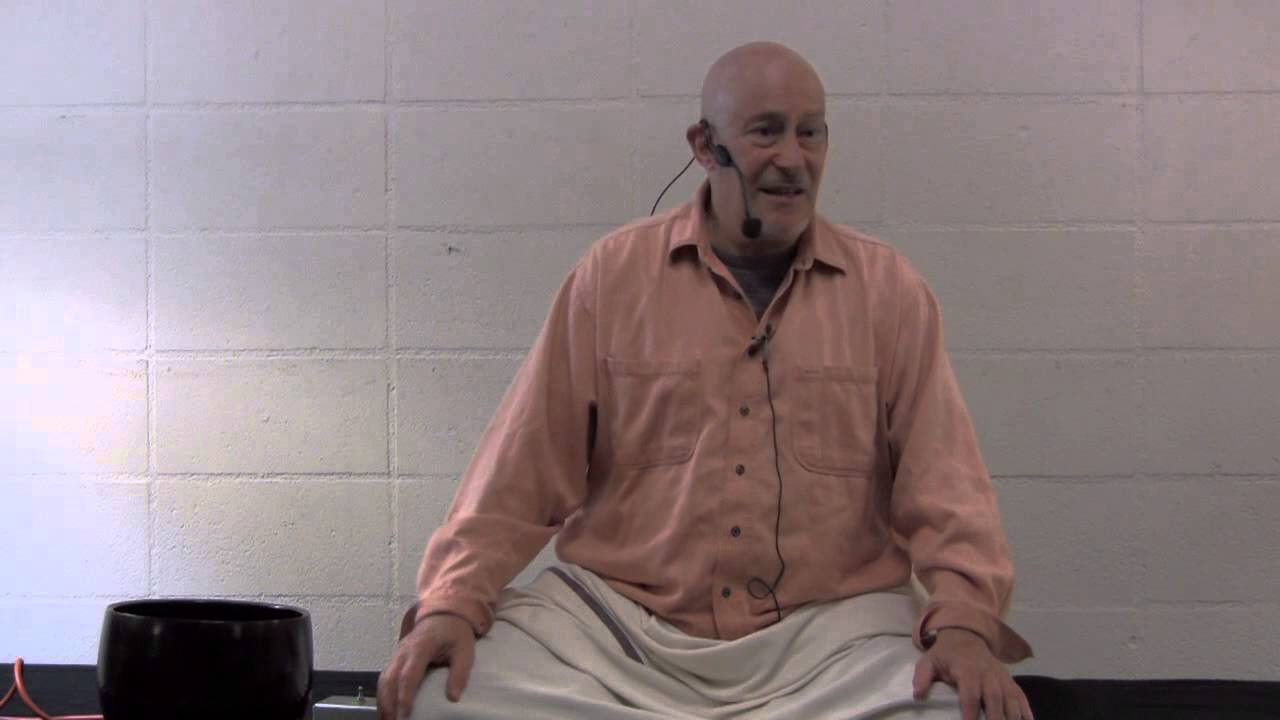
There is a moment in a recorded dharma talk, given at a Southern California retreat and posted to YouTube in 2012, when the teacher stops describing a practice and starts to talk himself into it. Shinzen Young has just laid out the logic of the Yaza, the all-night sit that was scheduled to begin the moment his talk ended. He has spoken about the chemistry of the night, about waves of sleepiness, about a Pali term for the boundary between waking mind and unconscious mind. Then he glances at a fellow practitioner and says, in effect, that he is beginning to persuade himself to join the group. The room laughs. But underneath the joke is a serious claim: that the drowsy, lurching, half-conscious hours of the night can be re-engineered into something closer to absorption than to sleep. This article works through that teaching, the concepts behind it, and the older traditions it draws on, so that a reader who never sat through the talk can still understand what is being proposed and why it has held the attention of practitioners for years.
The teacher starts with the word itself. "Yaza," he explains, "means 'night sitting' or 'extracurricular sitting,' and it's a tradition." At many retreats, he notes, he gives a full talk on strategies for the practice and on why people do it. This recording is his executive summary. The tradition lives in the margins of a retreat schedule: a block of hours, usually after the day's formal sitting has ended, in which practitioners stay on their cushions through the night rather than retreating to sleep.
What makes the teaching distinctive is that Young does not frame the all-night sit as an endurance test. He frames it as a laboratory. The night, he says, has its own conditions. "At night there's an alteration of brain chemistry that occurs, and that can sort of give you an interesting perspective from which to do the practice." That sentence carries the whole argument. The Yaza is not simply daytime meditation done longer. It is meditation done under a different neurochemical weather, and a skilled practitioner can learn to work with that weather rather than merely endure it.
The most concrete idea in the talk is also the most practical. "Each wave of sleepiness induces a wave of rest," Young says at 0:53. Anyone who has tried to stay upright through a long night will recognize the phenomenon he describes: the head drops, jerks up, drops again. He calls this the "lurch," and he points out that the lurch is not a failure of will but a physical event. "That's why people lurch, because actually what's happening is there's physical relaxation."
The shift he is asking for is one of attention. Rather than fighting each drowsy surge or surrendering to it, the practitioner notices the surge as it arrives and notices what it does. Young lays out the possibilities with the precision of someone describing a musical phrase. The body relaxes. The mental chatter may go quiet. The visual field may fill with either bright light or darkness, "sort of an undifferentiated visual experience." In his vocabulary, these are the contents of Feel Rest, See Rest and Hear Rest: sensory and perceptual states that appear when the usual machinery of thought loosens its grip.
The teaching turns on a single condition. If the practitioner can get into a rhythm, noticing the waves as they recur, then the rest that comes with each one begins to recur as well. "If you can get into that rhythm," he says at 2:00, "then what happens is you're re-engineering the experience of sleepiness into the experience of meditative absorption." The distinction is not subtle. Sleepiness that simply pulls you under is one thing. Sleepiness that you ride, attentively, is another.
To explain why the rhythm matters, Young reaches into the Abhidhamma, the systematic body of Buddhist scholastic analysis. He is careful to name the concept and to take it apart. The term is bhavanga-sota. "Bhava means 'existence,' anga means 'support' or 'underpinning,' and sota means 'stream.'" Put together, it is the underlying stream of existence that supports the flow of consciousness.
He then gives the definition that anchors the whole talk: "That's the boundary zone between the conscious mind and the unconscious mind." It is a threshold, not a place you visit once and leave. The teacher's claim is that three experiences cross it in the same way. "In meditative absorption, and in falling asleep, and in dying — in those three circumstances, we dip below the bhavanga-sota." He says there is "an intimate link" among the three, and that the crucial skill is being able to drop below that threshold without losing consciousness.
This is where the night sit earns its name. Sleep is the ordinary, unconscious version of the dip. Absorption is the same dip with awareness intact. The Yaza is a structured opportunity to practice the second while the body is being pulled toward the first. Young makes the stakes explicit with a line that is part koan and part provocation: to live and function below the bhavanga-sota, he says, "is to solve the koan that I'm going to give you, actually." He describes such a life as one lived from "the unborn," and he gives the koan away almost immediately, which draws laughter from the audience. The laughter is the point. The koan is not meant to be solved by understanding. It is meant to be lived through in practice.
He also draws a sharp line between two ways of crossing the boundary. "If you dip unconsciously, then you're going to have the Zen lurch, but if you get into the rhythm that I'm describing, it will just take you deeper and deeper." The lurch is the unconscious dip: a jolt, a loss, a return. The rhythm is the conscious dip: a steady descent in which the waves carry you rather than knock you over.
Young's most striking move is to leave Buddhism for a moment and reach for the Psalms. He tries out a Hebrew phrase he had learned in Israel, then gives the translation: "I sleep, but my heart waketh." The Latin version, which he quotes, is Ego dormio, sed cor meum vigilat. He notes that this line was held up as an ideal by Christian monks in the Middle Ages, when Latin was the working language of their life.
The monastic schedule he describes is itself a kind of night sit imposed by a rule. The canonical hours, he explains, were arranged so that monks were woken repeatedly through the night. "They never get more than a few hours sleep. Then they have to go to the chapel, and either do chanting, or singing, or have a liturgy of some sort, or Mass." He estimates the rhythm at around seven times in a twenty-four-hour cycle, and he adds that the sleep disruption is permanent. "They're sleepy all the time. And that's a lifestyle thing. It never varies, ever."
His question is the right one: why would anyone build a life around chronic sleepiness? His answer is the Psalm again. "You learn how to bring consciousness into sleep, so it's not sleep anymore." In Christian contemplative writing, he says, this capacity was called "infused contemplation." In Buddhist terms, he calls it "formless jhāna." Zen practice, he notes, uses a method of re-engineering the sleepiness itself, and the same method appears in the Christian tradition. "One facet is you can sort of ride it into these delicious restful states."
He is quick to temper the promise. "Of course, takes a little practice — a lot of practice." And he refuses to guarantee the outcome. "I'm not guaranteeing that you will experience 'I sleep, but my heart waketh,' and tomorrow morning be enlightened and live the rest of your life in the unborn, but you can take some sort of step in that direction." That restraint is part of what makes the teaching credible. It is an invitation to a particular kind of work, not a miracle offered on sale.
Young's description of the night's visual life is among the most vivid passages in the talk. He lists the experiences a practitioner might meet in the small hours: "You may never get mental images. Well, at three in the morning maybe you have mental images. The dreamscape starts to replace the landscape." A practitioner who has believed that imagery is simply unavailable to them may find it arrives at three in the morning. The solidity of the world may soften too, "as your eyes swim."
He anticipates the skeptic. "Now, you might say, 'Well, that's bullshit, because you're just tired,' and, 'That's an optical illusion.'" His reply is not to deny the fatigue but to reframe it. The swimming eyes are "also a place to stand to explore visual experience." The practice is to take the unstable image seriously as a object of attention. Done repeatedly, he suggests, this exploration yields insight into "the impermanent nature of See Out" that persists even after you have recovered and are looking at the world in a normal way. You carry, in his phrase, "this knowledge of Flow within that experience."
This is the teaching's quiet argument for the Yaza as a tool rather than a trial. The same fatigue that makes ordinary life hard becomes, in a disciplined frame, a way of seeing that ordinary life usually hides.
Young does not romanticize the experience. He catalogs the physical discomfort plainly: "this icky-sticky creepy-crawly yucky on your face, coagulating, and a sort of excruciating yawniness that just sits in your chest hour after hour after hour." He adds that emotions can surface because the practitioner is, in his words, "a little non compos mentis." He even acknowledges the uncomfortable parallel: "it is the classic way to break people down — brainwashing and so forth." He jokes that he is beginning to sound like a salesman for a product nobody should want.
Then he makes the distinction that gives the passage its weight. "The same process that breaks people down, also can break people up — if you follow the distinction." To be broken down, he says, "is a disempowering experience of abuse; to be broken up is an empowering experience of abuse." The first leaves a person like shattered glass. The second, he says, leaves a person "like a spray of pure steam that now joins the flow of nature forever." The Yaza, in this framing, is an occasion where the same pressures can either crush or release, and the difference lies in whether the practitioner is working through what surfaces or being overwhelmed by it.
He closes the segment with a practical reality check. Asking how many people in the room had done an all-night sit, he raises his own hand and waits, then asks who had done it more than once. The point is not to dazzle beginners. It is to show them that the practice is ordinary within the community that keeps it.
The talk does not offer a formula, and it is worth reading it as a set of instructions for attention rather than a checklist for achievement. A reader who wants to explore the Yaza can begin with the teaching's own building blocks:
- Notice the waves of sleepiness as they arrive, and observe what each wave does to the body. Young's point is that the lurch is physical, and that the rest which follows is also physical.
- Watch for the sensory shifts he names: the quieting of mental talk, the appearance of bright light or darkness, the dissolving of the solid visual world.
- Study the bhavanga-sota as a boundary, not a destination. The question he raises is whether you can cross it without losing consciousness.
- Read the Psalm and its Latin form side by side with the Zen and Buddhist vocabulary he uses, and notice how the same aspiration, to be sleepless and awake at once, runs through different contemplative traditions.
- Approach any all-night practice with the discernment he models: take the discomfort seriously, and distinguish between being broken down and being broken up.
For those who want the fuller treatment, Young points to his own teaching materials, including the strategies he gives at retreats, which the video description links through his site at shinzen.org. The recording itself is short, and its honesty is its best feature. "I'm not guaranteeing" anything, he says. What he offers instead is a way of standing at the edge of sleep and paying attention.