BrightStar

Browse All Events

Discover conscious gatherings

events

Yoga
Meditation
Breathwork
Qigong
Tai Chi
Sacred Music
World Music
Medicine Music
Sound Healing
Ecstatic Dance
Popular Destinations
BaliSedonaLos AngelesCosta RicaNew YorkSan FranciscoAustinMiamiJoshua TreeTulum
View All CategoriesView All Destinations

Explore All Features

Powerful tools to grow your events

Platform Features

Smart Dynamic Pricing
Ticket Categories
Assigned Seating
Abandoned Cart Recovery
Visitor Recovery
Donations & Sliding Scale
Affiliate Engine
Ticket Scanner
Coupon Codes
Custom Questions
Ticket Sharing
Upsells & Add-ons
Analytics & Reporting
Email Sequences
Waitlist / Notify / Remind
People & Places
Artists & TeachersEvent OrganizersVenues & StudiosKnowledge BaseGlossaryInspiration
View All FeaturesAbout Us
PricingBlog
Language
Saved events
Browse All Events

events

YogaMeditationBreathworkQigongTai ChiSacred MusicWorld MusicMedicine Music

Popular Destinations

BaliSedonaLos AngelesCosta RicaNew YorkSan Francisco

People & Places

Artists & TeachersEvent OrganizersVenues & StudiosKnowledge BaseGlossaryInspiration

Platform Features

Smart Dynamic PricingTicket CategoriesAssigned SeatingAbandoned Cart RecoveryVisitor RecoveryDonations & Sliding ScaleAffiliate EngineTicket ScannerCoupon CodesCustom QuestionsTicket SharingUpsells & Add-onsAnalytics & ReportingEmail SequencesWaitlist / Notify / Remind
View All FeaturesAbout Us
PricingBlog
Log inFind EventsHost Events
  • Browse All Events
  • For Seekers
  • Yoga
  • Meditation
  • Breathwork
  • Qigong
  • Tai Chi
  • Sacred Music
  • World Music
  • Medicine Music
  • Sound Healing
  • Ecstatic Dance
  • Retreats
  • Workshops
  • All Categories →
  • Bali
  • Sedona
  • Los Angeles
  • Costa Rica
  • Tulum
  • Byron Bay
  • San Francisco
  • Austin
  • New York
  • San Diego
  • Denver
  • Seattle
  • Portland
  • Miami
  • All Cities →
  • Join the Movement
  • Why we list
  • Sell Globally
  • For Creators
  • For Teams
  • For Writers
  • For Teachers
  • For Kirtan Artists
  • For Studios
  • For Festivals
  • For Retreat Centers
  • For Nonprofits
  • Brand Ambassador
  • Free Ticketing
  • Elevate
  • Amplify
  • 500K+ Buyer Network
  • Abandoned Cart Recovery
  • Smart Dynamic Pricing
  • Ticket Categories
  • Recurring Events
  • Assigned Seating
  • Affiliate Engine
  • Waitlist / Notify
  • Ticket Scanner
  • Embed Widget
  • Event Syndication
  • Message Center
  • Integrations
  • Reports
  • All Features →
  • About
  • The Ecosystem
  • Blog
  • Glossary
  • Inspiration
  • Help Center
  • Contact
  • API Docs
  • Brand Assets
  • Careers
  • Press
  • Terms of Service
  • Privacy Policy

Events

  • Browse All Events
  • For Seekers
  • Yoga
  • Meditation
  • Breathwork
  • Qigong
  • Tai Chi
  • Sacred Music
  • World Music
  • Medicine Music
  • Sound Healing
  • Ecstatic Dance
  • Retreats
  • Workshops
  • All Categories →

Destinations

  • Bali
  • Sedona
  • Los Angeles
  • Costa Rica
  • Tulum
  • Byron Bay
  • San Francisco
  • Austin
  • New York
  • San Diego
  • Denver
  • Seattle
  • Portland
  • Miami
  • All Cities →

For Creators

  • Join the Movement
  • Why we list
  • Sell Globally
  • For Creators
  • For Teams
  • For Writers
  • For Teachers
  • For Kirtan Artists
  • For Studios
  • For Festivals
  • For Retreat Centers
  • For Nonprofits
  • Brand Ambassador
  • Free Ticketing
  • Elevate
  • Amplify

Features

  • 500K+ Buyer Network
  • Abandoned Cart Recovery
  • Smart Dynamic Pricing
  • Ticket Categories
  • Recurring Events
  • Assigned Seating
  • Affiliate Engine
  • Waitlist / Notify
  • Ticket Scanner
  • Embed Widget
  • Event Syndication
  • Message Center
  • Integrations
  • Reports
  • All Features →

Company

  • About
  • The Ecosystem
  • Blog
  • Glossary
  • Inspiration
  • Help Center
  • Contact
  • API Docs
  • Brand Assets
  • Careers
  • Press
  • Terms of Service
  • Privacy Policy
BrightStar
Get the app
Download on theApp StoreGet it onGoogle Play
© 2026 BrightStar. All rights reserved.
Inspiration

The Thousand-Armed Bodhisattva and the Gift of Our Wounds

Michael Stone
Michael Stone
Nov 22, 2012
9 min read

From Michael Stone (Michael Stone Teachings)

Watch · 6

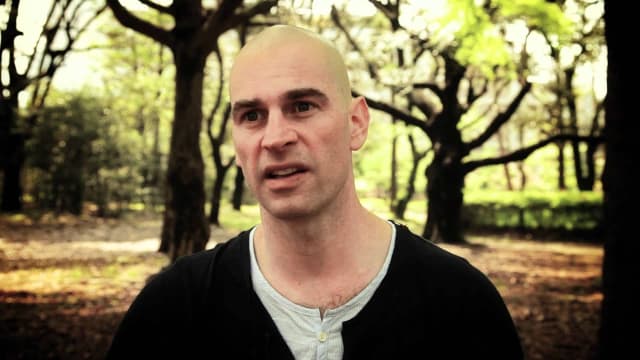
Picture a temple hall where the figure at the center is a Bodhisattva with a thousand arms. Stone asks the viewer to stop at the hands, because that is where the teaching lives. One arm holds a rake. Another holds a rope. Another holds an image of an awakened Buddha. "One arm might have an iPhone," he says, "one arm might have another app." The joke lands because it is precise: this is an inventory of working implements, not a catalogue of pious symbols. In a four-minute teaching posted to YouTube on November 22, 2012, Stone takes that many-handed figure, whom he names as both Guanyin and Kannon, and argues that our own wounds function the same way. The scars we carry from an eating disorder, depression, anxiety, or the ordinary hurts of a life need not be only places that hold us back. They can become the springboard for action, and the tools we need for compassion may have more to do with those wounds than with anything else.

The talk moves in two directions. It begins with the individual, a person who has been scarred and wonders what to do with the scar. Then it widens to the collective, asking what happens when a whole society looks at its damaged rivers, the shadow side of nuclear power, and the disparities in its economic system. Stone's answer in both cases is the same. The wound is not the end of the story. It is the place where the work starts.

Read · 6 sections

What does a thousand-armed figure have to do with a wound?

The iconography Stone uses is simple to picture and easy to misread. A thousand arms sounds like abundance or power, but the teaching is not about power. It is about method. Each hand holds something different because love expressed in the world does not arrive in one shape. A rope pulls someone out of a hole. A rake clears ground so something can grow. A reminder of the awakened mind keeps the hand from grasping at the wrong thing.

Stone draws on a traditional idea that he presents with the phrase "it's said." At about the 0:53 mark, he puts it plainly: "if you want to really put love into action or compassion into action, you need many kinds of tools." That single sentence reframes compassion as a practical discipline rather than a feeling. A person who only feels for others, without any means of helping, is missing most of the hands.

From there Stone turns the image inward. At about 1:05 he asks, "What does it mean to have tools of compassion?" It is a question he answers from his own life rather than from doctrine, and that choice matters. The teaching does not ask listeners to become someone else. It asks them to inventory what they already have, and what they already carry is, in large part, the record of what hurt them.

How can a wound become a tool for connection?

The central move of the talk happens around the 1:21 mark, when Stone describes the shift in perception he is after. He is not asking anyone to deny injury or to pretend the scar does not exist. He is asking them to change what the scar is for.

"Instead of seeing those wounds or those scars as kind of places that hold me back or stop me, maybe my woundedness is also a tool for connecting with others."
— Michael Stone, "The gift of our wounds" (2012), at about 1:21

The phrase "also a tool" carries the weight here. The wound does not cease to hurt. It acquires a second function. Because it is shared, it becomes a point of contact. Near the three-minute mark he states the logic directly: "when we're wounded, if we see our wounds as positive, it allows us to connect with others who have the same wounds." Pain that stays hidden isolates. Pain that is recognized and named can open a door to people who have walked the same stretch of road.

This is a subtle but important distinction. A tool is not a trophy. Nobody is asked to display a wound as proof of depth. A tool is something you pick up because it does a job. The reframe Stone describes is about use, not identity.

Can anxiety, depression, or an eating disorder become a springboard?

Stone gives three concrete examples, all framed as questions. "What if somebody who suffered from an eating disorder, or someone who suffered from depression, or someone who suffers from anxiety" recognizes something about their own process? Around 2:25 he continues: "What if they see that that process of working with their woundedness actually gives them real tools to take positive and creative action in the world?"

The question is careful. Stone does not claim that every person with anxiety will become an activist, or that suffering is secretly a gift that justifies itself. He points to a specific shift: the practices a person develops to work with anxiety, or to climb out of depression, are not only survival techniques. They are skills. Attention trained through difficulty, patience learned in the middle of a bad day, and a clearer sense of what fear feels like from the inside can all be carried outward into a life that serves others.

The thread here is the transformation of a private struggle into a public capacity. The wound is the thing you learned to work with. The tool is what you can now do with that learning. Stone's language of "real tools" and "real action" insists that the change is practical, not merely emotional.

What happens when the wound is collective?

At about 3:07 the teaching shifts scale. "But what about this at a collective level?" Stone asks. He names three specific areas: "What if we look at the situation in our rivers? What if we look at the shadow side of nuclear power?" Then he widens again to include "what we're doing to the environment and the disparity in our economic system."

What is striking is that Stone does not treat these as abstract policy problems to be solved from a distance. He treats them as wounds, in the same sense he used for personal scars. The method he proposes is the same, too. You look at the suffering directly, without flinching, and you recognize that you participate in it. Around 3:32 he puts it this way:

"We open to the suffering in what we're doing and the suffering we all cause and instead of being overwhelmed by it, we see it as a place to take action."
— Michael Stone, "The gift of our wounds" (2012), at about 3:32

The phrase "the suffering we all cause" is the hinge. It removes the easy comfort of pointing at someone else. A river that has been poisoned, a nuclear legacy, or a deeply unequal economy are not only things done by other people. They are the aggregate of countless daily choices, and so they are also places where anyone can intervene. The move from personal woundedness to collective woundedness is not a leap. It is the same practice performed on a larger field.

Stone is also careful about the risk that he names. The danger is being overwhelmed. A person who sees the scale of ecological and social damage can freeze, turn away, or burn out. His proposed alternative is to let the overwhelm itself become a signal: this is the place where action is needed. The wound, looked at honestly, points toward the work.

Is there one answer to the world's problems?

The talk ends with a warning against easy solutions. Near the 3:54 mark Stone says: "Anybody who has an answer for the complexity of our problems right now isn't telling the truth. There is no one answer that's going to solve our problems right now."

This is a useful counterweight to the more inspirational reading of the video. Stone is not offering a formula that turns suffering into success. The thousand arms exist precisely because no single hand can do everything. Different people have different woundedness, and so they hold different tools. An addiction counselor, a river advocate, and a person recovering from anxiety may each be working from a scar, and each may be doing something the others cannot.

He closes with the instruction that carries the whole talk: "We all need to look deeply at our woundedness and from that woundedness take action." The sequence matters. Look first. Then act. The action comes out of the looking, not out of a rush to fix things before the wound has been understood.

Where to go from here

The teaching runs about four minutes, and it is worth watching more than once, because the images stack up quickly. The video is credited on its page to Ian MacKenzie for shooting and editing, and its description points viewers to a project called REACTOR. Those details place the piece within a small, independent body of work rather than a large production, which suits its plain, direct style.

For a reader who wants to take the idea further, the practical version is a quiet exercise. Name one wound you carry, whether it is an old anxiety, a depressive stretch, or a hurt that still shapes how you treat people. Then write down one thing that wound has taught you about how others suffer. Ask what tool that knowledge might be, and what hand you could use to hold it. Stone's question, asked in his own voice, is the place to begin: what does it mean to have tools of compassion, and what in your own life has already given you some?

The image of the thousand arms will not solve the problems of rivers, power, or economics on its own. But it offers a way to stop seeing our scars as only evidence of what we lost, and to start seeing them as evidence of what we know. That shift, Stone suggests, is where real action begins.
Comments

Loading the conversation…

Transcript

[0:00] [Music]

[0:18] When you see an image ofwan

[0:22] yin, when you see an image of Canon,

[0:26] when you see a sculpture of the bodhic

[0:29] sattva, she has a thousand arms. And in

[0:32] every arm, in every hand, there is a

[0:35] different tool. One arm might have a

[0:38] rake, one arm might have a rope, one arm

[0:42] might have an image of an awakened

[0:44] Buddha, one arm might have an iPhone,

[0:48] one arm might have another app. And

[0:50] these thousands of arms have different

[0:53] kind of tools. And it's said that if you

[0:56] want to really put love into action or

[1:00] compassion into action, you need many

[1:02] kinds of tools.

[1:05] I think about this in my life. What does

[1:07] it mean to have tools of compassion?

[1:11] It seems in my life, having tools of

[1:16] compassion has everything to do with my

[1:19] own woundedness.

[1:21] to be able to take places where I've

[1:24] been wounded and recognize that instead

[1:27] of seeing those wounds or those scars as

[1:34] kind of uh places that hold me back or

[1:37] stop me. Maybe my woundedness is also a

[1:42] tool for connecting with others.

[1:46] What if I can use the ways that I've

[1:49] been scarred?

[1:51] What if we can use the ways that we've

[1:55] been wounded

[1:57] as

[1:58] the

[2:00] springboard for action? What if our

[2:03] wounds are actually tools? What if

[2:06] somebody who suffered from an eating

[2:08] disorder or someone who suffered from

[2:11] depression or someone who suffers from

[2:14] anxiety recognizes that the way they

[2:18] work with their anxiety, the way their

[2:21] practices help them overcome depression?

[2:25] What if they see that that process of

[2:28] working with their woundedness actually

[2:30] gives them real tools to take positive

[2:34] and creative action in the world. In a

[2:37] way, this is what the bodhic sattva

[2:39] represents with all her arms and in

[2:42] every hand with all her different tools

[2:45] is taking the places we've been wounded

[2:48] and using those wounds to become real

[2:51] tools for real action.

[2:55] That's how it works at an individual

[2:57] level. We all know that when we're

[3:00] wounded, if we see our wounds as

[3:02] positive, it allows us to connect with

[3:04] others who have the same wounds.

[3:07] But what about this at a collective

[3:09] level? What if we look at the situation

[3:12] in our rivers? What if we look at the

[3:15] shadow side of nuclear power? What if we

[3:19] really see what we're doing to the

[3:21] environment and the disparity in our

[3:23] economic system and we see this kind of

[3:26] woundedness and we open to the suffering

[3:30] in what we're doing and the suffering we

[3:32] all cause and instead of being

[3:35] overwhelmed by it, we see it as a place

[3:38] to take action. We see our woundedness

[3:41] as a tool and we're able to use those

[3:44] tools to affect positive change. Anybody

[3:48] who has an answer for the complexity of

[3:51] our problems right now

[3:54] isn't telling the truth. There there is

[3:57] no one answer that's going to solve our

[4:00] problems right now. We all need to look

[4:03] deeply at our woundedness

[4:06] and from that woundedness take action.

Michael Stone
ArtistMichael Stone

Michael Stone (1974–2017) was a Buddhist teacher, author and mental health advocate who brought yoga, meditation and psychology together, and hosted the Awake in the World podcast.

View profileWebsite
Explore Topics
WoundednessGuanyinBodhisattvaCompassion-in-actionWounds-as-tools

Got Questions?

Frequently Asked Questions

Stone describes the thousand-armed figure, whom he names as both Guanyin and Kannon, as a image of compassion that needs many different tools to act in the world. Each hand holds something different, such as a rake, a rope, or an image of an awakened Buddha, because love put into practice takes many forms.
Stone suggests that a wound can be seen as a tool for connecting with others rather than only a place that holds a person back. Because others share similar wounds, recognizing and working with one's own pain can open a path to understanding and helping them.
No. Stone poses questions rather than making claims, asking what if a person with anxiety, depression, or an eating disorder sees that the process of working with their woundedness gives them real tools for positive action. The emphasis is on the skills developed through the struggle, not on the suffering itself.
Stone extends the same method to the collective level, naming damaged rivers, the shadow side of nuclear power, environmental harm, and economic disparity. He argues that people should open to the suffering they cause and see it as a place to take action rather than being overwhelmed by it.
Stone says that anyone claiming a single answer to the complexity of current problems is not telling the truth. He argues that people need to look deeply at their own woundedness and take action from that place, with different people contributing different tools.
The video was published on YouTube on November 22, 2012, and runs about four minutes. It is a short talk built around the image of the thousand-armed Guanyin and the idea of wounds as tools for compassionate action.

Continue Reading

More from Michael Stone

View All
Non-Attachment as Intimacy: Engagement Without Clinging
Inspire

Non-Attachment as Intimacy: Engagement Without Clinging

Michael Stone argues that non-attachment is not dissociation but intimacy with life. Here is how his four-minute teaching reframes yoga, eng…

8 min read
Beautiful Light and the Song for the Day You Can't Get Up
Inspire

Beautiful Light and the Song for the Day You Can't Get Up

Rick Jude's "Beautiful Light," performed acoustically with Janet Robin, is a song about staying with someone in the dark. Its lyrics move fr…

5 min read
Medicine Buddha Practice: Refuge When the Teacher Is Away
Inspire

Medicine Buddha Practice: Refuge When the Teacher Is Away

A community-led Medicine Buddha session opens with honest anxiety and closes with prayers for the world. Here is how its refuge-based struct…

9 min read
Reclaiming Sita: How Retelling Shapes the Divine Feminine
Inspire

Reclaiming Sita: How Retelling Shapes the Divine Feminine

In a short clip, Nina Rao describes the easy answer she wanted about Sita, why she resisted it, and how reading women's retellings of the Ra…

5 min read

Keep exploring

Continue your journey

More wisdom and gatherings from across the BrightStar directory.

More Articles

Browse the full library of teachings, interviews, and guides.

Back to all articles →

Teachers & Artists

Explore the lineages, musicians, and guides of the conscious world.

Explore artists →

Find an Event

Kirtan, retreats, sound baths, breathwork, festivals — happening soon.

Browse events →