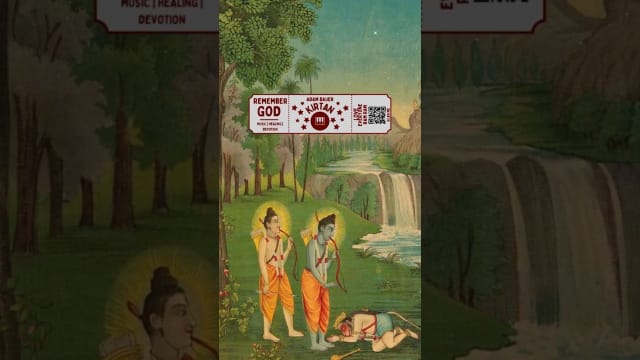
Ninety-eight seconds into a clip from a longer conversation with Acharya Shunya, Nina Rao reaches for the answer that many listeners would expect. Why has the figure of Sita been pushed into the shadows? "The very simple answer is the patriarchy," she says. Then she admits she did not want to believe it. What follows is less a verdict than a confession: a woman raised in a tradition that worships the goddess, who found that the story she had inherited about Sita was shaped by something she had to unlearn, and who only got there by rereading the text in a voice she had been hiding from herself. The clip is brief, and it is offered as a teaser for the full conversation, but it contains a complete argument about how the telling of a myth can decide what its heroine means.
The reason is not hard to hear in her voice. She starts from a place of belonging. "We come from a country where the goddess is worshipped," she says, and she names the central deity in her family, Saraswati Sharada Devi. The contradiction is the point. If the goddess is honored at home, how did the story of Sita end up diminished? The easy explanation is a political one, and it is tempting precisely because it is clean: a male-centered culture reshaped a female figure to suit itself.
Rao does not dismiss that reading. She does, however, treat it as insufficient, and the way she frames it matters. "How the story is told now determines who she is," she says at roughly the eighteen-second mark, and the sentence moves the question from history to narration. Who gets to tell the Ramayana, in what register, and for whose benefit becomes the working question. A figure is not simply found in a text. She is assembled, retold by retold, and the assembly carries its own assumptions.
"How the story told is told now determines who she is." (Nina Rao, in her YouTube clip, 2026)
Rao places a turning point at about the forty-first second: a meeting with Michael Sternfeld, who asked her a plain question, "What do you think?" It is the kind of prompt that sounds small and then rearranges everything. In her account, the question sent her back into the stories, rereading who Sita is inside them rather than accepting a summary of her. The clip does not elaborate on the exchange, and it would be wrong to fill that silence with invented detail. What it does show is the mechanism of the shift: a direct question asked of oneself, rather than a conclusion handed down.
Her framing also reveals something about her own relationship to Acharya Shunya's work. She says that before these events she had already read his book and heard him speak. The reading was not a discovery that arrived out of nowhere; it was preparation she did not yet recognize as preparation.
This is the most personal passage in the clip, and it is where the piece turns from theory to self-inquiry. Rao describes reading other versions of the Ramayana, rewritten in more recent times, and recognizing a voice she had kept inside. "I didn't dare retell that story in the way I've heard other women like Vrinda and Deena Meriam and um Chitra and all these wonderful women have retold the story," she says. The admission is about permission as much as craft. Seeing other women retell the epic gave her a model, and it also named the thing she had been suppressing: her own right to speak in that register.
She says the retellings left her feeling "fortified." For a moment she adopted the patriarchy explanation wholeheartedly: "It was just the patriarchy that was pushing her into the shadows. There was nothing wrong with Sita." Then the clip folds back on itself. "I had to I had to relearn who she was," she says at about the ninety-third second. The repetition is audible, and it reads as the sound of someone correcting a conclusion she had grabbed too quickly.
The lesson Rao draws is subtle. A ready-made explanation, even a correct-seeming one, can become a second cage. Blaming the patriarchy frees a figure from her distortions, but it can also fix her in the role of victim, a passive figure waiting for rescue by a better narrator. Rao's own movement goes the other way. She ends not with a reversal but with a responsibility: to reread, to listen for the voice inside her, and to keep the question open.
That is a useful stance for anyone who encounters the divine feminine through inherited stories. The honest approach is to notice who is doing the telling, what they gain from it, and whether the figure you are looking at still has agency once the commentary is stripped away. The clip gestures at these questions without resolving them, and that restraint is part of its value.
The clip is an opening, not a full argument. Rao's longer conversation with Acharya Shunya, linked from the video description as "Reclaiming Sita's Voice from the Shadows," is where the reasoning is developed. The description also points to an audio program, Sita's Gems, presented as the way to dive into the story of Devi in the form of Sita, which the video frames as a Diwali offering. Watch the full conversation before drawing conclusions, and then reread the Ramayana yourself, paying attention to the voice that feels most like your own.