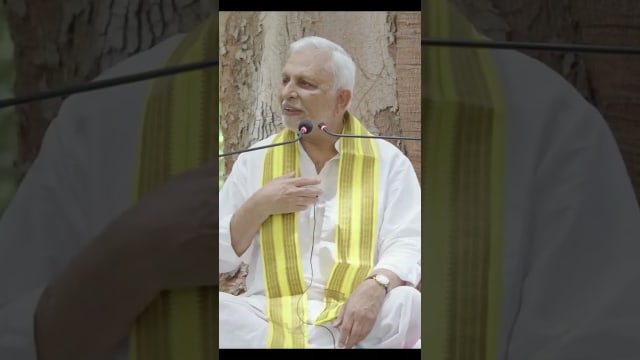
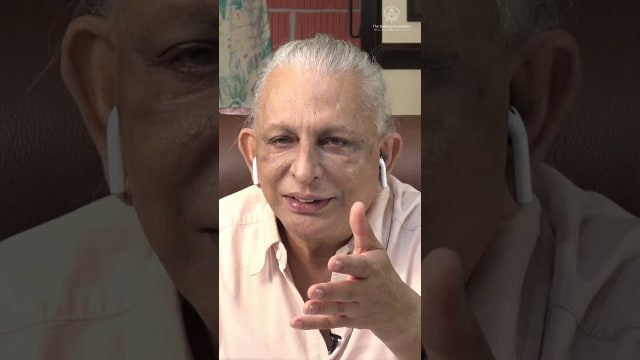
The mind does not come to us whole. This is the fundamental insight Sri M returns to again and again: we are, most of us, internally divided—pulled in opposite directions by competing desires, conflicting thoughts, and fragmented intentions. The gentleman who wanted to meditate but whose mind suggested beer first. The young couple at the bus stop seeing something in each other that the rest of us cannot articulate. These are not digressions in Sri M's teaching; they are the texture of the problem itself. The mind is not one witness observing the world. The mind is the battlefield.
Sri M begins by anchoring his teaching in the Bhagavad Gita, specifically the concept of dialogue—or "samvada." A dialogue, he explains, requires two parties. And when two parties engage deeply enough, something shifts: "When this happens, there is no more dialogue required. It is understood. Words are not required." The Gita itself is a dialogue between Krishna and Arjuna, but it models something deeper about the structure of consciousness itself.
The progression is systematic. When spiritual practice begins—when you start dharana, the practice of concentration—there are still two: the meditator and the object of meditation. "I am meditating upon May I be my intelligence be awakened. There are two. There's a petitioner and there is somebody who received the petition." But in samadhi, the highest state, "there is no meditator, there is no meditated upon, there's only one meditation." The goal of yoga, Vedanta, and bhakti—the main paths Sri M names—is not to suppress one part of the mind and elevate another. It is to end the dialogue entirely by dissolving the two into one.
Yet our ordinary experience is the opposite. Psychologically, Sri M says, "our minds are always two." We want to meditate; the mind wants a beer. We know what is right; we do what feels easier. There is not conflict because we are weak. There is conflict because we are genuinely divided.
Sri M makes a provocative move here. He invites us to look at the word schizophrenia itself: it means "split brain," from the Greek "schizo" (split) and "phren" (mind). "Most of us are split brain," he says. "We are thinking one thing, doing another. There's one part of us hidden, there's another part of us out. There's one thing which says do this, the other says do that. So we are all split."
The only difference between those labeled mentally ill and the rest of us is a matter of degree. When the craziness stays within socially acceptable bounds, we call it normal. When it exceeds those limits, we institutionalize the person. But the fundamental split is not exceptional; it is universal. And this is why, as Sri M notes, "some level some percentage we are all crazy."
This is not intended as dark comedy, though there is humor in his delivery. It is an invitation to honesty. If we believe ourselves sane and unified while we act against our own understanding, we are simply not looking at ourselves clearly. The first step toward integration is to see the split as it is.
If the split is universal, what resolves it? Sri M introduces the concept of the sakshi—the witness. The witness is not one side of the conflict taking victory over the other. The witness is what remains when you stop identifying with either side of the internal war.
"The tussle is not the witness, but the tussle is all that is not the witness fighting. Witness is watching both." The two (or many) parts of your mind will continue to have their disagreement. That is their nature. But behind all of it—behind the competing voices, the hidden and the exposed, the yearning and the doubt—there is something that simply watches. It does not judge the conflict. It does not choose a side. It observes.
When you recognize yourself as this witness rather than as the warring parts, Sri M suggests, the grip of the internal conflict loosens. You are no longer trying to force one part of yourself to obey another. You are resting in that which is prior to both.
The final turn in Sri M's teaching moves toward love—not as sentiment but as the lived experience of two becoming one. He speaks of young people falling in love, emphasizing the word "fallen." "To be really to really understand what love is, you have to fall and get hurt a few times. You can't think I'm safe and still be in love. Not possible."
What they are experiencing at the bus stop, looking into each other's eyes, cannot be explained in words. Yet everyone who has felt it knows exactly what he is pointing toward. It is an ordinary glimpse of something that, in spiritual realization, is multiplied "a thousand times."
This is crucial to Sri M's method. He does not ask you to abandon feeling in favor of logic. The Gita, he says, "is music that's trying to match and bring together these two and make it one. And that comes not through intellectualization, but through the heart, to understand it through feeling, through song, music, through love and affection."
The resolution of the split mind is not intellectual. No amount of philosophical understanding will end the war. But love—and by this, Sri M means the opening of the heart to what is true—can begin to bring the fragmented self back into wholeness. This is why bhakti, the path of devotion, sits alongside yoga and jnana (knowledge) in the teaching. All three are necessary because we are whole beings, not just minds.
Sri M closes by naming what he is offering: "Where there are no two, but there is only one. That's the theme of our satsang." A satsang is a gathering in truth. It is not a lecture. It is a space where, if the conditions are right, the internal dialogue can begin to quiet, and the witness can be recognized. The more you practice observing your own split without trying to fix it—the more you watch the mind's war with curiosity rather than judgment—the more the possibility of genuine unity opens. Not unity imposed from above, but unity discovered underneath everything.