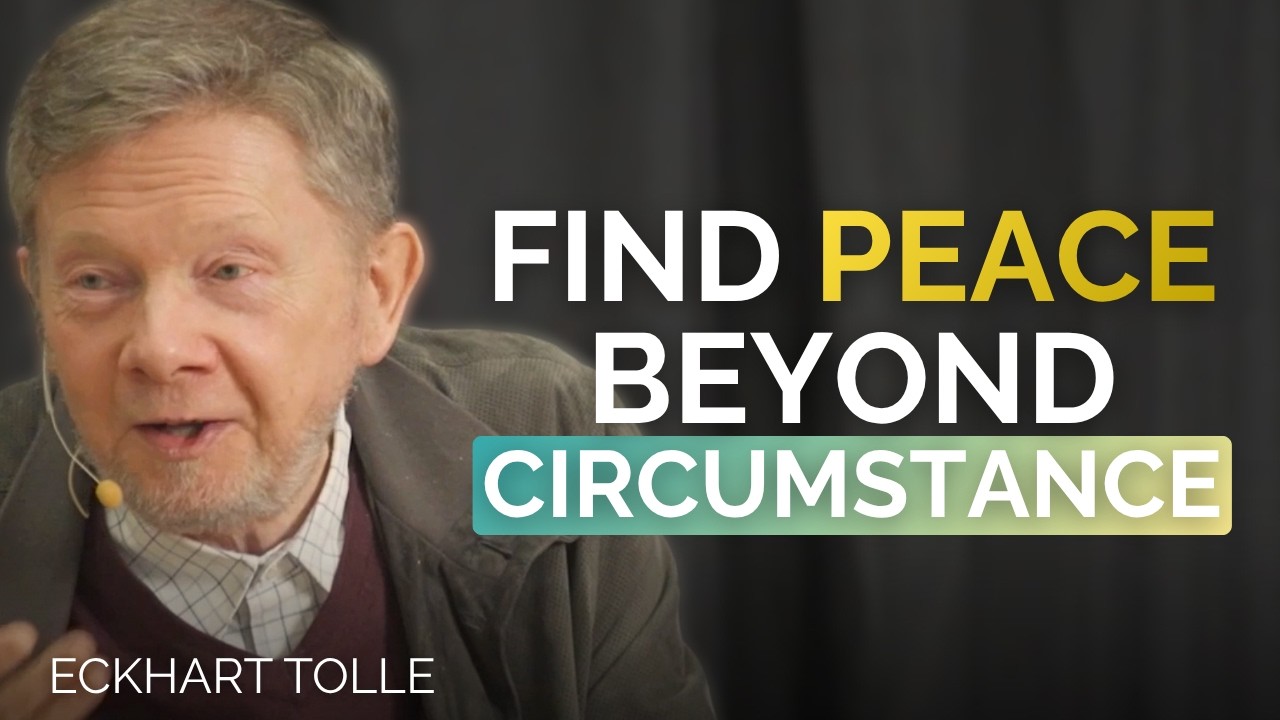
You've felt it: you're lost in work for an hour, absorbed completely, and your anxiety simply vanishes. Then something reminds you—a notification, a stray thought—and it crashes back, full weight. That moment contains a radical truth that Eckhart Tolle isolates with precision: your problems don't live in the world. They live in your mind, and they exist only when you think about them.
This is not philosophy dressed as comfort. It's an anatomical description of how consciousness operates under what Tolle calls "egoic consciousness"—the default state of the unawakened mind.
Where Problems Actually Exist
A crucial distinction grounds everything that follows: the situation is real. Your bills exist. Your health diagnosis exists. The relational conflict exists. But here's the hairline fracture where most people lose the thread: "Every situation can only be experienced or faced or solved or simply accepted in the present moment." Tolle emphasizes this with the clarity of someone who's spent decades watching people confuse the two. "Nothing ever arises in your life that's not in the present moment. So in the present moment you can deal with it. It's just here now. Either you take action or you don't."
Right there—that's all the actual problem you possess. One situation. One choice: act or don't act.
But almost no one lives at that threshold. Instead, Tolle describes what he calls "a whole super structure of the problematic my problematic life that lives in your mind"—a vast, interlocking narrative assembled from the past and projected into the future. You're not just facing a diagnosis; you're carrying the story of your sickness, the history of your family's health, the future suffering you imagine, the identity you've built around being sick or vulnerable, the resentments about how you got here, the fears about what happens next. That superstructure is the burden. And it lives nowhere but in thought.
"Everybody lives with this burden," Tolle says, "if they have not awakened to the deeper dimension." For those locked in surface consciousness, "it's a terrible prison."
Why We Defend Thoughts Like They're Part of Us
Watch what happens when you question someone's opinion. They don't simply engage the idea—they become defensive, angry, sometimes volatile. Tolle traces this directly to identity. "An opinion is a thought or a group of thoughts in your mind that you identify with. When you identify with it, it becomes part of the ego." The opinion isn't a detachable piece of information anymore; it's *you*. To attack it is to attack the self.
This explains why people will escalate to violence over disagreement. "People sometimes kill each other because they can't agree on a subject. Why? Because you derive your sense of identity from thought." When your sense of who you are is built entirely from the thoughts passing through your mind, every thought becomes sacred territory. Every position a fortification.
This is egoic consciousness operating: "The ego is operating in you and it pretends to be you." The mind creates an identity, a constructed self, and then defends that construction with all the ferocity of a creature protecting its survival. But the mind isn't you. It's a layer—an active, chattering, aggressive layer that has learned to masquerade as identity itself.
The Temporary Escape and What It Reveals
Tolle's honesty about substance use cuts through a lot of familiar moralizing. He's not condemning; he's describing. When someone drinks—or takes other substances—they experience "briefly a sense of self-transcendence." The substance doesn't solve anything. It does something simpler and more revealing: it slows the mind. It quiets the chatter.
"Because you can't think that much anymore, life becomes somewhat less problematic," he explains, with dry humor. "Because if you don't remember your problems, they're gone."
What's left when the thinking stops? Only immediate situations. Real things that require real action or don't. The burden—that massive superstructure of identity, history, projection, fear—momentarily lifts because it has no fuel. It can only exist in thinking.
Tolle doesn't romanticize this escape. He understands the pull: "There's an enormous pull, an enormous longing," he says, acknowledging why millions pursue this momentary freedom. But he's clear: substances are a trap because they point toward the solution while offering no real way out. You get a taste of what freedom feels like, then you crash back into the same prison.
The Prison of Personality and Conditioning
What makes egoic consciousness a prison is that it operates invisibly. You're not aware you're trapped. "I can sometimes watch people," Tolle observes, "how they are trapped in their personality and everything they say and every way they perceive things is totally colored by the conditioning of their mind. They're identified with every thought that comes into their head."
Total identification with thought is the lock. Most humans, Tolle says bluntly, "are only aware of the surface eye"—the egoic mind—"and that's a terrible deprivation. A permanent sense of nonfulfillment with brief interludes of deluded fulfillment." You get a good meal, a moment of pleasure, a brief hit of accomplishment, and you think you're fulfilled. But you're not. The moment passes, the superstructure reasserts itself, and you're back in the prison, searching for the next hit of false fulfillment.
"You are spiritually speaking asleep. You are a totally conditioned entity," Tolle concludes. This isn't pessimism. It's diagnosis. And diagnosis is the first step toward freedom.
Where to go from here
The implications are practical and immediate. If your problems exist in thought and not in the world, then the work isn't to solve your problems—it's to stop feeding them with thinking. To recognize the moment when you slip from dealing with a real situation into spinning the superstructure. To watch when your mind takes a single challenging thing and builds a whole narrative identity around it. To notice when you're defending a thought as though it's defending your survival.
Most crucially: to awaken to what Tolle calls "the deeper dimension"—the consciousness that exists beneath the egoic mind. The part of you that doesn't derive identity from thought, that isn't trapped in past and future, that can be present to what is, without the burden of the constructed self.
That awakening doesn't solve your bills or your diagnosis. But it changes your relationship to them fundamentally. You face them as they are—manageable, present, real—instead of weighted with the superstructure of who you think you are supposed to be.